On Airlines, Hospitals, Blizzards and Flu Outbreaks

Here is a really interesting article comparing the airline industry to the public health system, with full service hospitals being the legacy carriers, serving everyone and subsidizing low fare services with high fare ones. Specialty hospitals are the upstart airlines, able to focus on only providing profitable services. And as they all cut capacity to remain profitable, what happens when crisis hits? We just saw what happens to airlines when a blizzard strikes; so what happens to hospitals when a pandemic hits?

Northern Austerity vs. Southern Profligacy

I recently wrote a post discussing the differences between North and South. Taking as my starting point Anne Applebaum’s article about well-budgeted Northern European countries vs. profligate Southern European countries, I extended her theme to discuss Northern hemisphere vs. Southern, and Northern states vs. Southern states here in the US. Now I want to continue my riff and see if I can expand even further on this latitudinal dichotomy.

Can we call this dichotomy a civil war of behavior? And if we do, does the allusion to America’s Civil War help or hurt? Certainly one could make a case that the American South, by building an economy on the backs (literally) of slaves, enabled a profligacy that wasn’t really warranted. An economy built on the untenable foundation of slave labor is sort of like building the economy of Greenwich, Connecticut on the false profits of Wall Streeters trading sham mortgage securities, or building the economy of Greece on money borrowed from other countries and then stolen from the national treasury. People still get to buy their Maseratis, but they haven’t really earned the money.

What explains this broad gap between North and South? Or is North v. South even the right distinction? After all, Australia and New Zealand are pretty far south, and they are generally well run. South Africa is also way south, and even has south in its name, but it’s the best run country in Africa. Maybe the proper axis to examine is equatorial v. non-equatorial.

In my (admittedly limited) traveling experience, it does seem like tropical lands generally have a relaxed attitude about life. This relaxed attitude could easily become profligacy or corruption, or apathy regarding profligacy or corruption among leaders. Perhaps it is the ease of living in these climates that engenders this relaxed attitude. I mean, if you can wear shorts and flip flops all year round, and crops grow easily, why wouldn’t you just hang loose and relax? Compare that to Germany, for example, or Massachusetts, where there are seasons and snow and you have to bundle up and carefully plan your crops. It stands to reason that cultures in these more challenging environments would consequently be more organized and open to austerity.

Winter in Germany

I should note that I have no data to back this up; I am purely using deductive reasoning. I should also emphasize that I am NOT saying that tropical cultures are bad, worse, corrupt, inferior, or any other pejorative. I am purely noting that if your climate makes it that you don’t need to worry or plan, you probably won’t worry or plan that much.

Free Trade Works, But Can Cause Real Pain

I understand and appreciate free trade. I was an economics major at a college with a pretty conservative econ department (our professors regularly write op-eds in the Wall Street Journal), so I was well inculcated in the ways of Ricardo. Comparative advantage works: each country exports what it’s good at and everyone comes out ahead.

The developing world’s comparative advantage is generally cheap labor. That’s why China exports clothing and furniture. America’s comparative advantage is innovation and creativity. That’s why we export Avatar. Unfortunately, we also export Charlie’s Angels 2, but that’s a different issue. This theory also explains why the US invents iPods and China makes them.

The theory postulates that in the long run, as the developing world does more and more labor, the developed world will move into higher value services and creativity and all will be good. Everybody’s standard of living continues to go up. In the short term, however, dislocations can occur. Think of the television factory in Pennsylvania that shuts down, laying off a thousand workers, because the corporate parent can make things cheaper in China. Under free trade theory, those workers will shift into jobs that leverage America’s comparative advantage: something creative or innovative, something involving technology.

But in the short run, how do they do that? They live in the middle of Pennsylvania, likely with just a high school education. They can’t design iPods or program social networking sites. They can’t all move to Hollywood and become gaffers. For classic blue collar factory workers, their comparative advantage IS their labor. That advantage is now gone, taken by the developing world. So for free trade to work for everyone (at the micro level that is; we know it works at the macro level), we need to figure out ways to smooth those short term dislocations. Education and training for dislocated workers is the most obvious path, but I’m sure there are others.

U.S. Army Ranger Is #3 Pastry Chef…In The World

Active duty Army Ranger Master Sgt. Mark Morgan recently placed 3rd in the pastry competition in the Culinary World Cup competition in Luxembourg.  This despite being out of practice because he has deployed twice to Iraq and 4 times to Afghanistan in the past decade. That is pretty studly, as far as I’m concerned. He was part of the Army’s Culinary Arts Team (who knew?), which also won a gold medal for its cold food table. Go Army indeed.

Interesting Thoughts on the Federal Deficit

From the smart folks at the Roosevelt Institute, including Nobel prize winner Joe Stiglitz.

Summary: 1) there are smart and there are less smart ways to reduce the deficit; and 2) it’s not clear that the deficit is as terrible as some are making it out to be.

US: Religiously Diverse, Tolerant and Turning Liberal

As I pointed out in a previous post, Robert Putnam has a new book out describing the current status of religion in America, based on a large survey he conducted. I recently heard Putnam give a lecture about his new book. One of his key theses is that America is highly religious, but extremely diverse and tolerant.

Putnam’s survey, like others in the field, reveals that most Americans describe themselves as religious and many go to church regularly. The numbers in America are significantly higher than in other developed countries. This religiosity is spread across a wide diversity of faiths and denominations. Interestingly, although the vast majority claims to be religious, there is a strong polarity in how seriously they take their religion. When asked whether they said grace regularly, sometimes, or never, the responses were 44%, 10% and 46%, respectively. In other words, people either practice hard or not at all, with very little in the middle. This matches the polarization of politics that is tied to religion.

However, unlike the political polarization, in which the two sides seem to hate each other, when it comes to religion America is highly tolerant despite its polarization. When asked whether they had positive views of other faiths, most Americans said yes. The most popular faiths: Judaism, Catholicism and mainline Protestantism. Only 13% of Putnam’s respondents said that their faith was the only path to heaven, and 80% said there was some truth in all religion.

Why such tolerance? Putnam, who thinks like a sociologist despite being a political scientist, provides a social explanation: diversity breeds tolerance. With all the different faiths in America, and more geographic mobility than in the past, we are all more likely to know, and like, someone of a different faith.  Putnam supports this with data showing that more people change religions now than ever before, and pointing out that the majority of marriages are now interfaith, at 51%, compared to 25% a century ago. Putnam calls this the “Aunt Susan” phenomenon. We all know someone, perhaps our aunt by marriage, who is of a different faith, but who is totally awesome. How can Aunt Susan not go to heaven just because she is Methodist rather than Catholic?

An additional reason for the tolerance, which Putnam didn’t point out but I will, is that while Americans are broadly religious, they are also somewhat shallow about it. In other words, and despite the data on saying grace mentioned above, many Americans don’t take the teachings of their faith that seriously. For example, not only do 87% of Americans believe people of another faith can go to heaven, but 54% of evangelical Protestants believe that non-Christians can go to heaven. This means that 54% of evangelical Protestants are rejecting (or don’t understand) a basic tenet of their faith. Catholics, at 22% of the country, should alone swamp the 13% figure, but they clearly don’t. In other words, Americans’ willingness to ignore (or ignorance of) some of the key teachings of their faiths allow them to be more tolerant of other faiths.


Religion and Politics is a New Mix

I recently went to hear a lecture by Robert Putnam, a Harvard professor who is best known as the author of Bowling Alone, a book about the decay of civil institutions in America. Putnam has a new book out, called American Grace, about religion in America and its intersection with politics, and his lecture was a summary of that book. The book is based on both historical study and a large survey of US citizens, and has two main theses:

  1. The mix of religion and politics in America is new and massively polarizing
  2. American religion is so diverse and tolerant, especially among the younger generation, that the above polarization will likely moderate over time

This post is about Putnam’s first thesis; I will add another post soon summarizing his second thesis.

Putnam started his lecture by describing the rise of the religious right and how this is a new development in America. Of course the founding fathers were – mostly – deeply religious men; that’s how people rolled 250 years ago. But historically you could not correlate a person’s religious belief with their political beliefs. There were devout Christians who were liberal and secularists who were conservative. The Democratic and Republican parties each contained a mix of religious beliefs and commitments.

Things began to change in the 1960’s, with the rise of hippies and free love and drugs and rock & roll (all the stuff my parents dug, man). In reaction to this libertine environment, conservative people moved toward more bedrock values, generally in the form of evangelical Christianity. These people got more serious about their religion and then certain church leaders (eg. Jerry Falwell) saw an opportunity to turn that movement into political power. As the religious right gained power there was something of a backlash, and non-evangelicals moved further toward secularism.

Thus you have significant movement to the poles – the religious right and secularism – without any growth in the center. And now you have, according to Putnam, significant correlation between religion and politics. Putnam says the best way to understand how someone will vote is to ask about their church-going, or vice versa. This plays right into the polarization that we are seeing in modern American politics. Of course, Putnam’s theory of religious trends is not the only explanation for the rise of the religious right and political polarization. There were also geographic, economic and racial trends at work. But religion clearly played a role, and this is Putnam’s bailiwick, so I give his theories some weight.

An interesting side note: Putnam says that according to his research, if a person’s politics and religion don’t match, they are more likely to change their religion than their politics. In other words, conservative people move to more conservative churches and liberals move to more liberal churches or to none at all. Given that religion controls your soul whereas politics affects your pocketbook, this is surprising, but the surveys say what the surveys say. Another, less interesting, side note: the waves of religion and backlashes toward secularism described by Putnam could make for a classic dialectic, with their thesis and antithesis, but there is no synthesis. Instead, the movement trends apart rather than together. This is further proof of my pet theory that Hegel was an idiot.

Here is a photo of someone bowling, possibly alone:

Nixon bowls, possibly alone

Red States Living on Federal Money

Here is a new article with data showing a direct correlation between how GOP leaning a state is and how much federal money it sucks down. This follows up on my posts on this very topic.

Congress Becoming a Parliament?

Jack Balkin has a great post describing how Congress, particularly the Republicans, are acting like a European style parliament. His forecast: more gridlock, worse policy, and a decaying country.

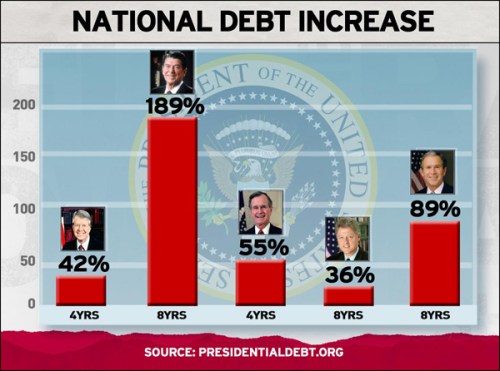
Increase in National Debt by President

Increase in national debt...by president