Tag Archives: Politics

Don’t Screw Up Healthcare to Make Political Points

The health care reform effort in Congress is hitting some snags, and reports are discussing how the republicans see this as a make or break moment for the Obama administration. The republicans want to stop reform to make Obama look bad and weaken his chances to implement other parts of his agenda. Jim DeMint (R-SC) called it a “Waterloo moment” for the president.

This is why people hate politicians. Because instead of focusing on policy and helping their country and their constituents, they play douche bag political games like this is some sort of high school mock senate instead of the real thing.

If politicians don’t like the health care reform bills being presented, that’s fine. They are challenging bills, and concerns about their cost or about growing government bureaucracy or any number of other issues are legitimate. Hell, if you think that the free market should rule and people should be on their own for health care, that’s a legitimate, although heartless, view.

Virtually everyone – including republicans – agrees that health care reform is needed. The disastrous state of the American health care system is well known. So to fight health care reform bill – not fight to improve it, but fight against it passing at all – just to score political points, well that sucks. As happens so often here at Thoughtbasket, I must ask our representatives to stop dicking around and do the right thing.

Carbon: The Ultimate Externality

The House of Representatives just passed (barely!) the climate change bill, although analysts say that it will face a tough road in the Senate. This is the bill that includes a cap and trade system for carbon, or “cap and tax,” as the Republicans call it. Certainly the Republicans, and all the conservative bloggers, have attacked the bill, saying that it will increase the cost of energy and of many manufactured goods, and those increased costs will be passed on to consumers. And I agree; costs will go up, which is exactly the point. The cost of things that create carbon should go up. To explain this, I thought it might make sense to take a step back and discuss externalities.

In economics, “an externality…of an economic transaction is an impact on a party that is not directly involved in the transaction.” There can be positive and negative externalities, but the classic example is a negative one: pollution. If a plant manufacturing widgets spews its waste chemicals into a river, poisoning that river for 15 miles downstream, that is an externality. People downstream – fishermen, swimmers, kayak tour guides – suffer an impact from the widget manufacturing, but they have no economic say in that impact.

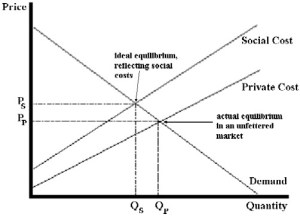
You might just say “whatevs,” as many have said over the years about pollution, but even the most ardent free market fan should recognize that externalities warp the market. As the supply-demand graph (a diagram dear to the heart of any good capitalist, and to me, since I was an econ major) below shows, an externality causes the market to produce too much of a good, at too low of a price, relative to the optimal solution if the externality is taken into account. This is not efficient, and economists hate inefficiency.

Negative_externality
Of course, as regular readers of Thoughtbasket know, I am not an ardent free market fan, so I would layer in an ethical cost as well. Why should the owners of the widget plan make money at the cost of the health of people living downriver? Who gives them the right to take the public good – the river – and ruin it?

Fortunately, both the economic and the ethical problem can be solved by actually monetizing the externality and including it in the business calculation. Polluting a common good should not be free. Assign an actual cost to polluting, and charge the factory owner that cost, and you will quickly see the plant move to producing the preferred social equilibrium quantity. Of course it is tremendously difficult to come up with the appropriate cost, but it’s difficult to go to the moon too, and we still managed that (unless you are a conspiracy theorist). Just because something is hard doesn’t mean we shouldn’t do it.

Unfortunately for factories, as science discovers more pollutants that are bad for us, there are more and more externalities that they have to take into account. Carbon and global warming are a perfect example. Carbon emissions didn’t reach the externality level – unlike, say, dioxin spewing into a lake – until science discovered that global warming was going to kill us all.

Hence, cap and trade legislation. Which is, in many ways, as the Republicans have pointed out, like a carbon tax. Either way, the point is to take what was a social cost – the spewing of carbon – and then monetize it and apply it to producers. What will happen as the costs of carbon go up? We will use less of it. Factories will figure out how to make their widgets using less carbon. People will turn their air conditioners down. Whatevs. Make carbon expensive and people will use less of it, moving production down to the appropriate social equilibrium. That’s what the economists would want, and it’s certainly what our grandkids will want.

Gitmo Prisoner in US: Run, Run for Your Life!

Just a few hours after I posted yesterday regarding the ridiculous fear surrounding the transfer of Gitmo prisoners to the United States, a story comes out that Ahmed Khalfan Ghailani, a suspect in the 1998 embassy bombings, was moved from Gitmo to the federal detention facility in New York City so that he can stand trial in federal court. Yes, you heard that right: the federal lockup in Manhattan, not the Supermax prison in Colorado. The same facility that currently houses Bernie Madoff. Are New Yorkers leaving town to avoid this horrible danger? Will the authorities order the evacuation of Manhattan? No, of course not. Ghailani (oddly close to Giuliani, don’t you think?) is under massive guard, and nobody thinks he will escape. The only person worked up about this is notorious douchebag John Boehner, who called the move ”the first step in the Democrats’ plan to import terrorists into America.”

Please Focus on Policy, Not on Fear

Opponents of President Obama’s plan to close the prison at Guantanamo Bay have recently seized on the tactic of asking “do you want these terrorists in your neighborhood?” and thus playing on people’s fears. This is purely a rhetorical feint, and it’s offensive. The president isn’t planning on installing the Gitmo inmates in your local condo complex, and his opponents know that. The inmates will go into military brigs or maximum security prisons: the same places that currently house murderers, rapists and drug dealers. Are Obama’s opponents saying that these prisons aren’t secure? If so, shouldn’t they focus on fixing the prisons, so that rapists aren’t wandering your neighborhoods?

The fact is that the opponents of closing Gitmo know perfectly well that moving the inmates to a US supermax facility is perfectly safe. They just disagree with closing the island prison on policy grounds. And that’s fine. There are reasons – cost, isolation from US courts, desire to maintain military control – for wanting to keep Gitmo open. But let’s discuss those actual reasons, instead of using fear mongering and mistruths to get people scared and worked up.

Speaking of mistruths, on the same day that Admiral Mike Mullen, the chairman of the Joint Chiefs, said that he has long wanted to close Gitmo because it “has been a recruiting symbol for those extremists and jihadists who would fight us,” Republican Senator John Kyl, who is a major league douchebag, claimed that “it’s palpably false to suggest that the existence of Gitmo created terrorists.” Who is a more reputable source – the career soldier or the sleazy politician?

Glenn Greenwald has an excellent piece in Salon describing how this is an ongoing pattern: Republicans use specious arguments to make voters afraid, and Democrats feel a need to act tough instead of pointing out the ridiculousness of the Republican arguments. The NY Times recently ran a piece showing how the Republicans were planning even before Obama’s inauguration to use this strategy. To me, this demonstrates that the strategy is purely political, with no basis in fact or policy.

Chrysler Bailout and Contract Law

Conservative commentators have been criticizing how President Obama handled the Chrysler bankruptcy, saying that because the Administration pushed the secured creditors to take less than the UAW, which was unsecured, the basic tenets of contract law were violated. If the Administration had actually forced the secured creditors into this position, by passing some new law or threatening to arrest them, I would completely agree with these commentators. Rule of law is an essential underpinning of the American system.

But Obama did not “force” the creditors to do anything; he simply applied leverage. This is what parties do in contentious business negotiations. Whether it’s a bankruptcy or unwinding a marketing partnership, when it gets ugly the businesspeople start deploying whatever leverage they have. In Obama’s case, he had two levers: 1) the bully pulpit of the presidency; and 2) the fact that without the UAW on board, Chrysler was worthless and the creditors would get nothing.

With his bully pulpit lever, Obama did indeed “browbeat” the creditors. But hey, this is hardball here, and there were billions of dollars at stake. Plus these are vulture funds…they are used to being insulted. With his second lever, Obama simply was playing the game of chicken that is usually played in a bankruptcy, and he won. The creditors were saying “give us what we want or we’ll take over the company” and Obama replied “take what we’re offering or we’ll give you the company.” The creditors blinked first; they knew that if they took over the company it would essentially disintegrate overnight, and they would be left with a bunch of factories nobody would buy.

I’m as big a supporter of the rule of law as anyone – I have long said that exporting law is more important than exporting democracy – but this is not a case of the government ignoring the law. Instead it’s a case of government playing by the same rules as business, but playing better, which is something the right wing ideologues just can’t handle. And lest you think I’m alone in this, here are a law professor and a private equity professional saying similar things.

Which isn’t to say that I am a blanket supporter of the auto bailouts, because I’m not. I would have been perfectly happy to see Chrysler shut down. But any criticism should be on the merits, not based on a spurious claim being advanced for political reasons.

Is Sub-prime the New Dot-com?

I recently came across an article that I wrote in 2001, right after the dot-com bubble had burst in the San Francisco area, and I was struck by how similar the themes were to articles that are being written now in the wake of the mortgage meltdown. In fact, replace “dot-com” with “sub-prime” and I could nearly publish the article as is. But I would never be so lazy with Thoughtbasket, so instead I’m going to point out some parallels between then and now. I would like to do this in table format, but my friends at WordPress haven’t added that technology yet, so I’m going to use paragraphs (very Gutenberg, I know (no, not Guttenberg)) instead.

The first, and most obvious, parallel is that of income and spending. During the dot-com boom folks in the Bay Area were making tons of money, and spending it freely. Salaries were high, and nobody bothered saving because their options were all going to be worth zillions. Every fancy restaurant in SF was packed, and there were waiting lists at the BMW and Mercedes dealerships. Audi too, but that’s an SF thing. This is remarkably similar to the mortgage and hedge fund frenzy of the past few years, including my paradigmatic example of the Cristal-swilling mortgage-writing meathead.

A second, and much less obvious, parallel is that both bubbles had specious intellectual theories trying to justify what were obviously market failures. The dot-com’s sham theory was the “new economy,” in which economic cycles were banished, cast into the dustbin of history by the ever-increasing productivity that computer technology would drive forevermore. As the recession of 2002 clearly demonstrated, the new economy was a fairy tale. The mortgage meltdown was fueled by the theory that financial firms could, using mathematical models, split up and quantify the risks in a basket of securities and then sell off the pieces to parties who had corresponding risk appetites, as calculated by their own mathematical models. As the recession of now is clearly demonstrating, the efficient market for risk is a fairy tale. Sound familiar?

The last parallel is the aftermath of the bubbles, the hangovers resulting from what were really drunken bacchanalia of faux-mastery of the universe, with the lucky few guzzling goblets of their own press and in their dizzy haze thinking themselves geniuses. Ex post partyo, of course, there is a period of regret and soul-searching (“I’m never going to drink again”), as people are humbled and their bank accounts flushed, and they try to make sense of their sudden fall from grace. In the case of the dot-com, this period lasted a few years. For a while, VCs lived by their stumbling home mantra (“I’ll never again invest in a company without a business model”), until they saw Twitter. Wall Street remains chastened, still debating whether it should stay in bed or go out for a greasy breakfast, but how long will that last? Wall Street spinmeisters are already pumping out stories about how they have to pay fat bonuses to retain good people. My prediction: by the fall of this year, we’ll see Wall Street reaching again for their beloved goblet.

The Internet and Democracy

I have always been something of an internet contrarian, claiming since 1996 – despite having worked in the internet industry the entire time – that the whole thing is overrated. And now, finally, I have someone on my side. Harvard law professor Cass Sunstein, who President Obama named head of the White House Office of Information and Regulatory Affairs, recently published a critique of the internet.

Specifically, Sunstein claims that the Internet creates self- reinforcing communication systems, in which internet users choose to associate solely with like-minded individuals, thereby reducing the diversity of opinion to which they are exposed, and so become more and more fixed in their viewpoints. Sunstein is not the first to discuss this, and it seems fairly common sense that single-viewpoint exposure will narrow one’s range of beliefs.

But Sunstein adds empirical data from several studies he has worked on. He had groups of Democrats and Republicans fill out surveys and then enter discussion groups with like-minded citizens. After the discussion groups, they again filled out surveys. The post-discussion surveys showed significant decrease in diversity of opinion relative to the pre-discussion surveys. Again, this shouldn’t surprise anyone, but it’s good to have the data to back it up.

Taking this concept a step further, Sunstein comments on the negative impact these self-reinforcing systems have on democracy. For him, the free flow of ideas is the essence of the democratic process. He quotes Alexander Hamilton, who believed “the jarring of opinions” would help promote thoughtful deliberation and curb excesses.

But in a world of Fox News and the blogosphere, is Sunstein simply tilting at windmills? Have Hamilton’s jarring opinions been swept away by the internet, much like travel agents and your daily paper? To some extent, and I say this with a heavy heart, I think the answer to both those questions is yes. It’s hard to see a Fox Newser switching to CNN, just as I don’t visualize a lot of Daily Kosers heading over to Ann Coulter’s pleasant little blog.

Of course, the editors of various online publications could address this by adding opposing viewpoints to their mix. Perhaps Daily Kos could add a couple of conservative columnists, or even have a “Conservative’s Corner” on the home page. But would that even help? According to Sunstein, only 2% of Daily Kos readers are Republicans so it might be too late. And it might drive away Daily Kos readers, who could leave to visit a site that caters more purely to their liberal views.

If editors of politically tilted websites and publications can’t, for business reasons, add diverse opinions, then maybe we all need to do it ourselves. Perhaps each liberal should read one conservative article a day, and vice versa. Of course this will take discipline, and sometimes even holding our noses, but if it helps promote a Hamiltonian jarring of opinions, isn’t it worth it?

The GOP is Splitting in Two

In the wake of sweeping Republican losses on November 4, we are seeing the GOP fracture into two wings. The first wing is the traditional, intellectual wing, as personified by George Will. This is the low taxes, small government, muscular foreign policy wing. The second wing is the Main Street, rail against the elites wing, as personified by Sarah Palin. This is the social conservative, religious right, law and order wing. These two wings always had a tenuous coexistence in the party, with the intellectual wing using wedge social issues to get the Main Street wing riled up, and then screwing them economically. The intellectuals provided the money and ideas while Main Street provided the votes.

This tenuous coexistence, however, has now turned into open hostility, with each side blaming the other for McCain’s loss. And as the GOP tries to figure out what it really is, and how to avoid a third consecutive stomping in 2010, these two wings are fighting for dominance. Unfortunately for the future of the Republican Party, the two wings can’t reconcile, and neither wing can win an election on its own. After all, even with the wings combined, they just got smoked by Barack Obama’s politics of hope. On their own, they are doomed.

The intellectual wing itself has two components – the rabid neocons and tax cutters versus the more moderate Rockefeller Republicans – but they both share a commitment to lowering taxes and shrinking government. They also share a slavish devotion to President Reagan. McCain, despite his campaign rhetoric in 2008, is part of this wing. As Joe Klein from Time described him:

He believed in the unilateral exercise of American power overseas, with an emphasis on military might rather than diplomacy. He believed in trickle-down, supply-side, deregulatory economics: his tax plan benefited corporations and the wealthy, in the hopes that with fewer shackles, they would create more jobs.

But widening income disparity and the financial crisis of 2008 have fundamentally discredited that economic approach. Reaganism failed. And while the Rockefeller Republicans might be able to craft a workable economic theory, they are so marginalized in the party that they can’t ever win. Moreover, there simply aren’t enough Americans driven by desire for lower taxes to support this wing of the party. There are too many citizens who actually want their government to provide something.

The Main Street wing of the GOP is the part that believes there is a “real America,” as opposed to the liberal “fake America.” It’s anti-elite, anti-intellectual and anti-media. Which is its main problem: it’s against everything and for nothing. It is fueled purely by anger and self-pity. This is unsustainable; without new ideas, this wing will wither and die. It will be consumed by a black tumor of hate, like Lee Atwater‘s brain.

Also, much like the intellectual wing, the Main Street wing isn’t large enough to win on its own. There aren’t enough voters who buy into its false dichotomy. This wing, however, has a chance. If it were to embrace a truly populist economic strategy, it might be able to peel off enough blue collar Democrats to build a winning coalition. Even the Wall Street Journal notes that “new Republican voices are popping up to argue that the importance of working-class voters means the party needs to develop economic policies more obviously directed toward the working class than the capitalist class.” But that would require a complete reworking of Republican economics: supporting unions and trade protection at the expense of corporate interests and wealthy individuals. It would require an approach that sounds strikingly similar to….the Democrats.

This is the problem facing GOP strategists as they figure out what to do. They want to chase the voters, but that will require moving away from their core philosophy, because that’s what the voters are doing. As Politico put it, the GOP is “a party that is overwhelmingly white, rural and aged in a country that is rapidly becoming racially mixed, suburban and dominated by a post-Baby Boomer generation.” Some strategists want to pursue growing demographics, namely black and Hispanic voters. But how do you do that when your two wings cater to wealthy WASPS and white rednecks, respectively? Both wings of the GOP have painted themselves into electoral corners, and there is no obvious way out.

Perhaps the recent election marked the generational shift that we all knew was coming. For the past 20 years government has catered to, and been run by, people of our parents’ generation – those who grew up in the 1940’s and 1950’s – often leaving those of us from later decades mystified at the decisions being made. And we kept wondering, as old fogeys (Ted Stevens!) retired or died, and young folk grew old enough to vote, when our generation would start making decisions. Nobody WE knew hated blacks, or thought that poor people should be abandoned, so why was government pursuing such crappy policies? Why was the GOP so out of touch with our generation? After all, when you belong to a generation where a third of you have tattoos, it’s hard to see how branding a black candidate as “Muslim” is going to work. And it didn’t: Obama won, while conservative congressional candidates lost.

The GOP isn’t dead; its basic message of small government and individual liberty will always resonate. But it needs to do a lot of work to retool that message into a governing philosophy that will appeal to the new generation.

Shock & Awe – The Good Kind

Last night’s results created the type of shock and awe that we can all use. Not so much shock for me, since I’ve been confident of an Obama win for about a week, but definitely awe.

I was watching the results last night with about 20 friends, and we are generally a boisterous crowd. But when Obama gave his acceptance speech, we were utterly silent. That silence was not because we wanted to hear Obama’s dulcet tones; it was because we were struck speechless by the import of the moment.

America’s first black president. Think about it. We did; in mute awe my friends and I contemplated the greatness of that achievement. None of us are black, but we all recognized how important this was. Obama’s election probably won’t solve all the country’s race problems, but it sure feels like a big step. How can you not love a country where a black man named Barack Hussein Obama can rise from modest means to become president?

Yet our awed silence transcended Obama’s race, for there was a sense that his election represented a transformation of American politics. Votes for Obama were votes against divisiveness and for unity. They were votes against dishonesty and for solutions, against paralysis and for progress. They were votes that swept aside the past eight years, years of Bush and DeLay, of crony capitalism and Terri Schiavo. We were silent because Obama’s victory justified – wait for it – the audacity of our hope, our hope for change.

Treasury Plan Turns Taxpayers into Dumb Money

Yesterday’s Wall Street Journal ran an article about how the Treasury’s bank buyout fund is luring “thousands of banks.” When the program was first announced, banks were afraid to apply, thinking it would make them look weak, but now they are afraid not to apply, since not having government money could make banks look like they were too weak to qualify.

But the article also noted that banks are thronging the Treasury because the Treasury capital – taxpayer capital – is so cheap. Here is the money quote:

Now institutions across the U.S. worry that if they don’t try for the money, the market will judge them as too unhealthy to qualify, or lacking the savvy to deploy cheap government capital on acquisitions and investments.

Many years ago I worked for a venture fund that was captive to a small investment bank. All the other VCs looked at us as dumb money. “Nobody else will invest in it, call those guys…they’ll do anything to get a banking fee.” Dumb money is who you call to bail out your losers. Dumb money accepts whatever price you offer, and doesn’t ask for better terms.

The Treasury department, acting on behalf of the taxpayers, is dumb money. WE’RE dumb money. That sucks.