Tag Archives: Business

Medical Doctors: Stop Being Greedy

Check out this article about the panel that decides how Medicare reimburses every procedure, doctor visit or call in the medical world. The panel is completely run by the AMA, and dominated by specialists. So, big surprise, specialist visits and procedures are continually going up in value, while simple visits to your GP stay static. And the government does nothing to stop this; instead, the AMA — an organization of doctors — gets to decide how much doctors should get paid. Paid by taxpayers.

This is why simple tests cost $3,000, or why my GP tried to charge me $250 to spend 90 seconds freezing off a wart (I refused to pay). I have commented before on how greedy doctors are no better than subprime mortgage traders on Wall Street, and this article adds evidence to my viewpoint. A system where people get to decide on their own compensation is a bad system, and a world where jerk off dermatologists (yes, I’m talking about you, Dr. K) think they deserve $500k per year is a world with misplaced priorities.

So, AMA, organization of money-grubbing doctors that has fought health care reform for the past 60 years, I say to you: stop being greedy and screwing over your patients.

Auto Bailout Revisted; Thoughtbasket Gloats

Back during the heat of the auto bailout, when President Obama was being criticized for usurping the contractual rights of the bondholders, I wrote that he was doing no such thing…that he was merely playing hardball and winning. My money quote: “The creditors blinked first; they knew that if they took over the company it would essentially disintegrate overnight, and they would be left with a bunch of factories nobody would buy.”

New York Magazine recently did a long piece on Steve Rattner, Obama’s car czar, and in the sections that discuss Rattner’s negotiations with the creditors, it becomes clear that Rattner played the factual business hand, not the federal government will crush you hand.  To wit:

“In this go-round, Rattner held all the cards, and Lee [JP Morgan Chase Vice-Chairman Jimmy Lee] knew it.  The government was the lender of last resort, and if it walked away, Chrysler and GM would be sold off for parts.”

And then:

“Rattner almost laughed. “Jimmy, look. If you want the company, it’s yours,” Rattner told him. “If we can’t make a deal, then it’s your company,” which Lee knew he couldn’t afford.”

Finally, after JP Morgan Chase agreed, and only a few hedge funds were holding out, led by Daniel Arbess, portfolio manager of Xerion, we get the following:

“He’d [referring to Arbess] shrewdly picked up some bonds for as low as $.15 on the dollar. If the government paid $2 billion, he’d still make money. Did he want to risk that for the chance of greater returns? Arbess signed on.”

We don’t like to gloat here at Thoughtbasket, but sometimes we have no choice. Now if only we could get WordPress’ block quote function to work, life would be awesome.

U.S. Is Not A Meritocracy

George Will recently published a column in Newsweek about taxation. It was his usual supply side pabulum, about how nobody will work or invest if marginal tax rates go up. Ironically enough, a guy whose only thought ever is cut taxes says the following: “But people with only one idea really have no idea.” Whatever. I am happy to take on George Will; he’s a moron whose view of the world is that everybody goes to Exeter and Yale and thus they can all fend for themselves. For Will, higher taxes means waiting a year to remodel the kitchen in your weekend house on Nantucket.

But in his column, Will quoted Richard Posner, a judge on the US Court of Appeals and professor at University of Chicago Law School. Taking on Judge Posner is something I do with trepidation. He is among the smartest of America’s public intellectuals, with knowledge that is both deep and broad, and he is insanely prolific. He seems to publish a book about as often as I can write a blog entry. However, I have no choice but to take issue with what he was saying in Will’s column. Here is the quote in its entirety:

“As society becomes more competitive and more meritocratic, income inequality is likely to rise simply as a consequence of the underlying inequality—which is very great—between people that is due to differences in IQ, energy, health, social skills, character, ambition, physical attractiveness, talent, and luck.”

Judge Posner is not entirely wrong. Smart, hard-working people can get ahead in America, and that can take the form of higher salaries or greater wealth. But this is true more often in theory than in practice. There are many Americans who are very smart, very hard-working, chock full of merit, who for a variety of reasons don’t manage to get ahead. Those reasons include geography, family, or education. But the reason I most want to focus on is generational. When you include the impact of inherited opportunities, it is difficult to call America a pure meritocracy.

Commitment to education, legacy admissions to elite colleges, career networks, wealth – these are all things that parents can pass to their children, and they all tilt the playing field against merit. Economist James Heckman, another University of Chicago professor (and a Nobel Prize winner) has produced significant work showing how early childhood treatment (eg. having parents who use a large vocabulary) correlates to adult success skills. But as important as nurturing an infant may be, I don’t think it compares to having a father who is a partner at Skadden Arps and thus helps gets you in the analyst program at Goldman Sachs.

Consider two teenagers, both equally smart and hard-working. One lives in Brookline, Massachusetts, where he goes to an excellent high school and his parents, who met when they were undergrads at Harvard, support him in his studies. The other lives in Oak Hill, West Virginia, where his school is terrible, and his high school dropout parents are too busy earning a living to help him with his coursework. Of these two teens, which do you think is more likely to go to a good college, join a hedge fund and become wealthy? Sure, the West Virginian could, in theory, make it to Wall Street, but we all know that his odds are low.

So for Judge Posner to argue that meritocracy inevitably leads to an acceptable inequality is to completely miss the point. Success in America’s meritocracy is correlated as much to parental merits, or grandparental merits, as it is to any individual’s merits. This is precisely why Bill Gates’ father (whose partner position in a corporate law firm helped send young Bill to computer classes and then to Harvard) is such a full-throated proponent of the estate tax. He knows that America’s meritocracy is skewed by inheritance. Judge Posner is more than smart enough to know the same thing.

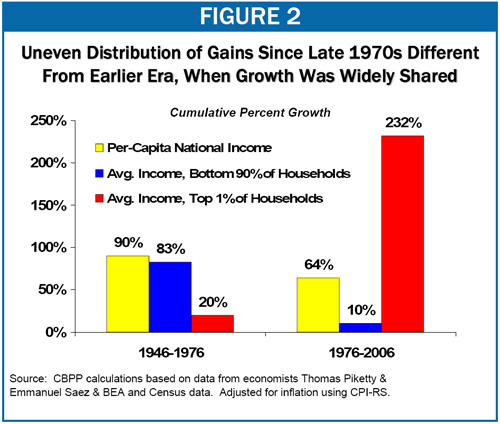
Income Inequality at Record Post-1929 Levels

I point you to this study (from October of last year, but as new to me as a never before seen rerun of 30 Rock) from the Center on Budget and Policy Priorities, which shows how the proportion of national income accruing to the top 1% of households is as high as it has been since the Great Depression. I encourage you to read the entire study, or just look at the graphic below, which sort of says it all.

Income Inequality

Income Inequality

Slate on $100 Million Bonuses

Slate business writer Daniel Gross has another take on Andrew Hall’s bonus, about which I wrote last week. Gross notes that hedge funds primarily exist to make traders rich, and do little for non-employee shareholders. So he questions why Citigroup shareholders would want to retain Hall and his Phibro operation.

Krugman on $100 Million Bonuses

Just a quick link to Paul Krugman’s column on Andrew Hall’s $100 million bonus, about which I wrote the other day. Krugman focuses more on the downside of financial speculation than on the economic factors I discussed, but he is a Nobel prize winner, so linking to him is generally a good thing.

$100 Million Bonuses Should Not Exist

My headline refers to the $100 million bonus that Andrew Hall, the head of Citigroup’s Phibro commodities trading group, is reputedly due this year. This bonus is in addition to the $100 million he was paid last year. Mr. Hall has a profit sharing formula to determine his pay, and his group is very profitable; hence the huge paydays.

When I say that such a large bonus should not exist, I am not referring to the controversy of whether a bank that has received so much taxpayer aid should honor Hall’s contract and pay such a large bonus (although they probably shouldn’t) or whether it is in any way appropriate for a society that pays teachers and firemen $50,000 per year to pay a guy $100 million to speculate in oil futures (duh: it isn’t appropriate, and in fact is obscene).

No, I say that such a bonus shouldn’t exist because economic theory says it shouldn’t. Under classic microeconomics [as I learned in Professor Bresnahan’s Firms and Markets class), if a firm is making outsized profits, other firms will see those profits and enter the market. The competition will reduce returns until profitability is in line with the industry.

If Phibro is repeatedly paying Hall $100 million per year, it’s safe to say that their profits are awesome, and thus outsized. There certainly isn’t a lack of traders and capital on Wall Street, all chasing returns. Hedge funds alone have $1.4 trillion in capital. So why isn’t the competition battering Phibro? I don’t know the answer, but here are a few possibilities:

  1. There is some sort of barrier to entry. It’s not capital, because plenty of people have that, but maybe there is a regulatory hurdle. Perhaps the few entrants in oil trading have figured out a way to maintain an oligopoly and thereby restrain competition.
  2. Maybe everyone in the oil trading business is insanely profitable, but only Hall has the sort of contract that pays him such a huge sum. It could be so easy that if I started swapping a few oil futures, I too could make millions.
  3. Or, it could just be that Hall and the folks at Phibro are really that much better than anyone else in the industry.

Again, I don’t why, but I do know that the only way a person should be able to consistently make that much money is if they are an absolute superstar or if they have figured out a way to restrain trade, which is usually illegal. Given the ways of Wall Street, if I had to pick one of those answers, I’d guess the slimy one.

Rolling Stone Hates Goldman Sachs

If you have the time, I recommend reading this Rolling Stone article. It places Goldman Sachs at the center of every financial bubble since the Great Depression, and details how the firm has profited greatly from the travails of the average investor. I don’t necessarily agree with the author’s focus on Goldman. I think all the big investment banks have been doing this; Goldman just does it biggest and best. But I do think that the banks have been  manipulating prices and selling securities that they knew were crap. And, as mentioned by John Talbott and Simon Johnson in my new favorite article, if there were just one criminal investigation that started to subpoena internal emails, we would see all kinds of nefarious behavior exposed. In fact, just yesterday the Commodity Futures Trading Commission came out with a study that blamed last year’s crazy oil prices on financial speculators, rather than on operating supply and demand.

iPhone Bad For the Psyche?

I recently saw a magazine ad for the iPhone. This ad was promoting the app store, and was specifically pushing small business apps. “Helping you run your small business, one app at a time” was the headline of the ad. This post isn’t about the iPhone per se, although my friends know how I mock their Apple toys, and how I compare the iPhone to the Range Rover: overpriced, unreliable, and purchased primarily for brand status. Hmmm, maybe I should compare it to a Gucci purse instead….

Anyway, the point is not the iPhone; the point is some of these ridiculous apps. I call them ridiculous because they do things that nobody needs to do while mobile. Let me list a few here:

  • Nomia: Get help picking a business name, finding available domain names and running trademark searches.
  • Analytics: See how your website is doing with reports showing visitors, page views, etc.
  • Credit Card Terminal: Accept customer credit card payments right on your phone.

Here’s the thing: I do run a small business, and I have never had the urge to do any of those things while mobile. When I’m analyzing my website or processing orders, I’m doing it at my computer, so that I can make adjustments or run things through my accounting software. I can certainly imagine circumstances where one might want to do such things while on the run, but those circumstances are rare.

Some might say: why be tethered to your computer? But I retort: why be connected all the time? Do you really want to check your website performance while at the beach? I relish the chance to disconnect. As more and more Americans are complaining about lack of time to think, or play, or spend with their kids, do we really need to be online more? Instead of apps that let you look at your website stats while on the bus, maybe Apple should promote apps that remind you to read to your children.

Austin, TX Sticks it to Wall Street

The Wall Street Journal ran a great article on Thursday about how a small investment firm in Austin made a clever trade at the expense of some of the biggest Wall Street firms. Amherst Holdings wrote credit default swaps on a specific pool of mortgages, which had $29 million in loans outstanding out of an original pool of $335 million. Because these remaining loans were the dregs of the pool, everyone assumed they would default. So JP Morgan and Bank of America and their pals were willing to pay 80-90% of the face value for insurance that would give them 100% on default, apparently assuming that their own genius would allow them to book a risk-free 10-20% return.

Because people can buy these swaps without owning the underlying bonds, Amherst wrote about $130 million of the swaps, pocketing $104 million to $117 million. With the proceeds, Amherst went and paid off all $29 million of the mortgages. Therefore, there were no defaults, the swaps expired worthless, and Amherst got to keep all the proceeds. Genius! According to the WSJ, the big banks are “seething” at being outwitted by a Texas runt, and are complaining to various authorities. Wait, aren’t these the same banks who are lobbying against regulation of credit default swaps? And now they are complaining to the authorities? Stop crying like whiny little babies and take your losses. Welcome to the new world, masters of douchebaggery.