Folder People vs. Non-Folder People

In reading reviews of the new Apple OS X (Lion), I was struck by how many reviewers mentioned the All My Files, Mission Control and Launchpad features, all of which display files and applications in a way so that users don’t have to organize their work in folders. I was reminded of when Gmail first came out, and everyone talked about how it didn’t have folders, because you could just search for whatever email you wanted to see.

This was alien to me. I have always organized my work in folders, both in my computer and in real life. When I worked in finance, each new deal got its own accordion file into which went a series of manila folders: due diligence, projections, legal issues, etc. So organizing my computer files and email into folders and sub-folders seemed completely natural to me. How else could you display your work on a computer?

Folders. Very neat, very organized. Even with a mustache.

And there I went, blithely assuming that everyone was comfortable with the folder metaphor. Sometimes I would look at someone’s computer where the desktop was a mass of unorganized icons, but I assumed that was an aberration; I must have just caught them in the middle of a crazy project.

It wasn’t until I read about computer scientist David Gelernter that I realized there might be other ways to look at your information. He developed something called Lifestreams in order “to minimize the time users spend managing their documents.” Lifestreams dumped the file and folder metaphor in favor of “a time-ordered stream of documents.” That seemed crazy to me – I would much rather look for documents “from Project Neptune” than “from sometime in 2003, which I think is when I worked on Neptune” – but it was clear that other people, even computer science people, didn’t think that way.

It appears that lots of people don’t think the way I do. Maybe most people. But whether the count is lots or most, clearly many would prefer to avoid the folder metaphor. To quote from one review of Lion, “The addition and prominence of “All My Files” is yet another vote of no-confidence in the user’s ability to understand and navigate the file system.”

So let’s add another dichotomy into which we can divide people: folder people vs. non-folder people. While improvements in search technology may eventually make this distinction obsolete, right now it seems like the non-folderites have the upper hand, with user interface designers catering to them. That’s fine, as long as folder capability still exists. But if that capability disappears, folder thinkers will have no choice but to rise up and let the Lifestreamers tremble. We have nothing to lose but our files!
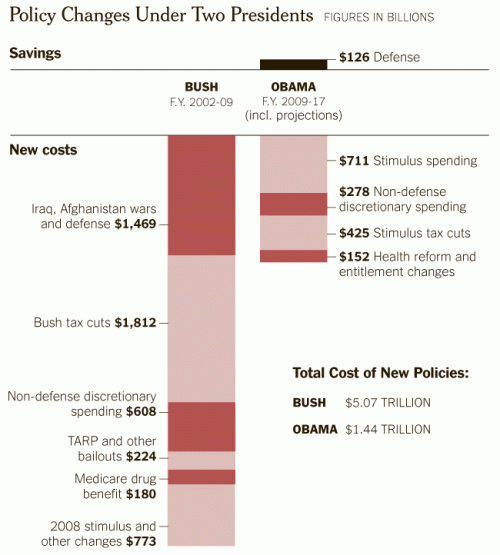

Graphical Look at Federal Deficit

Courtesy NY Times

Democrats Need to Lead, or Lose

S&P downgraded US debt from AAA yesterday, knocking Treasuries from their perch as the safest debt on earth. We will see what happens to yields on Monday, but so far it’s not clear that the markets agree with S&P. After all, this is an agency that had AAA ratings on subprime mortgage-backed securities not that long ago.

But in the meantime, the GOP is using the downgrade to attack Obama, saying “look what happened on his watch.” The president doesn’t deserve all the blame, but I understand why the GOP has seized the downgrade as a bludgeon. And in the same way, democratic operatives are putting the blame on the tea party and its refusal to compromise on deficit cutting.

But you know who isn’t saying anything? Democratic leaders. The White House, Harry Reid, Nancy Pelosi — they are all keeping silent on this. They are trying to be the “adults” and not play the blame game. I appreciate that high-mindedness, but here’s the thing: the game is being played, with or without them. If they stay silent then they just let the GOP control the narrative. You know the Sunday talk shows will be full of Boehner and Cantor and Romney and the gang piling on Obama for the downgrade.

The Democrats have to realize that they are in the middle of a street fight and if they don’t fight back they will lose. And they’ll deserve to lose. If you are going to suck ass at politics, then you shouldn’t be a politician. Regular readers know that I mostly support Democratic policies (with some huge exceptions that I ought to detail one of these days), but I sure don’t support Democratic fecklessness. The Democrats got rolled on the debt ceiling negotiation, and now they are getting rolled on the downgrade. It’s pathetic. Or, to quote a senior democratic official: “if this White House showed a gram of leadership on the debt crisis we could have avoided this historic embarrassment.”

More Tech Bubble Datapoints

Here are two more items showing that Silicon Valley is in the midst of another startup bubble:

  1. TaskRabbit, which has A) a dumb name; B) a terrible premise; C) the ridiculous idea that it won’t need to staff up in order to grow (because it has a terribly inexperienced CEO); and D) NO REAL BUSINESS MODEL.
  2. A WSJ article about how PR firms are now turning down clients and taking equity in lieu of cash compensation. Since the main value of PR firms is hiring cute young women who flirt with male reporters to ensure that their clients get press coverage, any time PR firms start feeling as powerful as VC funds (like they did in 1999), you know that you’re in a bubble.
  3. San Francisco apartment rents are skyrocketing, to the point that local real estate people are calling it a bubble.

More on Tipping Point Flaws

A new study out of RPI shows that when 10% of a population shares a belief, that belief will inevitably be taken up by a majority of society. And when less than 10% has a belief, it will never be taken up. This conclusion was reached by running many scenarios through various computer models of societies. Most interesting, and most daggerly through Malcolm Gladwell’s theoretical heart, is that no matter what sort of connection scheme the researchers put in their models — equal connections, some highly connected “influencers,” promiscuous connections — the results turned out the same. Yet again, Gladwell’s concept of important trend setters falls under the weight of experimental data.

No More Tipping Point

Wisps of Spanish Memory

I recently returned from a week’s vacation in Spain, and here are some thoughts:

1. iPhone mania is international. I would estimate that iPhones (mostly 4’s) represented 60-70% of the phones I saw in use in Madrid and Valencia.

2. Spain is really pretty. See below.

Spanish alley

3. It turned out to be Gay Pride weekend in Madrid. This looked exactly like Gay Pride weekend in San Francisco, but with a Spanish soundtrack.

4. Picasso’s Guernica is amazing. The photo below doesn’t do it justice.

In the Prado

5. Spanish hotel chains have a weak grasp on grammar, as indicated below:

All about whom? You? Me?

6. They eat a lot of ham in Spain. Jamon. Serrano, Iberico, and many other types. It’s all delicious. I want some right now.

7. High speed trains. 200 mph from Madrid to Valencia. Awesome.

We All Get Government Help

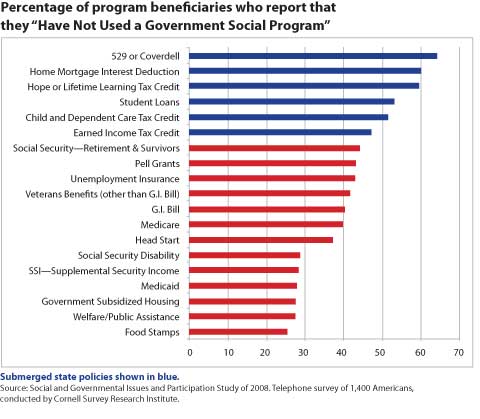
OK, maybe not all of us. But a lot of us. Really a lot. Cornell political scientist Suzanne Mettler has an article in the Washington Monthly about what she calls the “submerged state,” or the massive amounts of money at play in various tax deductions (eg. the mortgage interest deduction) that benefit particular populations.

As the chart below shows, there are all kinds of tax deductions that many people take, but those same people continue to insist that they don’t get any help from the government. Mettler’s point, backed up by her survey data: despite their cost, these programs are invisible to the public, making the public more susceptible to claims that government is too big.

How Businesses Really Think

James Fallows posts a comment from a businessman on what really creates jobs:

“IT’S DEMAND, STUPID!…A few more customers and I’ll hire another worker. Look, guys, that’s what we do out here! Don’t worry about cutting my taxes, don’t concern yourself with over-regulating me, don’t fuss about the “death tax” depriving my progeny of the joy of running my business. That is all trivia! This is all about Demand Side Economics.”

Exactly. Businesses don’t base their hiring decisions on taxes or uncertainty. They invest (in people or machines) to meet demand.

Also in the economic vein, here is Joe Stiglitz on the failure of pure free market economics.

The Calculus of Romance

I’m not using calculus metaphorically in that headline. I really want to talk about calculus and romance, specifically differential calculus and romantic relationships. But this needn’t be a math lesson; you can follow the links to Wikipedia for the full details on how calculus works, or take lessons from the Khan Academy.

Generally speaking, a derivative is a measure of change, and you can take derivatives of derivatives. So a first derivative describes a function, measuring the rate of change of that function. In the graph below, the first derivative is the tangent that measures the slope of the function. A second derivative describes the rate of change of the first derivative, a third derivative describes the second, and so on. You get the point.

Illustration of derivatives

How on earth does that relate to romance? Well, consider a romantic relationship to be a function, moving along the X-axis of time. When you are discussing your relationship (which you hopefully do sometimes), that is like the first derivative – describing the trajectory of your relationship. Sometimes you may talk about how you talk about your relationship, improving your communications skills. That is the second derivative. But if you are having real problems communicating, you may talk about how you talk about talking about your relationship. That is the third order derivative, and it’s bad.

Nobody likes higher order derivatives, and nobody likes talking about talking about talking. So make sure you get those second derivatives right!

Cupcakes Anyone? Yes, Please!

As long as we are talking about bubbles (which I did here and here and here), I should note that some people also think we are in a cupcake bubble (like this person and this person and even this person). I can’t disagree; here in SF there are three cupcakeries in just a 10 block area, each selling pretty much identical over-priced cupcakes with too much frosting.

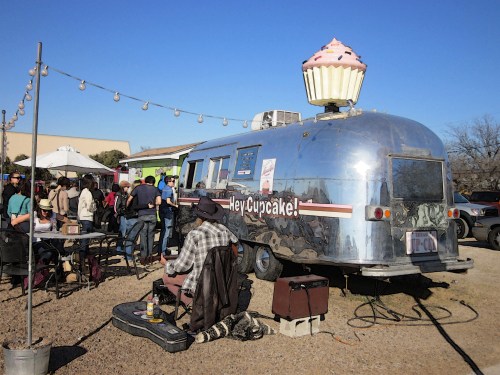
And yet, there is something special about a cupcake. Look at this photo (taken by me, in case you thought I was just a pretty writer):

The cupcake trailer, in Austin TX

Seriously, how fun does that cupcake look? Really fun. And that, I think, is the key to the cupcake’s success. They are so little and whimsical and colorful that you can’t help but smile when you see them. Most important, they have that dollop of frosting on top. Of course it’s too much, and too sweet, but it looks like a swirly party hat, a pastel pillow of creamy goodness that you could jump right into. No wonder you can’t resist a cupcake on your plate.

When you see a full cake, it looks delicious, but also kind of serious, maybe even intimidating. You have to slice it, and share it, and then probably store what you didn’t finish, and then you have the pressure to keep eating the leftovers so that you can finish them before they start to get hard and crusty in the refrigerator. A cupcake, on the other hand, has none of those difficulties. No slicing, no leftovers, no pressure. Just pop it in your mouth (one, two or three bites…it’s up to you) and be transported back to your childhood.

So yes, there is definitely a bubble in cupcake bakeries, but the cupcakes themselves will continue to crowd out cakes, as long as we prefer fun to dour in our desserts made out of flour.