Alaska Loves Federal Money

Yesterday I posted about how Alaska politicians talk a big game about wanting the federal government to leave them alone, but in reality they suck down more federal money than any other state. Having just spent a week in Alaska, I brought some photographic evidence of our biggest state’s big appetite for taxpayer money.

Here is the beginning of a beautifully built and maintained trail at the Mendenhall Glacier outside Juneau. You can see that construction of the trail, which must have employed several people to cut brush and grade the path, was paid for by the federal stimulus package. As for the big Bob Marley joint depicted on the sign….it’s unclear if federal dollars paid for that.
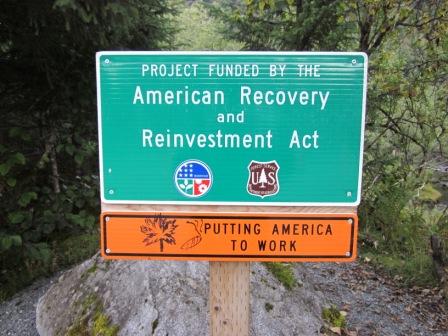
Trail paid for by US taxpayers

In Gustavus, a small town which is the gateway to Glacier Bay, a brand new $20 million dock is being built with federal stimulus dollars. I spoke with the owner of my hotel and with the pilot of my whale watching boat, and both said that the dock was completely unnecessary. But it was employing a whole bunch of skilled laborers, so many that they had to come in from Juneau, since Gustavus didn’t have that many construction workers.

The new dock at Gustavus

Here is a photo of all the pickups and SUVs owned by the people working on the dock. Again, these are local workers being paid with US taxpayer dollars.

Construction worker trucks

I have no problem with stimulus dollars paying people to build paths and docks; that is how a government stimulus package works. The government injects money into the system to boost employment and spending.  My problem is with a state that talks about how it doesn’t believe in the stimulus or in federal help at all while it continues to take as much federal money as it can.

Voters are Ill-informed; Politicians are Hypocrites

The NY Times recently ran an article about Alaska, which attracted my attention since I was planning a vacation to that giant state (in fact, I am drafting this entry on my flight to Anchorage). But this article wasn’t about fishing, or the awesome glaciers, or how to avoid being eaten by bears. No, this article was about the irony of Alaska being the home of such anti-government fervor (Sarah Palin’s small government views are pretty representative of her home state) while at the same time being the largest recipient of federal stimulus money.

For example, Alaska state representative Carl Gatto called to roll back the federal government’s “entire socialistic experiment in federal hegemony.” Yet he also celebrated that “for every $1 we give them in taxes for highways, they give us back $5.76.”  Jay Ramras, another state rep, embodied the dichotomy in a single quote: “If you want to feed us federal money like it’s a narcotic and make the state into a junkie of the U.S. Treasury, O.K.,” he allows. “But we would like to be an Emersonian Alaska and just get control of our resources.”

Of course, Alaska is not alone in this irony. There is a strong correlation between conservative states talking a big game about “government out of our business” while sucking aggressively at the federal teat. This map shows how red states take more than they give, and this chart shows traditionally republican states leading the way in receiving more federal dollars than they pay in taxes. And here is a brand new map from the NY Times based on census data.

So how do we explain this paradox? I suppose it could simply be the essential greed of humanity, people feeling that they are justified in taking as much as they can while giving as little as possible. Or it could be a canny political move, trying to drain the coffers of the government in order to force it to shrink, sort of a “starve the beast” movement at the grass roots level. But I don’t think either of those explanations fly. I think, instead, that the average voter doesn’t even make the connection between small government and services provided, between taxes paid and resources received. When voters say “don’t tax me” while taking a bridge paid by other citizen’s taxes, they don’t see the irony because they don’t even realize that taxes are what pay for bridges. See this piece by James Kwak on how the whole tax & service thing works, and this piece by David Sirota on how American voters seem to lack the ability to remember what policies worked or didn’t work in the past.

The politicians, on the other hand, who vote for these policies, like Carl Gatto and Jay Ramras from the NY Times article, or Ted Stevens, a major obtainer of federal dollars for the state, should actually understand how taxes and services are related. I mean, they are professional legislators, and this is a basic part of government budgeting. They are not ignorant, like the voters; they’re just hypocritical, saying and doing whatever they must to get reelected. They recognize the irony in calling for lower taxes while trumpeting the bacon they bring home from Washington…they just don’t care. They use that irony to cynically take advantage of the electorate’s lack of understanding, and it gets them elected year after year.

I just returned from a week in Alaska, where I saw this phenomenon in action multiple times. There will be follow-on posts on this topic.

More on Mobile Check-ins

With Big Kahuna Facebook launching its own check-in service yesterday, the commentariat is chiming in. Here is a nice article from Wade Roush noting that A) Facebook wins, and B) it wins because it’s useful, rather than a novelty. You know I love posts that agree with mine!

Do Angel Investors Make Technology Shallow?

Just two days ago I wrote about super angels potentially crowding out VCs in the funding of technology companies, and I noted that this dynamic was mostly relevant to consumer internet companies rather than hardware companies. And I didn’t even mention biotech, medical device or energy companies, most of which take far more capital than even the superest of angels could provide.

Now, lo and behold, a former Gartner analyst comes out with an article about how Silicon Valley is too focused on consumer internet, on “the glitz and the superficial,” rather than on solving big problems, like medical and environmental ones. He notes that the new innovators in those areas are big companies, who are focusing their R&D budgets on these big problems with big markets, rather than entrepreneurs, who are focusing their energies on figuring out the best way to get you to “check in” at your local bar.

On Super Angels and Lean Startups

Both the Wall Street Journal and TechCrunch recently wrote articles about the new breed of “super angels” in Silicon Valley, individuals who are aggressively investing in technology startups, often in amounts large enough that they are starting to squeeze out traditional venture capitalists.

TechCrunch states that this movement is enabled by the rise of the “lean startup,” in which companies use new technologies to reduce their costs:

“But the last several years have seen the rise of the cheap startup. Internet startups can use open source software and new scripting languages to ship products fast and cheap.”

That’s true, but only for a certain segment of technology companies. Sure, consumer internet companies can leverage these new technologies and launch without gobs of capital, but much of the technology world doesn’t have that luxury. Any company that produces hardware is in a different situation. Chips, devices, networking appliances – these guys all need just as much capital as they ever did. And even folks working on software for the enterprise are still somewhat tied to the old ways of building products.

TechCrunch tends to see Silicon Valley as consisting solely of web startups fueled by former Googlers, but there are still entrepreneurs out there working on traditional products. So before you start writing the obituary for venture capital, remember that consumer internet may be fun and sexy, but there are plenty of technology companies that still need the sorts of resources only large funds can provide.

Mobile Check In: Fad or Function?

If you follow the technology business at all, you know that one of the hot new trends is “checking in,” whereby you use an application on your smartphone to tell the world, or at least your friends, where you are. Using the now free wifi at your local Starbucks? Check in. Just ordered a Manhattan at the hip new bar? Check in from there. You can see where your friends are, and vice versa, and if you check in frequently enough, you may get special status.

There are a jillion companies offering these applications now, each with annoying names reminiscent of the dot com boom of a decade ago: Loopt, Whrrl, Gowalla, Foursquare (now with Snoop Dogg on the service!) and Check.in to aggregate them all. Plus big players are expected to enter the business: Yelp already has, Google is circling, and Facebook is the 800 pound gorilla everyone fears, with rumors that they are buying Hot Potato.

The question is whether any of these services will be more than just another fad briefly embraced by fedora-wearing technorati hipsters in SF, NY and Austin. Being “mayor” of the local pub only goes so far. Knowing where your friends are is nice, but email and text can do that. For checking in to have legs, it needs to add actual value beyond its current novelty. Getting discounts from the bars and restaurants where you check in frequently – now that is valuable. Assistance in meeting members of the opposite sex (or same sex…however you roll) is valuable.

Clear and tangible benefits need to be provided, and in a way that can’t be gamed; bars won’t participate if they are getting scammed for free drinks. All the check in players are working on this – they aren’t stupid – but nobody has hit on a winning formula yet. In the meantime, when you read the breathless press about this amazing new capability, remember that it’s not a business yet. Or, appreciate the savagery of Time magazine, which called Foursquare “just another tool tapping into a generation of narcissism.”

Michael Kinsley Takes on Laffer

Regular Thoughtbasket readers know how I mock the Laffer Curve, a flawed theory that tax-cutting fiends use in order to claim that reducing marginal tax rates will actually increase government revenue as it unleashes a flood of investment and entrepreneurship. See my mockery here and here, for example.

So of course I was heartened to see Michael Kinsley at The Atlantic take up the cause.  Enjoy his mockery here.

Slate Magazine vs. Sarah Palin

I had pretty much forgotten about Sarah Palin, or started to ignore the news items about her, and I had assumed that maybe she was holed up learning about policy or facts. But then Slate runs an article trying to analyze how she might come up with some of the wacky stuff  she says.  I read a quote like the one below, and it’s hard to see the issue as one of policy differences:

“Oil and coal? Of course, it’s a fungible commodity and they don’t flag, you know, the molecules, where it’s going and where it’s not. … So, I believe that what Congress is going to do, also, is not to allow the export bans to such a degree that it’s Americans that get stuck to holding the bag without the energy source that is produced here, pumped here.”

I’m sorry, but regardless of where you are on the political spectrum, that makes no sense. Take Newt Gingrich: he is deeply conservative and I deeply disagree with him, but that guy could talk for a week straight and he would never say anything as idiotic as the Palin quote above. I want to be generous and assume that Palin isn’t stupid; that she just uses folksy idioms and is slightly misinformed. But I read what she says, I hear about the “refudiates”  and that generosity is hard to find. Can someone help me solve this conundrum?

The Taliban as a Desert Gang

Here is a great article in Foreign Policy that compares Afghanistan’s Taliban movement to the Bloods and Crips and other urban gangs here in the US. The author notes similar structures and similar motivations, and then discusses successful methods that urban police departments have used to reduce gang violence, and how they could be applicable in the deserts of Afghanistan.

Interesting fact: as part of counterinsurgency training, US Marines from Camp Pendleton are embedding with Los Angeles cops to see anti-gang policing in action.

Extra shout out: for the headline Straight Outta Kandahar.

Piling on Google

Om Malik has a great post today on Google’s utter inability to compete in the social media world, as evidenced this week by the company shutting down Google Wave, which was a complete flop, and the sad purchase of Slide for $200 million.

I recently posted about the risk that Google’s culture poses to its future success, and Malik makes the same point, noting that Google simply doesn’t have social media in its DNA. He says that algorithms can’t factor in empathy, which is another way of saying that hiring only engineers doesn’t guarantee future success.