Category Archives: Pop culture

The University Isn’t Going Anywhere

Image

There is a lot of talk going around about how universities are broken, and Silicon Valley is going to put the Ivy League out of business. Certainly change is afoot, and continued tuition hikes at twice the rate of inflation are ridiculous. Online universities like Udemy and the Miverva Project are interesting, and may even succeed, depending on whether success is measured in teaching students or in making tons of money. But if success is measured in pushing the existing elite universities out of their current position, don’t hold your breath.

Kevin Carey wrote a piece in The New Republic saying how the roster of leading companies has completely changed over the last century but the roster of leading universities has not. American Cotton Oil is gone, but Harvard remains. Carey states that this is unsustainable; education should be as prone to disruption as business.

But there is a deep flaw in Carey’s analogy. Companies go out of business mostly because people no longer want their products. When was the last time you bought cottonseed oil, or film for your camera? But people still want what universities are offering, especially elite universities. Is education still valuable? Yes. Is a Harvard degree still valuable? Yes. I don’t want any cottonseed oil, but I sure want my kids to get a Harvard education and diploma. And as long as the desire for education and prestige remains (ie. as long as human nature still rules), the elite universities will remain so.


Four Keys to a Happy Work Environment

I’ve been thinking about work, and what makes working at a company enjoyable. What any person might like or dislike about work can vary widely, of course, but I’ve worked at a lot of different companies, and across those various companies I’ve found four main factors that determine how pleasant work at a company might be:

  1. The wind is at your back
  2. Things work smoothly
  3. Common commitment to a mission
  4. Strong management team

Wind at your back means that the market is moving your way and revenues are coming easily (as easily as they ever do). Like you’re Instagram and everybody wants your app. Or you’re Caterpillar during a construction boom, when people are clamoring for your tractors. When the wind is at your back, everything is easier. Your decisions all seem right, and if you happen to make a mistake, it just doesn’t matter that much. Your colleagues are in good moods, your bosses are happy with your work, and bonuses are in your future. When the wind is at your back, work almost seems like play.

Having your company work smoothly is an internal state, rather than one dependent on the market. Processes are in place and lines of communication are established. Objectives are set, each group is executing on those objectives, and everybody is in synch. When your organization is firing on all cylinders you feel productive, even if the wind isn’t at your back. Sure, maybe you could be growing faster, but you are getting things done, and that feels great.

Even if you aren’t all in synch, you can all be committed to the same mission. And this doesn’t need to be a feel-good, change the world sort of mission. Going back to Caterpillar, if everyone is committed to the mission of making great tractors and selling the heck out of them, then you are all on the same team, heading toward the same goal, and that is fun. You might be facing a headwind (housing crisis!) and your company may not be very organized, but at least you are all in it together, pulling in the same direction.

If you’ve got good management, everything is a little better. A good boss makes you feel appreciated, like your contributions actually matter. And if your contributions matter, you will work harder on those contributions, and feel better about that work. Good management can make work more rewarding, and more fun. Bad management, on the other hand, makes you dread coming to work each day.

CEOs: Imagine You Are The Janitor

OK, I promise this will be the last entry on cultural change. At least for a while.
But I wanted to return to the topic that started this arc: changes in corporate culture. You might recall how I postulated that a company could change its culture only if that change started at the top. The CEO needs to live the culture that he wants the whole company to have.

But that raises a question: can a CEO, from his top of the heap position, even successfully think through cultural issues? Go back to my prior example, where there is a culture of being late to meetings because the CEO is always late to meetings. If the CEO is always late, but nobody is late to the CEO’s meetings (because he is the boss, after all), then maybe he doesn’t even realize that this culture exists, and that it wastes everyone’s time. His time isn’t being wasted, so perhaps he doesn’t even see the problem.

If this is true of the CEO, it is likely true of other high level executives, depending on the size of an organization. So how can these oblivious executives work to develop a functional corporate culture? Here I turn to the work of John Rawls, a titan of political philosophy.  Rawls tried to develop a political system that maintained the liberty of markets while countering the tendency of market economies to perpetuate economic disadvantages.

In his masterwork, A Theory of Justice, Rawls balanced these two competing strands through an invention he called the veil of ignorance. Rawls suggested that policy makers devise policies via a thought exercise in which they ignored their actual station in life and imagined how the policy would affect the least advantaged person in society. By operating behind a veil of ignorance as to how policies would affect them personally, they would develop policies that were fairer to everyone.

Maybe CEOs and other top executives should sometimes step behind a veil of ignorance. As a thought experiment, it’s not really that hard. Ask yourself “How would the average employee feel about this? What about the lowest ranking employee?” Only a CEO whose ego has been stoked to l’etat c’est moi proportions will not be able to imagine how his underlings might feel. In the case our always late CEO, surely he will recognize how people feel when he is always late to their meetings.  And if he is so Louis XIV that he is truly unable to imagine how others might feel, then that company’s culture is utterly doomed and everyone should just leave.

Is Corporate Culture The Same As Country Culture?

I recently posted about corporate cultures, and how the only way a corporation can change its culture is from the top. Based on some of the feedback I received I’ve decided to expand my scope and explore a larger cultural change: how the United States might change some parts of its culture. For example, one aspect of America’s current culture that seems problematic is that we want all kinds of services (Medicare, Social Security, strong defense, good roads, etc.) but we want the lowest taxes possible. Those two desires are incompatible; a culture that emphasizes taking without giving will prove challenging in the long run.

In my prior post, I discussed that a change in corporate culture requires a CEO who is willing to push that change. In the case of a country, who might play that role? You would naturally think the president, but we know that won’t work. Plenty of recent presidents have talked about changing the culture, but none have succeeded. Hell, none of them could change the culture of a few hundred people in Congress, let alone a whole country. And that’s not really surprising; a country is not a hierarchical structure the way a company is, so people have no reason to necessarily follow what the leader says.

The president could try to lead by example, or by using the bully pulpit, but I can only imagine the furor  that would erupt  if a president (or governor, or senator, or mayor) announced that “OK people, your constant desire to get lots while paying little is complete crap; going forward we are all going to be more realistic.” No, that wouldn’t work at all.

What if all our leaders teamed up? Suppose a whole slew of politicians – national and local, democrat and republican, male and female – got together to announce an initiative aimed at realism. This could be risky, since taking a stand isn’t really what politicians do; they hate being out on limbs by themselves. But that is why they would team up with members of the other party. After all, as I noted in my prior post, cultural change requires leaders to actually lead. Then they could get business leaders on board; everyone from Warren Buffett to Charles Koch. Throw in some celebrities – nothing happens in America without celebrities – and then maybe we’d have something.

It’s possible that this is nothing but a pipe dream. Can we really expect politicians to team up in order to lecture voters? Probably it will never happen. But maybe we should expect more from our leaders.

The Myth of the “Job Creator”

A key Republican talking point is that the wealthy are “job creators” and that any tax on these job creators will cause them to fold their cards and go home, hurting the economy in the process. This is clearly ridiculous, and I have challenged before the concept that tax rates diminish incentives to build companies, but here is a great essay from an entrepreneur and investor (a successful one — he is clearly in the 1%) describing how people don’t create jobs, the economy does. And the economy is made up of regular folks — the 99% — who need to buy the products produced by the entrepreneurs. Without a successful consumer class, nobody will be a job creator.

Folder People vs. Non-Folder People

In reading reviews of the new Apple OS X (Lion), I was struck by how many reviewers mentioned the All My Files, Mission Control and Launchpad features, all of which display files and applications in a way so that users don’t have to organize their work in folders. I was reminded of when Gmail first came out, and everyone talked about how it didn’t have folders, because you could just search for whatever email you wanted to see.

This was alien to me. I have always organized my work in folders, both in my computer and in real life. When I worked in finance, each new deal got its own accordion file into which went a series of manila folders: due diligence, projections, legal issues, etc. So organizing my computer files and email into folders and sub-folders seemed completely natural to me. How else could you display your work on a computer?

Folders. Very neat, very organized. Even with a mustache.

And there I went, blithely assuming that everyone was comfortable with the folder metaphor. Sometimes I would look at someone’s computer where the desktop was a mass of unorganized icons, but I assumed that was an aberration; I must have just caught them in the middle of a crazy project.

It wasn’t until I read about computer scientist David Gelernter that I realized there might be other ways to look at your information. He developed something called Lifestreams in order “to minimize the time users spend managing their documents.” Lifestreams dumped the file and folder metaphor in favor of “a time-ordered stream of documents.” That seemed crazy to me – I would much rather look for documents “from Project Neptune” than “from sometime in 2003, which I think is when I worked on Neptune” – but it was clear that other people, even computer science people, didn’t think that way.

It appears that lots of people don’t think the way I do. Maybe most people. But whether the count is lots or most, clearly many would prefer to avoid the folder metaphor. To quote from one review of Lion, “The addition and prominence of “All My Files” is yet another vote of no-confidence in the user’s ability to understand and navigate the file system.”

So let’s add another dichotomy into which we can divide people: folder people vs. non-folder people. While improvements in search technology may eventually make this distinction obsolete, right now it seems like the non-folderites have the upper hand, with user interface designers catering to them. That’s fine, as long as folder capability still exists. But if that capability disappears, folder thinkers will have no choice but to rise up and let the Lifestreamers tremble. We have nothing to lose but our files!

More on Tipping Point Flaws

A new study out of RPI shows that when 10% of a population shares a belief, that belief will inevitably be taken up by a majority of society. And when less than 10% has a belief, it will never be taken up. This conclusion was reached by running many scenarios through various computer models of societies. Most interesting, and most daggerly through Malcolm Gladwell’s theoretical heart, is that no matter what sort of connection scheme the researchers put in their models — equal connections, some highly connected “influencers,” promiscuous connections — the results turned out the same. Yet again, Gladwell’s concept of important trend setters falls under the weight of experimental data.

No More Tipping Point

Wisps of Spanish Memory

I recently returned from a week’s vacation in Spain, and here are some thoughts:

1. iPhone mania is international. I would estimate that iPhones (mostly 4’s) represented 60-70% of the phones I saw in use in Madrid and Valencia.

2. Spain is really pretty. See below.

Spanish alley

3. It turned out to be Gay Pride weekend in Madrid. This looked exactly like Gay Pride weekend in San Francisco, but with a Spanish soundtrack.

4. Picasso’s Guernica is amazing. The photo below doesn’t do it justice.

In the Prado

5. Spanish hotel chains have a weak grasp on grammar, as indicated below:

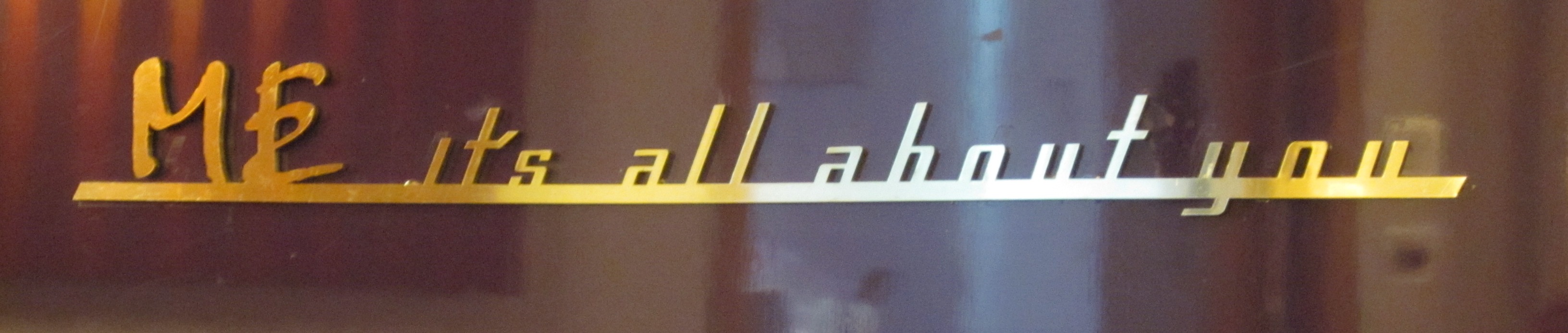
All about whom? You? Me?

6. They eat a lot of ham in Spain. Jamon. Serrano, Iberico, and many other types. It’s all delicious. I want some right now.

7. High speed trains. 200 mph from Madrid to Valencia. Awesome.

The Calculus of Romance

I’m not using calculus metaphorically in that headline. I really want to talk about calculus and romance, specifically differential calculus and romantic relationships. But this needn’t be a math lesson; you can follow the links to Wikipedia for the full details on how calculus works, or take lessons from the Khan Academy.

Generally speaking, a derivative is a measure of change, and you can take derivatives of derivatives. So a first derivative describes a function, measuring the rate of change of that function. In the graph below, the first derivative is the tangent that measures the slope of the function. A second derivative describes the rate of change of the first derivative, a third derivative describes the second, and so on. You get the point.

Illustration of derivatives

How on earth does that relate to romance? Well, consider a romantic relationship to be a function, moving along the X-axis of time. When you are discussing your relationship (which you hopefully do sometimes), that is like the first derivative – describing the trajectory of your relationship. Sometimes you may talk about how you talk about your relationship, improving your communications skills. That is the second derivative. But if you are having real problems communicating, you may talk about how you talk about talking about your relationship. That is the third order derivative, and it’s bad.

Nobody likes higher order derivatives, and nobody likes talking about talking about talking. So make sure you get those second derivatives right!

Cupcakes Anyone? Yes, Please!

As long as we are talking about bubbles (which I did here and here and here), I should note that some people also think we are in a cupcake bubble (like this person and this person and even this person). I can’t disagree; here in SF there are three cupcakeries in just a 10 block area, each selling pretty much identical over-priced cupcakes with too much frosting.

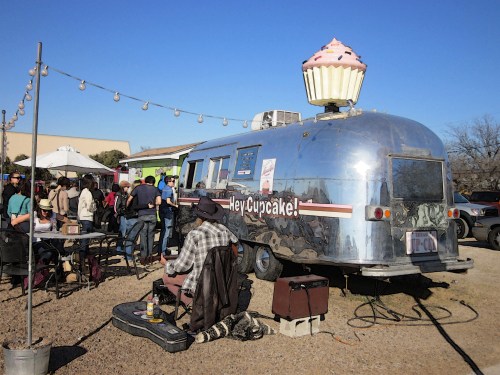
And yet, there is something special about a cupcake. Look at this photo (taken by me, in case you thought I was just a pretty writer):

The cupcake trailer, in Austin TX

Seriously, how fun does that cupcake look? Really fun. And that, I think, is the key to the cupcake’s success. They are so little and whimsical and colorful that you can’t help but smile when you see them. Most important, they have that dollop of frosting on top. Of course it’s too much, and too sweet, but it looks like a swirly party hat, a pastel pillow of creamy goodness that you could jump right into. No wonder you can’t resist a cupcake on your plate.

When you see a full cake, it looks delicious, but also kind of serious, maybe even intimidating. You have to slice it, and share it, and then probably store what you didn’t finish, and then you have the pressure to keep eating the leftovers so that you can finish them before they start to get hard and crusty in the refrigerator. A cupcake, on the other hand, has none of those difficulties. No slicing, no leftovers, no pressure. Just pop it in your mouth (one, two or three bites…it’s up to you) and be transported back to your childhood.

So yes, there is definitely a bubble in cupcake bakeries, but the cupcakes themselves will continue to crowd out cakes, as long as we prefer fun to dour in our desserts made out of flour.