Category Archives: Business

The Benefits of Financial Regulation

Harvard Magazine recently published an article regarding bank regulation. Like many articles (in fact, like the vast majority of articles I’ve seen), it makes the case that the current situation virtually guarantees another financial meltdown, since all major financial institutions now have implicit government backing, under the “too big to fail (TBTF)” doctrine. However, this article is a little different than many because it’s written not by a journalist, but by David Moss, a professor at Harvard Business School, which is, of course, the main source of the overconfident financiers who created the recent meltdown.

Professor Moss suggests a number of solutions to the TBTF problem and the moral hazard it creates. Most of these suggestions revolve around making the implicit guarantee an explicit one, with transparent limits and with the government charging for the guarantee. He would also add a tight regulatory regime.

The most interesting thing about Moss’ article was the graph I’ve inserted below. This graph has the date on the X axis, from 1864 to 2000. The Y axis shows the number of bank failures during each year. As you can see, bank failures were a regular occurrence in the American economy until 1932, when in the wake of the Great Depression a whole series of regulations were implemented, including Glass-Steagall. Then there is a long, calm period with very few bank failures, running up to the early 1980’s, when bank deregulation began under the Reagan administration. This graph speaks volumes.

Bank Failures Over Time

Bank Failures Over Time

Bank CEOs and Republicans are arguing strenuously against new bank regulations. CEOs have a good reason: they want to make as much money as possible. But Republicans are fighting regulation simply because they have an ideology that regulation is inherently bad. I think the last two years have proven this ideology wrong, but even if you don’t buy that, it’s hard to argue with the chart. So the question for Republicans is whether they are going to look at 136 years of data, or listen to the anti-government ramblings of people like former exterminator and creepy dancer Tom Delay, or fact-hindered quasi-philosopher Ayn Rand?
A Market Approach to Health Care

As regular readers know, I am focused on health care reform and am frustrated by the general dysfunctionality of the American health care system. My few posts have approached the problem from the perspective of working within the system we have, in particular by pushing doctors to emphasize patient care instead of revenue generation.

However, the latest issue of The Atlantic magazine has a fascinating article that takes the entire system to task and suggests a radical new approach. The author, David Goldhill, is a businessman rather than a policy guy, but he was driven to explore the health care system after his father died from a hospital-acquired infection. (Disclosure: I know David and am friendly with him) This article has been praised from the right and the left, and even has its own Facebook page.

Goldhill starts from the specifics and moves outward. He notes the 100,000 deaths per year in the US from hospital-acquired infections, and how hard it is to convince doctors to adopt a checklist that has been proven to dramatically reduce infection. “But many physicians rejected the checklist as an unnecessary and belittling bureaucratic intrusion, and many hospital executives were reluctant to push it on them.” He wonders how a society that shuts down restaurants for a single case of food poisoning tolerates this.

As a businessperson, Goldhill assumes there must be a reason for these terrible facts. Since people respond to economic incentives, the incentives in health care must be deeply flawed for our system to work as poorly as it does. Goldhill’s diagnosis: rather than following a market system, where consumers drive providers to lower costs and improve service, our health care system is a patchwork of information-obscuring insurance and lobbying-influenced regulations. In a market system, DVD players get better and cheaper, while in the health care system, nothing ever gets cheaper.

Goldhill’s treatment plan is to make health care more like a standard consumer product. Everyone will have catastrophic insurance, but in his system, those plans will have a deductible of $50,000 rather than the usual $2,000-$4,000. The government will provide subsidies to make this insurance affordable. But for most medical expenses, consumers will pay for them out of income and savings. Where will they get the money for this? Under Goldhill’s plan, since employers will no longer need to provide insurance ($12,000 per year for the average family), workers will be paid more, and thus have money to spend on medical expenses. If consumers are paying for most things themselves, the entire system will be subject to market forces, which improve quality and decrease cost.

I’m not doing justice to Goldhill’s solution. When read in full, it makes a lot of sense. Goldhill notes at the beginning of his piece that he is a Democrat who believes that everyone should be covered, and his system would do that. Ignoring the fact that Goldhill’s system will never happen (the insurance and hospital lobbies are way too strong), I have only one general critique, which has that Goldhill has, I think, too much faith in the market, which we have seen over the past two years is not always efficient, and is sometimes capricious and cruel. It’s bad enough when the market screws up your mortgage, but if it ruins your health care….

Here are two specific examples where I think Goldhill overestimates the wisdom of the market:

  1. Goldhill says that if companies did not have to provide insurance, all the money saved would go to the workers as increased salary, so they could afford their own health care. But we all know that the majority of the savings would actually go to executives and stockholders, and workers would be left uninsured and unable to pay for visits to the doctor.
  2. I certainly agree that we want people to be better informed consumers in the health care market, but as the mortgage debacle has shown us, many people are simply incapable of making intelligent decisions in a complicated environment. If somebody is unable to figure out if they can afford an adjustable rate mortgage, can we really expect them to intelligently perform the cost-benefit analysis between possible treatment plans for their cancer?

The New Republic vs. Ayn Rand

Jonathan Chait of The New Republic recently took on Ayn Rand and her philosophy, and thus he took on the entire intellectual edifice of the right, which is built on Rand’s view that any restrictions on the activities of capitalism ubermen is a moral abomination.

Chait critiques Rand on moral and logical grounds, but he is strongest when he subjects Rand’s worldview to withering factual criticism (see page 3 of his article). Alan Greenspan, a famous Randian, recently admitted that his free-market ideology was wrong. Passages like the below, from Chait’s article, should convince more Randians of the error of their ways:

“In reality, as a study earlier this year by the Brookings Institution and Pew Charitable Trusts reported, the United States ranks near the bottom of advanced countries in its economic mobility. The study found that family background exerts a stronger influence on a person’s income than even his education level. And its most striking finding revealed that you are more likely to make your way into the highest-earning one-fifth of the population if you were born into the top fifth and did not attain a college degree than if you were born into the bottom fifth and did. In other words, if you regard a college degree as a rough proxy for intelligence or hard work, then you are economically better off to be born rich, dumb, and lazy than poor, smart, and industrious.”

Malcolm Gladwell is Often Wrong

I’m a little late in getting to this, but a semi-recent suite of letters to the editor regarding Malcom Gladwell’s New Yorker piece on basketball’s full court press provided me with a reason to write something I’ve been stewing over for years: Malcom Gladwell is massively overrated. I have been disagreeing with him for years, since before he published The Tipping Point, back when he was just a New Yorker staff writer.

The letters about the full court press, which sadly are not on the New Yorker website, generally press [heh heh] on the theme that Gladwell’s conclusion was superficial if not downright specious. This makes sense to me, since when I read his article, it clearly seemed to be wrong. And that has been my problem with Gladwell all along: too often I feel like his conclusion doesn’t make sense.

I should state here that I don’t want to fully attack Gladwell. Sometimes his conclusions are correct. And in all cases I think he is a truly talented writer with an amazing skill at explaining complex ideas in clear and concise language. He just sometimes leaps to unwarranted conclusions.

Here is how the typical Gladwell article works: he presents a few facts, which he then links into some sort of “surprising” conclusion (e.g. underdogs should always press or a few well-connected hipsters started the Hush Puppies trend) and then does a series of riffs on the implications of this conclusion. But his conclusion is based on some analysis he has done of those first few facts. My problem is that he never gives you the details of this analysis or how he did it. That means that you can’t tell if he’s right or not. He might have misread the data, or skewed it to fit his thesis, or just screwed the analytical pooch. You have to trust his analysis, and if you don’t, his whole article is meaningless.

The real problem here is that Gladwell’s analyses are sometimes wrong. As the letters indicate, his view of the press is flawed. Of course any new strategy can prove effective for a while, but fundamentally all a press does is move the locus of competition from the basket to the backcourt. Once teams get used the press, the good teams will break it the same way they can outscore the bad teams once under the basket. In addition, as the letters pointed out, it is often the favorite that presses, leveraging its physical advantage.

Similarly, Gladwell’s first — and still most famous — analysis, in The Tipping Point, is equally problematic. Recent research in trends has shown that that randomness and social dynamics provide a full explanation for why some trends explode and some don’t. Gladwell’s whole structure of Mavens and Connectors is irrelevant. Check out Duncan Watts’ work on music popularity to see how wrong Gladwell really was. See links here, here, here, here and here.

Here is Watts from the NY Times magazine: “This means that if one object happens to be slightly more popular than another at just the right point, it will tend to become more popular still. As a result, even tiny, random fluctuations can blow up, generating potentially enormous long-run differences among even indistinguishable competitors.”

As statisticians always say, just because the data looks like a trend doesn’t mean the trend exists. Gladwell’s problem is that he likes to make a thesis out of a few data points, without doing the work to truly understand whether his thesis actually has causative properties.

Or, as MIT professor Ezra Zuckerman put it in a letter to the New Yorker regarding Gladwell’s piece on the Wall Street meltdown, “This is an interpretive leap drawn from two facts….But Gladwell’s logic is faulty.”

I want to emphasize again, however, that I am not fully anti-Gladwell. His writing is great, even if his analysis is sometimes flawed. And his review of Free, the idiotic book by Chris Anderson, is right on the money. So to speak.

Medical Doctors: Stop Being Greedy

Check out this article about the panel that decides how Medicare reimburses every procedure, doctor visit or call in the medical world. The panel is completely run by the AMA, and dominated by specialists. So, big surprise, specialist visits and procedures are continually going up in value, while simple visits to your GP stay static. And the government does nothing to stop this; instead, the AMA — an organization of doctors — gets to decide how much doctors should get paid. Paid by taxpayers.

This is why simple tests cost $3,000, or why my GP tried to charge me $250 to spend 90 seconds freezing off a wart (I refused to pay). I have commented before on how greedy doctors are no better than subprime mortgage traders on Wall Street, and this article adds evidence to my viewpoint. A system where people get to decide on their own compensation is a bad system, and a world where jerk off dermatologists (yes, I’m talking about you, Dr. K) think they deserve $500k per year is a world with misplaced priorities.

So, AMA, organization of money-grubbing doctors that has fought health care reform for the past 60 years, I say to you: stop being greedy and screwing over your patients.

Auto Bailout Revisted; Thoughtbasket Gloats

Back during the heat of the auto bailout, when President Obama was being criticized for usurping the contractual rights of the bondholders, I wrote that he was doing no such thing…that he was merely playing hardball and winning. My money quote: “The creditors blinked first; they knew that if they took over the company it would essentially disintegrate overnight, and they would be left with a bunch of factories nobody would buy.”

New York Magazine recently did a long piece on Steve Rattner, Obama’s car czar, and in the sections that discuss Rattner’s negotiations with the creditors, it becomes clear that Rattner played the factual business hand, not the federal government will crush you hand.  To wit:

“In this go-round, Rattner held all the cards, and Lee [JP Morgan Chase Vice-Chairman Jimmy Lee] knew it.  The government was the lender of last resort, and if it walked away, Chrysler and GM would be sold off for parts.”

And then:

“Rattner almost laughed. “Jimmy, look. If you want the company, it’s yours,” Rattner told him. “If we can’t make a deal, then it’s your company,” which Lee knew he couldn’t afford.”

Finally, after JP Morgan Chase agreed, and only a few hedge funds were holding out, led by Daniel Arbess, portfolio manager of Xerion, we get the following:

“He’d [referring to Arbess] shrewdly picked up some bonds for as low as $.15 on the dollar. If the government paid $2 billion, he’d still make money. Did he want to risk that for the chance of greater returns? Arbess signed on.”

We don’t like to gloat here at Thoughtbasket, but sometimes we have no choice. Now if only we could get WordPress’ block quote function to work, life would be awesome.

Living The Health Care Debate

There are plenty of policy papers out there on both sides of the health care reform issue, as well as plenty of nutjobs talking about death panels. But here is an anecdote from the front lines: I recently had a test done at California Pacific Medical Center, which is purportedly a non-profit hospital affiliated with Sutter Health, a collection of non-profit hospitals. CPMC is the only hospital in the northern half of San Francisco, and essentially has a monopoly on health care for a big chunk of the city. What do they do with their monopoly power? My breath test, which was run not by a doctor but by a young technician, and which took 90 minutes, was billed at $3,000. That’s right: $2,000 per hour was what they charged for their technician’s time and use of the machine. To compare, a top partner at a major corporate law firm I have used billed me at $650 per hour. This is why the current system is unsustainable. Insured individuals never see these bills, because their insurance pays it, so hospitals keep charging obscene rates. But for those of us who have to pay our own medical bills, we have no choice but to protest and fight back. Reforming the system is part of our fight.

Bankers Moving for Higher Pay? Go Ahead!

A recent item in the Wall Street Journal talked about how British banks are pushing back against any sort of regulation on pay practices, saying that such regulation “will harm competitiveness, as jobs and tax revenues move to friendlier climates.” Wall Street banks are saying the exact same thing to Washington. My question is: where exactly are they going to move? Is the talent going to run to Bear Stearns or Lehman? Clearly not. After all the recent layoffs, there are fleets of unemployed bankers ready to replace anyone on a trading desk. But maybe the talent will move offshore, to Paris or Zurich or Tokyo – any place that doesn’t limit compensation. Really? They are going to take their kids out of Greenwich Country Day School, quit the country club, and move around the world? Some will, sure, but the majority won’t. The uproar from kids and spouses alone will force most of them to stay put. For those without families, I would think that the concept of living in a social democratic country makes moving a non-starter.

Income Inequality at Record Post-1929 Levels

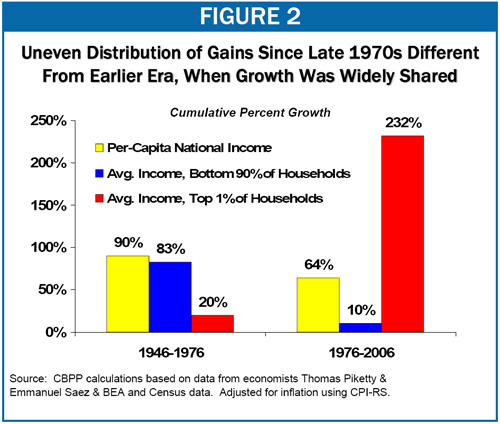
I point you to this study (from October of last year, but as new to me as a never before seen rerun of 30 Rock) from the Center on Budget and Policy Priorities, which shows how the proportion of national income accruing to the top 1% of households is as high as it has been since the Great Depression. I encourage you to read the entire study, or just look at the graphic below, which sort of says it all.

Income Inequality

Income Inequality

Slate on $100 Million Bonuses

Slate business writer Daniel Gross has another take on Andrew Hall’s bonus, about which I wrote last week. Gross notes that hedge funds primarily exist to make traders rich, and do little for non-employee shareholders. So he questions why Citigroup shareholders would want to retain Hall and his Phibro operation.