Monthly Archives: September 2010

Americans Want Income Equality

Despite all the rhetoric out there about free markets and entrepreneurship and meritocracy and winners getting just rewards, results from a new survey (done by a professor at Harvard Business School, the fountainhead of free enterprise) show that Americans actually want a more equal distribution of wealth. Moreover, it turns out that most Americans have no idea how unequally wealth is currently distributed.

I posted recently about Timothy Noah’s long piece on income inequality; now he summarizes the results of the aforementioned survey. The survey shows that Americans generally think that the richest 20% of us own 60% of the wealth. In reality, the richest 20% own 85%. The survey also reveals that when shown graphs illustrating America’s income distribution, Sweden’s income distribution and an equal distribution, most American’s chose the Swedish graph. The equal graph was second, and the actual American graph came last.

Or, look at this graph from the survey (hat tip to Baseline Scenario for pulling the graph from the original pdf):

American's ideal wealth distribution

Americans very clearly want a more equal distribution of wealth than they have now. They aren’t agitating for it because A) they have no idea how unequal things really are; and B) there is an aspirational optimism in Americans whereby they always think that they will end up at the top.  But the next time some Tea Partier or Fox pundit starts talking about how Americans love the current system and are totally OK with hedge fund managers making $1 billion per year, remember this graph.

Has Silicon Valley Stopped Solving Problems?

That is the claim of Dan Lyons in the recent Newsweek, wherein he claims that the trend of consumer internet companies (Facebook, Twitter, Zynga, etc.) making gobs of money by doing essentially shallow things will draw engineers and entrepreneurs away from solving the hard problems that have traditionally driven Silicon Valley.

Erick Schonfeld at TechCrunch disagrees, saying that Facebook and its ilk aren’t shallow and are also technically hard, since they have to scale to support so many users.  Most of Schonfeld’s article is, quite frankly, dumb (I mean seriously, using anti-virus software, which solves a real and burdensome problem, to show that internet companies are useful too, is nuts. And saying that Twitter’s many-to-many communication is a bigger tech achievement than the telephone network…dude, do you even know anything about technology?), but I appreciate his viewpoint and that of the many comments his article generated (as usual with comments, they are split between wisdom and inanity).

It won’t surprise regular readers of Thoughtbasket to learn that I come down somewhere between these two poles. I wrote a post on this very topic recently, riffing off a former Gartner analyst who said pretty much exactly what Gross said. Yes, Facebook makes people happy, and some of the technology required to build it to scale might help build other products. But it’s basically a toy, and the technology isn’t that innovative. More importantly, it sure isn’t curing cancer or solving the energy problem.

It’s OK for fun products to do well; Facebook and Zynga make tons of money because people love using them. But Lyons makes a good point: the wealth and attention being lavished on these fun products could lead smart people to build ever-shallower products (hello Foursquare) instead of solving big and important problems. Silicon Valley is a big place, and there seem to be a lot of entrepreneurs attacking all sorts of problems, but the tendency of the press (particularly TechCrunch) to focus on consumer internet companies as if they were the only things of note in Silicon Valley adds to the problem Lyons describes.

Income Inequality; Rise of Wacky Politicians

Here are links to two long and thoughtful articles worth reading.

The first is Timothy Noah’s ten-part (yes, 10!) piece in Slate on income inequality in America. He explores all the possible causes, in a non-ideological way, and then discusses why it all matters. Among the factors at play: taxes, overseas manufacturing, lobbyists and Wall Street. Check out this graph below to see how the share of the top 10% has grown over the last 40 years.

The second article is Matt Bai’s piece in the NY Times about Linda McMahon’s campaign for senator of  Connecticut. Bai explores how a staid, preppy state like Connecticut could possibly elect a cartoonish figure like McMahon, who based on her public statements seems utterly unqualified to be senator. He discusses the long-term trends, including white flight and the loss of industry, which lead to young adults leaving the state and public sector unions gaining power, which leads to a weakening of the traditional political system, which leads to wrestling impresarios running for senate. It’s a long article, but nuanced and thoughtful and well worth reading.

Why Football Trumps Soccer

In a recent post on why Americans don’t like soccer, I alluded to an overarching theory of sports which would provide a broader explanation. That theory is called the Hierarchy of Sports, and was originally promulgated by my college roommate Otis Hammer. The theory is really quite simple: the best athletes gravitate toward the sports that provide the most rewards. Different athletes may value different rewards, of course, but they will all play the sport that generates the most of their favored reward.

In high school, for example, where most athletes decide what sport to focus on, the reward is unlikely to be monetary. The potential for future money in a pro career may have some influence, but for the average 15 year old, the most powerful rewards are more immediate: the adulation of peers. In short, getting laid. What about the joy of playing, you ask, or the fun of teamwork? Yes, sure, those are great, but for most teens those ephemeral rewards pale beside the opportunity to have sex with one of your school’s hotties. If you are the top athlete in your high school, you will play the sport(s) with maximal potential for sex.

At most American high schools, this means football, basketball and baseball. Which, not coincidentally, are the big pro sports in this country. Here is a table from the US Census listing the most popular high school sports. Football, then basketball, then track, then baseball. Of course there are regional and economic variations. Lacrosse or tennis could be the big sports at some schools (Exeter) or swimming at others (Southern California). In some areas, football might trump everything else (Friday Night Lights and all). But generally speaking, if you are a good enough athlete to choose your sport, you’ll choose the one that will help you get some action.

Think I’m crazy? Don’t take my word for it. Listen to Zoltan Mesko, placekicker for the New England Patriots, who came to the US from Romania when he was ten. From a Wall Street Journal article: “A couple years later in high school, Mr. Mesko had to decide between playing soccer, which only parents watched, or football, which everyone watched, including cheerleaders. “No brainer,” Mr. Mesko says.”

The implication of this theory is that sports in the upper reaches of the hierarchy tend to attract better athletes. A great athlete will focus on high-reward sports rather than low-reward ones. Which again means, in much of America, the big three: football, basketball and baseball. Generally speaking, players in the big three are going to be better athletes than players in lower sports. If the guy on the high school tennis team had been a good enough athlete to join the basketball team, he would have, because it would have improved his social standing. Of course, international athletes have a totally different hierarchy, so comparing Roger Federer to LeBron James isn’t relevant.

But in America, the Hierarchy of Sports explains why pro athletes in the big three tend to be so good at other sports. For example, pro basketball player John Lucas was an All-American in tennis at University of Maryland, and even played a few pro matches. Or, going back a little further in time, pro football Hall of Famer James Brown was All-American in lacrosse at Syracuse.

Before you go all counterexample on me, of course this is a generalization. As noted above, how sports rank in the hierarchy can vary, and people can vary too. Maybe some great athletes loved tennis so much that they kept playing it even if playing basketball would have gotten them more action. And maybe the best looking girl in your high school dated the president of the chess club because she liked his brain. But this is a blog, so I get to generalize, and looking across the many data points of life I continue to claim that the hierarchy theory holds.

Virtual Companies Also Unfocused Companies?

One of the hot new trends in Silicon Valley is the “virtual” company: a firm where everyone works from home, only coming together for the occasional meeting at Starbucks. This can be a great thing, part of the lean startup trend. Obviously, saving money on rent and furniture and the like allows a company to get farther along before it needs to raise capital.

However there are also special challenges for virtual companies. I am consulting for two of them now, and I’m seeing some of these challenges first hand. These challenges primarily stem from the difficulty in communicating at a virtual company. With employees spread out, communication is usually via email or IM. These are mediums that tend to promote brief, sometimes inconsistent, communications.

Sometimes when “discussing” an issue with my clients there will be 15 or 20 emails, each only 1 or 2 lines long, with multiple people chiming in, often with their missives crossing each other, and thus not incorporating other thoughts and comments. It can be difficult in this environment to drive toward a conclusion, particularly if you want any kind of consensus. Ideas and concepts are more likely to fall through the cracks. Email can be super efficient, don’t get me wrong, but it can also make group communication less effective than it would be if everyone were together in same space.

A possible consequence of this sort of fragmented communication is that it makes solving difficult problems more difficult. A virtual company is likely to be better at solving problems a single person can tackle than at solving problems requiring cohesive group effort. Based on my consulting experiences, this is true whether the problem is technical or business oriented.

Technology can help mitigate these communications challenges. Skype and other services provide free conference calls, so you can at least communicate in real time. Web conferencing and virtual whiteboards can replicate meetings, and project management software can help ensure that everything gets done on schedule. But if the management of the virtual company isn’t aware of the communication difficulties and does nothing to address them, the company is likely to generate fragmented products or strategies.

Hal Holbrook and Meg Whitman: Twins?

If you have been watching Sons of Anarchy this season (which I recommend…it’s a solid and well-acted show. It’s no Wire or Mad Men, to be sure, but enjoyable nonetheless) then you know that Hal Holbrook has joined the cast playing the senile, or possibly even dementia-addled, father of one of the main characters. Of course, he is great in the show — I mean it’s Hal freaking Holdbrook — but what I find most interesting is how much he looks like Meg Whitman, the former eBay CEO and current candidate for governor of California.

Here is a picture of Holbrook from the show:

Hal Holbrook in Sons of Anarchy

And here is a picture of Whitman:

Meg Whitman

I mean, seriously, don’t they look similar?

Time for America to Dig In

I have mostly given up on Thomas Friedman at the NY Times, since he generally seems hopelessly out of touch.  But he recently published a column talking about how America’s fiscal difficulties will force us to retrench in our foreign policy. We won’t be able to afford to be the world’s policeman going forward.  Unless, of course, we bear down and make the tough decisions necessary to get our economy growing again. You know, entitlement reform, tax reform, etc. All the stuff our politicians seem unable to do. So let’s encourage them to start making the hard decisions that will enable America to keep kicking ass.

Alaska Loves Federal Money

Yesterday I posted about how Alaska politicians talk a big game about wanting the federal government to leave them alone, but in reality they suck down more federal money than any other state. Having just spent a week in Alaska, I brought some photographic evidence of our biggest state’s big appetite for taxpayer money.

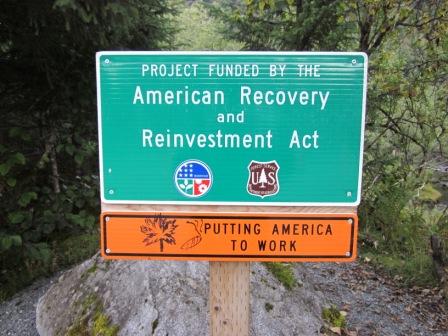
Here is the beginning of a beautifully built and maintained trail at the Mendenhall Glacier outside Juneau. You can see that construction of the trail, which must have employed several people to cut brush and grade the path, was paid for by the federal stimulus package. As for the big Bob Marley joint depicted on the sign….it’s unclear if federal dollars paid for that.

Trail paid for by US taxpayers

In Gustavus, a small town which is the gateway to Glacier Bay, a brand new $20 million dock is being built with federal stimulus dollars. I spoke with the owner of my hotel and with the pilot of my whale watching boat, and both said that the dock was completely unnecessary. But it was employing a whole bunch of skilled laborers, so many that they had to come in from Juneau, since Gustavus didn’t have that many construction workers.

The new dock at Gustavus

Here is a photo of all the pickups and SUVs owned by the people working on the dock. Again, these are local workers being paid with US taxpayer dollars.

Construction worker trucks

I have no problem with stimulus dollars paying people to build paths and docks; that is how a government stimulus package works. The government injects money into the system to boost employment and spending.  My problem is with a state that talks about how it doesn’t believe in the stimulus or in federal help at all while it continues to take as much federal money as it can.

Voters are Ill-informed; Politicians are Hypocrites

The NY Times recently ran an article about Alaska, which attracted my attention since I was planning a vacation to that giant state (in fact, I am drafting this entry on my flight to Anchorage). But this article wasn’t about fishing, or the awesome glaciers, or how to avoid being eaten by bears. No, this article was about the irony of Alaska being the home of such anti-government fervor (Sarah Palin’s small government views are pretty representative of her home state) while at the same time being the largest recipient of federal stimulus money.

For example, Alaska state representative Carl Gatto called to roll back the federal government’s “entire socialistic experiment in federal hegemony.” Yet he also celebrated that “for every $1 we give them in taxes for highways, they give us back $5.76.”  Jay Ramras, another state rep, embodied the dichotomy in a single quote: “If you want to feed us federal money like it’s a narcotic and make the state into a junkie of the U.S. Treasury, O.K.,” he allows. “But we would like to be an Emersonian Alaska and just get control of our resources.”

Of course, Alaska is not alone in this irony. There is a strong correlation between conservative states talking a big game about “government out of our business” while sucking aggressively at the federal teat. This map shows how red states take more than they give, and this chart shows traditionally republican states leading the way in receiving more federal dollars than they pay in taxes. And here is a brand new map from the NY Times based on census data.

So how do we explain this paradox? I suppose it could simply be the essential greed of humanity, people feeling that they are justified in taking as much as they can while giving as little as possible. Or it could be a canny political move, trying to drain the coffers of the government in order to force it to shrink, sort of a “starve the beast” movement at the grass roots level. But I don’t think either of those explanations fly. I think, instead, that the average voter doesn’t even make the connection between small government and services provided, between taxes paid and resources received. When voters say “don’t tax me” while taking a bridge paid by other citizen’s taxes, they don’t see the irony because they don’t even realize that taxes are what pay for bridges. See this piece by James Kwak on how the whole tax & service thing works, and this piece by David Sirota on how American voters seem to lack the ability to remember what policies worked or didn’t work in the past.

The politicians, on the other hand, who vote for these policies, like Carl Gatto and Jay Ramras from the NY Times article, or Ted Stevens, a major obtainer of federal dollars for the state, should actually understand how taxes and services are related. I mean, they are professional legislators, and this is a basic part of government budgeting. They are not ignorant, like the voters; they’re just hypocritical, saying and doing whatever they must to get reelected. They recognize the irony in calling for lower taxes while trumpeting the bacon they bring home from Washington…they just don’t care. They use that irony to cynically take advantage of the electorate’s lack of understanding, and it gets them elected year after year.

I just returned from a week in Alaska, where I saw this phenomenon in action multiple times. There will be follow-on posts on this topic.