Tag Archives: economics

Fed Lends Millions to Well-Connected Wives

This story is by Matt Taibbi, so you should expect some hyperbole, but the basic facts are that two well-connected Wall Street wives, with no financial experience, managed to get $220 million in low interest loans from the Fed. They then invested the money in higher yielding securities, essentially minting money on the spread. And they still haven’t paid back $150 million of their loan.

Does Morality Vary By Culture?

Those of us who have grown up in a single culture (ie. almost all of us) often forget that our worldview is culturally mediated, and that people from a different culture might see things entirely differently. Not that we should be required to understand, or try to incorporate, other worldviews, but it can often be instructive to see how other cultures view things. For example, I recently read an interesting article about how morality operates in the Confucian worldview.

According to this article (and I should stipulate here that I am taking the article on face value, since it was written by an expert on the subject and published in a serious journal. I know virtually nothing about Confucianism, except what my fortune cookie tells me), in a Confucian world you cannot separate personal ethics from societal structure. The set of principles that structures society and guides the ruling classes “are mandated by Heaven, an abstract source of both natural order and human norms.” So too are personal ethics; they are part of the same system: “Heaven’s pattern for human affairs is what in fact works best, as a matter of natural logic.”

This has implications for how people should live, particularly those people who are in the power elite. The elites are held to a higher standard, because if they don’t follow Heaven’s pattern they “will inevitably undermine the basic solidarity and sense of fairness that every social order needs.” Leaders have a responsibility, to Heaven and to society, to follow the rules. If they “put their own private interests above the common interest, then they have lost their legitimacy.” Although this comes from a distinctly Eastern worldview, it is not that different than the very Western concept of noblesse oblige, or from the maxim of Spiderman’s Uncle Ben: “With great power comes great responsibility.”

However, it’s also a significant distance from the dominant Western worldview, which is one of free enterprise, in which individuals pursuing their own self-interest will be guided by Adam Smith’s mighty hand into patterns that will benefit society. In our system, there is no duty to maintain the social order and the ruling elites aren’t expected to have higher moral standards than anyone else. In the Western view, the system takes care of all that.

I’m not saying that this Confucian system is any better than ours; merely different. But it’s certainly interesting the way the worldview plays out in how individual are supposed to behave. Of course, given the willingness of Chinese executives to put poison into milk just to make an extra yuan or two, it’s not clear that the Confucian system really works.

Joe Stiglitz on Income Inequality

He’s a Nobel Prize winner, so he must be smart.

Read his article here.

Links to Great Articles

Yves Smith on the macro effects of oversized Wall Street pay.

I normally don’t love Paul Krugman, despite his Nobel Prize, since he is too strident and preachy and predictable, but this take on what really separates Right from Left in America is pretty interesting.

John Mearsheimer on American foreign policy and realpolitik.

John Cassidy on whether Wall Street adds value to society. Hint: it doesn’t. This is from the New Yorker, so it won’t be available online forever.

Law professor David Beatty compares American constitutional jurisprudence to how they do it in other countries. I’m no expert, but I found it fascinating.

On Airlines, Hospitals, Blizzards and Flu Outbreaks

Here is a really interesting article comparing the airline industry to the public health system, with full service hospitals being the legacy carriers, serving everyone and subsidizing low fare services with high fare ones. Specialty hospitals are the upstart airlines, able to focus on only providing profitable services. And as they all cut capacity to remain profitable, what happens when crisis hits? We just saw what happens to airlines when a blizzard strikes; so what happens to hospitals when a pandemic hits?

Free Trade Works, But Can Cause Real Pain

I understand and appreciate free trade. I was an economics major at a college with a pretty conservative econ department (our professors regularly write op-eds in the Wall Street Journal), so I was well inculcated in the ways of Ricardo. Comparative advantage works: each country exports what it’s good at and everyone comes out ahead.

The developing world’s comparative advantage is generally cheap labor. That’s why China exports clothing and furniture. America’s comparative advantage is innovation and creativity. That’s why we export Avatar. Unfortunately, we also export Charlie’s Angels 2, but that’s a different issue. This theory also explains why the US invents iPods and China makes them.

The theory postulates that in the long run, as the developing world does more and more labor, the developed world will move into higher value services and creativity and all will be good. Everybody’s standard of living continues to go up. In the short term, however, dislocations can occur. Think of the television factory in Pennsylvania that shuts down, laying off a thousand workers, because the corporate parent can make things cheaper in China. Under free trade theory, those workers will shift into jobs that leverage America’s comparative advantage: something creative or innovative, something involving technology.

But in the short run, how do they do that? They live in the middle of Pennsylvania, likely with just a high school education. They can’t design iPods or program social networking sites. They can’t all move to Hollywood and become gaffers. For classic blue collar factory workers, their comparative advantage IS their labor. That advantage is now gone, taken by the developing world. So for free trade to work for everyone (at the micro level that is; we know it works at the macro level), we need to figure out ways to smooth those short term dislocations. Education and training for dislocated workers is the most obvious path, but I’m sure there are others.

Interesting Thoughts on the Federal Deficit

From the smart folks at the Roosevelt Institute, including Nobel prize winner Joe Stiglitz.

Summary: 1) there are smart and there are less smart ways to reduce the deficit; and 2) it’s not clear that the deficit is as terrible as some are making it out to be.

Red States Living on Federal Money

Here is a new article with data showing a direct correlation between how GOP leaning a state is and how much federal money it sucks down. This follows up on my posts on this very topic.

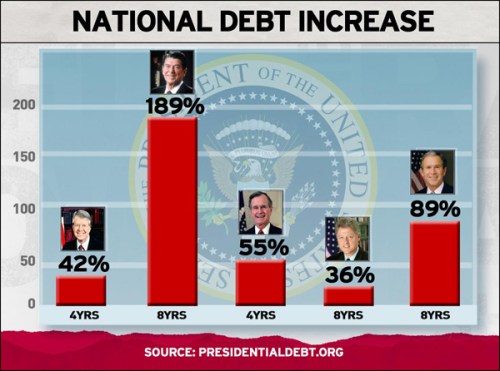
Increase in National Debt by President

Increase in national debt...by president

Humans Might Actually Like Taxes

The Wall Street Journal recently ran an article by Jonah Lehrer asking whether humans might not be as averse to paying taxes as our political discussion currently assumes. He describes a study by scientists at Caltech which showed that people dislike inequality. Study participants were put into scanners, and the pleasure areas of their brains lit up more when money was given to others than when money was given to them. This was especially true of those who had started the study “rich,” which was determined by random assignment. Following this study to its logical conclusion, perhaps people who are well off might not be as unhappy as politicians seem to think about paying higher taxes to help the less fortunate.

However, Lehrer points out that the random assignment of riches skews the study. Other studies have shown that this altruism effect is less powerful when the rich feel that their wealth is earned. When we bring this back to politics and tax rates it opens a whole can of worms. What is “earned” in a society where massive advantages (not just wealth) are passed down through the generations? I won’t open that can of worms here, but point you to this post from last year on some of the challenges of “earning” wealth for the lower classes.