Multinational Corporations and the American Commons

Harvard Business School recently launched what it’s calling the US Competitiveness Project, which is “a research-led effort to understand and improve the competitiveness of the United States.” To publicize this effort, Harvard Magazine just published a series of interviews with some of the professors involved. I don’t normally like reading interviews, because they tend to have a ridiculously high length to content ratio, but these were quite dense in content, and I recommend the whole set of interviews as important reading for anyone interested in the state of US business or multinational corporations operate.

The interviews ran to almost 20 magazine pages, so I won’t even try to summarize them. But I will note a recurring theme, which was about American companies investing in America. The professors called this America’s “business commons,” which they defined as “a skilled workforce, an educated populace, vibrant local suppliers, basic rule of law, and so on.” They pointed out that “historically, American businesses invested in these resources deeply, and that helped to build many of America’s strengths.”

Copyright 2012 Thoughtbasket

Interestingly, the professors went back and forth between reasons to support America’s business commons, from what I call “hard” reasons (those that drive profitability) to “soft” reasons (patriotic calls to support America).

Hard reasons included:

  • Outsourcing calculations often overestimate cost savings
  • Local manufacturing can drive product and process improvements
  • For most multinationals, the US still makes up the majority of their business

Soft reasons were more vague, with a desire of “many in the business community to roll up their sleeves and do things in their communities” being a typical statement. Michael Porter (a giant in the strategy and competition fields) and Jan Rivkin define US competitiveness as including “raising the living standards of the average American.”

This all raises an interesting dilemma. If the role of corporate executives is to maximize returns to shareholders (this is how most US managers operate, although there is in fact disagreement regarding shareholder v. stakeholder approaches: read relevant articles here, here, here and here) then they shouldn’t care whether they build America’s business commons or China’s business commons or any other business commons, except to the extent that any given commons supports their business. In other words, if Jeff Immelt at GE thinks that investing in China’s educational system will generate higher returns than investing in America’s, that is what he should do.

However, I suspect that most executives at big US companies would feel uncomfortable with that. Since most of them were born in the US, raised in the US, and live in the US, there is probably some part of them that feels a loyalty to the US, that wants to build America’s commons even if building China’s commons has a higher ROI. How do these CEOs reconcile their duties to shareholders with their inherent patriotism? I don’t know. The professors in the US Competitiveness Project would suggest that the disconnect is not as great as many think; that building the US commons DOES have a high ROI. But based on my reading, it sounds like they would also give executives permission to foreground their patriotism over pure shareholder analysis, at least on borderline cases.

In addition to Michael Porter and Jan Rivkin, other professors interviewed included Willy Shih, Rossbeth Kanter and Thomas Kochan (who actually teaches at MIT, not Harvard).
Aside

First of all, how come nobody told me that Richard Posner and Gary Becker had their own blog?

I have never referenced Becker in this blog, but he is a big hitter economist of the Chicago school. But I have referenced Richard Posner, judge and professor, and even though I have disagreed with him, I remain in awe of his erudition and productivity. See my entries on Posner here, here and here.

Here is a typically rational take on the role of luck in wealth creation by Professor Posner. Enjoy.

Luck Drives Pop Music AND Wealth?

Yesterday’s Baseline Scenario (one of my favorite blogs) had an entry describing an academic paper which modeled how income gets distributed in a society and why income inequality is so strong in some economies. Based on the abstract of the paper, and on Baseline’s summary of the rest of the paper (yes, I am admitting that I did not read the whole paper), the model shows that a set of homogenous homes will diverge in wealth, with wealth accumulating over time in fewer and fewer households, based purely on exposure to “idiosyncratic investments” which have higher returns. And in this model, exposure to these investments is random: based on luck.

Clearly this paper is not the be all and end all of explanations. Equally clearly, the assumption of homogeneity does not match reality. What I want to point out here is the connection to Duncan Watt‘s work on the development of hit pop songs, which he shows is also based on luck. Please see my posts here and here regarding Watts.

It’s interesting that two different approaches to modeling two different things come to such similar conclusions: the distribution of success is essentially driven by luck, not skill. Again, these are models, not complete explanations. I, for one, would certainly like to think that my skill will lead to success. However, judging by my reader counts, that may not be the case. Regardless, I think it’s important for us all to remember the role that luck plays in much of what we do.

Matt Taibbi on Romney and Private Equity

Matt Taibbi has a new piece in Rolling Stone about Mitt Romney’s time at Bain Capital, and how Bain used large amounts of debt to execute its buyouts. The overall theme is one of financial engineering vs. making things, of pillaging companies to generate wealth vs. building companies to create jobs.

Like most things Taibbi writes, this article is:

  1. Very funny
  2. Savagely mean
  3. Only about 75% accurate, and you need to know a lot about Wall Street to know which quarter is wrong

However, in light of my prior post on private equity, there are two paragraphs that I wanted to quote because they are both amusing and apt.

Talking about the private equity model of loading up a company with debt and then paying fees and dividends to the buyout firm, Taibbi says:

This business model wasn’t really “helping,” of course – and it wasn’t new. Fans of mob movies will recognize what’s known as the “bust-out,” in which a gangster takes over a restaurant or sporting goods store and then monetizes his investment by running up giant debts on the company’s credit line. (Think Paulie buying all those cases of Cutty Sark in Goodfellas.) When the note comes due, the mobster simply torches the restaurant and collects the insurance money. Reduced to their most basic level, the leveraged buyouts engineered by Romney followed exactly the same business model. “It’s the bust-out,” one Wall Street trader says with a laugh. “That’s all it is.”

And then, comparing Romney’s speeches decrying America’s level of debt with his Bain Capital strategy of loading up companies with debt, Taibbi writes:

To recap: Romney, who has compared the devilish federal debt to a “nightmare” home mortgage that is “adjustable, no-money down and assigned to our children,” took over Ampad with essentially no money down, saddled the firm with a nightmare debt and assigned the crushing interest payments not to Bain but to the children of Ampad’s workers, who would be left holding the note long after Romney fled the scene. The mortgage analogy is so obvious, in fact, that even Romney himself has made it. He once described Bain’s debt-fueled strategy as “using the equivalent of a mortgage to leverage up our investment.”

I like that one because it makes the connection between private equity and mortgages, as I did in my post.

Again, I’m not fully supporting Taibbi’s reporting or his conclusions, but he makes some good points.

Viral Growth & User Base Do Not a Business Make

Everybody in business wants to “go viral.” If you create a funny YouTube video, or tweet cleverly, or create a web service that people invite their friends to join, then you will spread like a flu pandemic, generating massive growth in users without massive marketing expenditures. Whether you are Old Spice or Dollar Shave Club or Instagram, growth without marketing expense is a good thing. And I agree: it IS a good thing. Going viral is awesome for a business, of course. Achieving growth without buying it is clearly good.

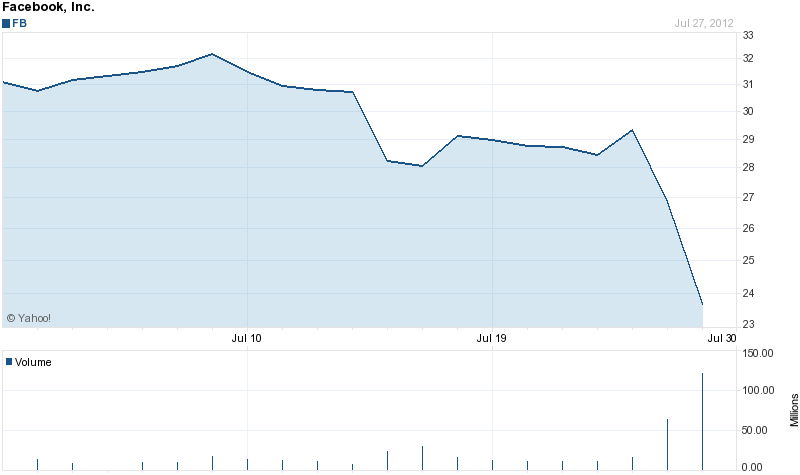
But companies are also learning that growth itself is not enough. A user base is not a business. If you can’t make money off those users – both revenue and profits – then all your viral growth is kind of a waste. We saw this last week with Facebook, which has had huge viral growth over its lifetime, and now has a billion users, but is having problems turning those users into money, leading to a stock chart that looks like this:


Ouch!

Or take the Dollar Shave Club. Their video is definitely hilarious and it went viral, which allowed them to sign up lots of users. But if their razor isn’t good enough to keep customers ordering more, or if they can’t sell the razor for more than it costs to make, no amount of viral growth will help them be a successful business. I haven’t heard anything about their razor quality, or their margins; they could totally succeed, and I hope they do. My point is that a clever viral video is only a means to an end. The end is a profitable business.

In the social bubble we have seen this year, people have been losing sight of what really matters in business: profits. User growth and virality are to 2012 what eyeballs were to 1999. Having lots of users is good, and your user base is an important metric to track, but at the end of the day, you need to make money. Not making money is what pops bubbles.

Private Equity Parallels the Mortgage Business

I’ve been trying to ignore all the discussion in the presidential campaign about Bain Capital and leveraged buyouts and private equity, but pull is too strong and I can no longer resist. Must….write…blog…entry.

First off, let me say that buyouts* are neither inherently good nor bad. People who are completely bashing buyouts as inevitably bad, as rapacious tools for the 1%, are simply wrong. People who are utterly defending buyouts as inevitably good, as the perfect form of free market capitalism, are also wrong. I mean, duh. Nothing as complicated as a buyout is going to just be good or just be bad.

Good: having a buyer focus a complacent or bloated company on its core products is often very productive. Bad: having a buyer stop investing in R&D and shut down pensions while continuing to pay itself fees and dividends is often very troubling.**

Rather than delve more into the good or the bad, I do want to point out one thing that isn’t often mentioned: how similar the buyout business is to the mortgage business as practiced on Wall Street. Both businesses are leveraged gambles with the government picking up at least some of the tab if you lose. We all know how Wall Street borrowed massively to bet on mortgage-backed securities. And they made jillions, paying out huge bonuses, until it went wrong, and the government bailed all of Wall Street out. Heads they win, tails we lose.

Buyout barons have a similar deal. Not quite as good, but similar. They borrow heavily to amplify the returns on their deals. If it goes well, they make tons; that is why Mitt Romney is so rich. But if it goes poorly, the Bains and KKRs of the world get to walk away, using the government bankruptcy code, and leaving the workers’ pension plan in the hands of the Pension Benefit Guaranty Program, a government agency. I don’t want to overstate the case: sometimes private equity firms lose money on bad deals. They don’t fully socialize their losses. But their losses are limited to that deal; the structure is such that they can walk away from bad deals.

In the meantime, they are borrowing against the assets of the company and paying themselves dividends with the money. You might say “they can’t be applying too much leverage, or banks wouldn’t lend them the money.” Sure, just like banks would never give mortgages to pool cleaners who made $25,000 per year. Oh wait, they did, repeatedly. To quote Mike Konczal, who is quoting Josh Mason, “It was a common trope in accounts of the housing bubble that greedy or shortsighted homeowners were extracting equity from their houses with second mortgages or cash-out refinancings to pay for extra consumption. What nobody mentioned was that the rentier class had been doing this longer, and on a much larger scale, to the country’s productive enterprises.”

Finally, I should also note that buyouts are structured as giant tax dodges. Again, this is not inherently bad; we expect companies and investors to legally minimize their taxes. But the fact is that a big part of the value of buyouts is their tax efficiency. That is why buyout firms continually sell companies to each other in a round robin of tax avoidance; they aren’t all adding “operational value.” There is only so much a bunch of ex-investment bankers can do to change the operations of a company, but each time a company is sold there is a new set of tax avoidance strategies.

How does this work? First of all, because interest payments are tax deductible, the leverage applied in a buyout is essentially subsidized. Much like homeowners are encouraged to take out larger home loans by the tax deductibility of mortgage interest, buyout firms are encouraged to leverage up as much as possible. This enables the company’s operating income be used on debt payments, amplifying returns, rather than going into taxable income. In addition, at the time of acquisitions, assets of the company can be written up to fair market value and then depreciated, with the non-cash depreciation expense also tax-deductible. That step-up in asset value at acquisition is precisely why buyout firms keep flipping companies to each other. In a perfect deal, the post-acquisition company will have taxable income below zero, but positive cash flow. In other words, regardless of whatever operational improvements a buyout firm might implement, a huge part of the value that accrues to that buyout firm is due to financial engineering, specifically financial structuring to avoid taxes.

* I will use the term “buyouts” here, which are usually leveraged but don’t need to be. Since “private equity” also refers to venture capital, I will avoid using that term.

** From a recent Vanity Fair article:
“According to Kosman, “Bain and Goldman—after putting down only $85 million … made out like bandits—a $280 million profit.” Dade’s debt rose to more than $870 million. Romney had left operational management of Bain that year, though his disclosures show that he owned 16.5 percent of the Bain partnership responsible for the Dade investment until at least 2001.
Quite soon, however, a fragile Dade faced adverse conditions in the currency markets, and it had to start in effect cannibalizing itself, cutting into the core of its business. It filed for bankruptcy in August 2002 and Bain Capital departed. When Dade emerged from bankruptcy, its new owners invested in long-term R&D, and it flourished again.”

Move Fast And Break Things. Like Your Customers’ Hearts?

Move Fast And Break Things is Facebook’s unofficial (or maybe official) motto. It’s part of the hacker ethos, and I get it. You need to try to new things, not follow established patterns, if you want to create really innovative products. “You would never build something great doing it the same way others have done it,” said Mark Zuckerberg.

Except, what if you move so fast that you break essential things? Facebook’s replacement of user emails with Facebook email address was not only a typical Facebook PR disaster, but it turns out that there was a bug so that some smartphone users had emails replaced not just in Facebook, but in their contacts too. So that they were sending emails to people’s Facebook addresses without knowing it. Facebook addresses that recipients don’t check. It was a complete clusterfuck, and users are rightly pissed. How many users ripped their Facebook app right out of their smartphone after that? And how many other users who were thinking about installing the app decided not to?

“Breaking things” is great unless your customers actually rely on those things. Then you are just breaking your bond of trust with your customers. And you never get that back.

Image

Education Trumps Entrepreneurship

There is a growing trend among universities to devote resources to studying entrepreneurship. This trend is primarily focused in the business and engineering departments, but it is spreading inexorably across campus. It seems as if everyone wants to create a new class of entrepreneurs. This impulse is understandable; after all, if you are the university that graduates the founders of the next Google, there are big donations in your future.

But this focus on entrepreneurship doesn’t come without costs. Universities generally don’t have limitless budgets, so if increased resources are flowing to entrepreneurship studies, that means resources aren’t flowing into other departments. At my alma mater, Stanford University (see below), our alumni magazine seems to be constantly writing about new initiatives to train entrepreneurs, but it almost never talks about a new program in English or history. I think that universities’ movement toward entrepreneurship has gone too far.

Not that entrepreneurship is a bad thing. If people want to start companies, that’s great. I’m happy that companies like Google exist. And Amgen, and Hewlett-Packard, and even General Electric, all of which were started by entrepreneurs. But notice that none of those companies were started by people who had studied entrepreneurship. In fact, they were all started before this trend in teaching entrepreneurship had even begun. It’s not as if this country had a serious lack of entrepreneurs before universities started training them.

But more important to me is the fact that there is more to a university education than just training for a future job, whether as an entrepreneur or engineer or ethicist. College is also about producing well rounded people, who can analyze life in a variety of ways, who are prepared to be good citizens of their country. And I’m not the only one who thinks that way. Thomas Jefferson founded UVA with the goal of “elevating the views of our citizens generally to the practice of the social duties and the functions of self-government.” John Adams thought that education was so important that he put it in the Massachusetts constitution:

Wisdom, and knowledge, as well as virtue, diffused generally among the body of the people, being necessary for the preservation of their rights and liberties; and as these depend on spreading the opportunities and advantages of education in the various parts of the country.

If people want to start companies, they will certainly do so. They always have. So let’s not waste their four years of college making them “better entrepreneurs,” as if we even know what that is. Let’s just make them smart, well-educated people, and the entrepreneurship will inevitably follow.

The University Isn’t Going Anywhere

Image

There is a lot of talk going around about how universities are broken, and Silicon Valley is going to put the Ivy League out of business. Certainly change is afoot, and continued tuition hikes at twice the rate of inflation are ridiculous. Online universities like Udemy and the Miverva Project are interesting, and may even succeed, depending on whether success is measured in teaching students or in making tons of money. But if success is measured in pushing the existing elite universities out of their current position, don’t hold your breath.

Kevin Carey wrote a piece in The New Republic saying how the roster of leading companies has completely changed over the last century but the roster of leading universities has not. American Cotton Oil is gone, but Harvard remains. Carey states that this is unsustainable; education should be as prone to disruption as business.

But there is a deep flaw in Carey’s analogy. Companies go out of business mostly because people no longer want their products. When was the last time you bought cottonseed oil, or film for your camera? But people still want what universities are offering, especially elite universities. Is education still valuable? Yes. Is a Harvard degree still valuable? Yes. I don’t want any cottonseed oil, but I sure want my kids to get a Harvard education and diploma. And as long as the desire for education and prestige remains (ie. as long as human nature still rules), the elite universities will remain so.

The Fakery of Paul Ryan

Like most (all?) Washington politicians, Paul Ryan is a liar and a hypocrite. Read about it here. Skip to page 6 for the ultimate example of Ryan’s nearly pathological fakery.