How Are Bribes Different Than Lobbying?

Reading stories about this year’s massive New Jersey corruption scandal, I almost have to laugh at the ridiculousness of it. The perp walk into the rented bus, the mayor only three weeks into his term, the cereal box (Apple Jacks!) stuffed with cash – the images are straight out of TV. But it brings up an important question: how do we draw the line between bribes and lobbying? When you hand a mayor $5,000 in cash in hopes of getting a building permit approved, you both go to jail. But when Goldman Sachs hands $3M in campaign contributions to congressmen in hopes of getting regulations eased, it’s totally legal. Does that seem right?

Simon Johnson and John Talbott recently published three articles (which I cannot recommend highly enough) in Salon describing the role of corporate lobbying and deregulation in the financial crisis. In their view, this sort of lobbying IS criminal. And when you look at the facts, it’s hard to disagree with them.

Here are some of those facts. In August 2008, as the financial crisis heated up, Goldman hired a famous lobbyist to come in house and focus on regulation. In January 2009, Goldman was one of several firms receiving bailout money that continued to lobby in Washington DC. And how much did they lobby? The chart below (from opensecrets.org) details their official lobbying over the last decade. ABC News reported that since 1989 Goldman and its executives have given $43 million in campaign contributions.

Goldman Sachs annual lobbying expenditures

Goldman Sachs annual lobbying expenditures

Or let’s look at earmarks. A defense spending bill that passed in the House this week contained more than 1,100 earmarks totaling $2.7 billion in spending. The 18 members of the subcommittee that wrote the bill included 148 earmarks totaling $461 million for entities whose employees have given $822,765 in campaign contributions to those congressmen since 2007. John Murtha, the notoriously corrupt earmark slut from Pennsylvania, chaired the subcommittee and wrote $77 million in earmarks. Defense contractor Argon ST and its employees donated $46,600 to Murtha since 2007, and it got an earmark providing $8 million to improve its torpedo-decoy technology. Special thanks to the Wall Street Journal for all of the info above.

So again, let’s make the comparison: a building inspector in New Jersey takes $30,000 to make sure a real estate developer’s projects move forward, and he goes to jail. A congressman takes $46,000 make sure a company gets an $8 million contract and it’s perfectly legal. And we wonder why the federal government is so screwed up.
iPhone Bad For the Psyche?

I recently saw a magazine ad for the iPhone. This ad was promoting the app store, and was specifically pushing small business apps. “Helping you run your small business, one app at a time” was the headline of the ad. This post isn’t about the iPhone per se, although my friends know how I mock their Apple toys, and how I compare the iPhone to the Range Rover: overpriced, unreliable, and purchased primarily for brand status. Hmmm, maybe I should compare it to a Gucci purse instead….

Anyway, the point is not the iPhone; the point is some of these ridiculous apps. I call them ridiculous because they do things that nobody needs to do while mobile. Let me list a few here:

  • Nomia: Get help picking a business name, finding available domain names and running trademark searches.
  • Analytics: See how your website is doing with reports showing visitors, page views, etc.
  • Credit Card Terminal: Accept customer credit card payments right on your phone.

Here’s the thing: I do run a small business, and I have never had the urge to do any of those things while mobile. When I’m analyzing my website or processing orders, I’m doing it at my computer, so that I can make adjustments or run things through my accounting software. I can certainly imagine circumstances where one might want to do such things while on the run, but those circumstances are rare.

Some might say: why be tethered to your computer? But I retort: why be connected all the time? Do you really want to check your website performance while at the beach? I relish the chance to disconnect. As more and more Americans are complaining about lack of time to think, or play, or spend with their kids, do we really need to be online more? Instead of apps that let you look at your website stats while on the bus, maybe Apple should promote apps that remind you to read to your children.

Don’t Screw Up Healthcare to Make Political Points

The health care reform effort in Congress is hitting some snags, and reports are discussing how the republicans see this as a make or break moment for the Obama administration. The republicans want to stop reform to make Obama look bad and weaken his chances to implement other parts of his agenda. Jim DeMint (R-SC) called it a “Waterloo moment” for the president.

This is why people hate politicians. Because instead of focusing on policy and helping their country and their constituents, they play douche bag political games like this is some sort of high school mock senate instead of the real thing.

If politicians don’t like the health care reform bills being presented, that’s fine. They are challenging bills, and concerns about their cost or about growing government bureaucracy or any number of other issues are legitimate. Hell, if you think that the free market should rule and people should be on their own for health care, that’s a legitimate, although heartless, view.

Virtually everyone – including republicans – agrees that health care reform is needed. The disastrous state of the American health care system is well known. So to fight health care reform bill – not fight to improve it, but fight against it passing at all – just to score political points, well that sucks. As happens so often here at Thoughtbasket, I must ask our representatives to stop dicking around and do the right thing.

Judges Are People, Not Robots

During last week’s confirmation hearings for Sonia Sotomayor, there were repeated calls from all concerned to show fidelity to the law, to call balls and strikes, to keep personal opinions out of judicial decision making. These statements were emblematic of the modern rules of confirmation hearings, in which any admittance of the role of personal interpretation will automatically raise the hackles of the other side, whether it’s John Roberts admitting “yes, I generally side with the powerful” or Sotomayor saying “as an underdog, I understand where underdogs come from.” Instead, everyone maintains the fiction that it’s all about facts and laws.

Of course, being a judge is very much about ruling on how the facts of a case fit the law as written. But sometimes the facts don’t exactly fit the law, and so the judge has to make some….wait for it….judgments. If it was all automatic, just applying the facts and law, then we could have machines do it, or bureaucrats. Even the Wall Street Journal recently noted that “judges are not algorithms.” If this judging gig was just calling balls and strikes, then the Supreme Court and courts of appeal and every other multi-judge panel would never have split decisions; everyone would simply agree on the facts and the law.

But we do have split decisions, because the facts are sometimes complicated and messy, and how a judge thinks can influence how they sort through the mess. Rather than pretending this doesn’t happen, wouldn’t we be better off addressing it and actually understanding how a nominee might rule? Maybe not. That might inflame senators’ passions so much that nobody could ever be approved. But it seems crazy to have a system where everyone is lying, we all know they’re lying, and the lies are essential to making the system work.

By the way, I’m not just talking out of my butt here. The friendly staff at the U.S. District Court listened to my diatribe and gently corrected me where appropriate.

Mortgage Broker Slimeballs Stay Slimy

I don’t have a lot to add to this NY Times article about people who were subprime mortgage brokers and have now morphed into “mortgage modification” specialists, charging homeowners $1,000 to $4,000 to help renegotiate their mortgage, but then doing nothing except keeping the money. The FTC is slapping cease and desist orders on them, but it doesn’t seem to be stopping the problem. Are people really that greedy and awful?

Is Healthcare Rationing Inevitable?

Yesterday’s NY Times magazine preview had a thought-provoking article by Peter Singer on health care rationing. Singer clearly comes at this from an extreme position (this is a guy whose fame is due to weighing hypothetical lives against each other), but he raises some excellent points. I’m not sure where I come down on rationing, and how it might work, but it’s clear that spending $50,000 on new drugs that only extend life by a few months is not a sustainable system. As congress gets ready to debate the health care bills coming out of committee, we should all start thinking about how America pays for health care, and reading Singer’s article is a good place to start. You only really need to read the first half. In the second half he goes into his usual shtick about disabled people vs. fully abled and goes off point.

Carbon: The Ultimate Externality

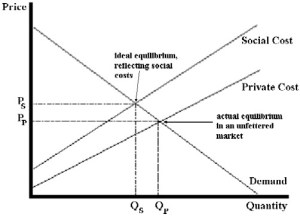
The House of Representatives just passed (barely!) the climate change bill, although analysts say that it will face a tough road in the Senate. This is the bill that includes a cap and trade system for carbon, or “cap and tax,” as the Republicans call it. Certainly the Republicans, and all the conservative bloggers, have attacked the bill, saying that it will increase the cost of energy and of many manufactured goods, and those increased costs will be passed on to consumers. And I agree; costs will go up, which is exactly the point. The cost of things that create carbon should go up. To explain this, I thought it might make sense to take a step back and discuss externalities.

In economics, “an externality…of an economic transaction is an impact on a party that is not directly involved in the transaction.” There can be positive and negative externalities, but the classic example is a negative one: pollution. If a plant manufacturing widgets spews its waste chemicals into a river, poisoning that river for 15 miles downstream, that is an externality. People downstream – fishermen, swimmers, kayak tour guides – suffer an impact from the widget manufacturing, but they have no economic say in that impact.

You might just say “whatevs,” as many have said over the years about pollution, but even the most ardent free market fan should recognize that externalities warp the market. As the supply-demand graph (a diagram dear to the heart of any good capitalist, and to me, since I was an econ major) below shows, an externality causes the market to produce too much of a good, at too low of a price, relative to the optimal solution if the externality is taken into account. This is not efficient, and economists hate inefficiency.

Negative_externality
Of course, as regular readers of Thoughtbasket know, I am not an ardent free market fan, so I would layer in an ethical cost as well. Why should the owners of the widget plan make money at the cost of the health of people living downriver? Who gives them the right to take the public good – the river – and ruin it?

Fortunately, both the economic and the ethical problem can be solved by actually monetizing the externality and including it in the business calculation. Polluting a common good should not be free. Assign an actual cost to polluting, and charge the factory owner that cost, and you will quickly see the plant move to producing the preferred social equilibrium quantity. Of course it is tremendously difficult to come up with the appropriate cost, but it’s difficult to go to the moon too, and we still managed that (unless you are a conspiracy theorist). Just because something is hard doesn’t mean we shouldn’t do it.

Unfortunately for factories, as science discovers more pollutants that are bad for us, there are more and more externalities that they have to take into account. Carbon and global warming are a perfect example. Carbon emissions didn’t reach the externality level – unlike, say, dioxin spewing into a lake – until science discovered that global warming was going to kill us all.

Hence, cap and trade legislation. Which is, in many ways, as the Republicans have pointed out, like a carbon tax. Either way, the point is to take what was a social cost – the spewing of carbon – and then monetize it and apply it to producers. What will happen as the costs of carbon go up? We will use less of it. Factories will figure out how to make their widgets using less carbon. People will turn their air conditioners down. Whatevs. Make carbon expensive and people will use less of it, moving production down to the appropriate social equilibrium. That’s what the economists would want, and it’s certainly what our grandkids will want.

Food and Politics

I was listening to Micahel Pollan on the radio last night (yes, on NPR; I was drinking chardonnay and eating sushi too) do his usual spiel on food, although this time it involved him promoting his new film “Food, Inc.” And although I know his viewpoint already — the American diet is unhealthy and politicians don’t care because they accept money from food corporations — this time I got  angry.

Maybe it was because this time Pollan told a story I hadn’t heard before: about how in 1977 Senator George McGovern led a committee that called for Americans to eat less red meat, until the meat industry threw a hissy fit and forced the committee to water its position down to “eat less saturated fat.” I just hate the fact that a single industry gets to throw money at politicians and thereby screw the American public.

Or possibly it’s because Pollan was speaking in the middle of the debate over health care reform. Politicians are feuding over the cost of health care and insurance, but they continue to throw subsidy money at the corn farmers and beef ranchers whose products are what make our diet so unhealthy. Hell, even the Wall Street Journal ran a column yesterday in which a doctor said that preventing obesity would save enough money to cover everything and everyone else.

So politicians, I ask you, again, please try to do what is right for the American people, and stop doing what some lobbyist pays you $2,000 to do.

Austin, TX Sticks it to Wall Street

The Wall Street Journal ran a great article on Thursday about how a small investment firm in Austin made a clever trade at the expense of some of the biggest Wall Street firms. Amherst Holdings wrote credit default swaps on a specific pool of mortgages, which had $29 million in loans outstanding out of an original pool of $335 million. Because these remaining loans were the dregs of the pool, everyone assumed they would default. So JP Morgan and Bank of America and their pals were willing to pay 80-90% of the face value for insurance that would give them 100% on default, apparently assuming that their own genius would allow them to book a risk-free 10-20% return.

Because people can buy these swaps without owning the underlying bonds, Amherst wrote about $130 million of the swaps, pocketing $104 million to $117 million. With the proceeds, Amherst went and paid off all $29 million of the mortgages. Therefore, there were no defaults, the swaps expired worthless, and Amherst got to keep all the proceeds. Genius! According to the WSJ, the big banks are “seething” at being outwitted by a Texas runt, and are complaining to various authorities. Wait, aren’t these the same banks who are lobbying against regulation of credit default swaps? And now they are complaining to the authorities? Stop crying like whiny little babies and take your losses. Welcome to the new world, masters of douchebaggery.

Gitmo Prisoner in US: Run, Run for Your Life!

Just a few hours after I posted yesterday regarding the ridiculous fear surrounding the transfer of Gitmo prisoners to the United States, a story comes out that Ahmed Khalfan Ghailani, a suspect in the 1998 embassy bombings, was moved from Gitmo to the federal detention facility in New York City so that he can stand trial in federal court. Yes, you heard that right: the federal lockup in Manhattan, not the Supermax prison in Colorado. The same facility that currently houses Bernie Madoff. Are New Yorkers leaving town to avoid this horrible danger? Will the authorities order the evacuation of Manhattan? No, of course not. Ghailani (oddly close to Giuliani, don’t you think?) is under massive guard, and nobody thinks he will escape. The only person worked up about this is notorious douchebag John Boehner, who called the move ”the first step in the Democrats’ plan to import terrorists into America.”