Income Inequality at Record Post-1929 Levels

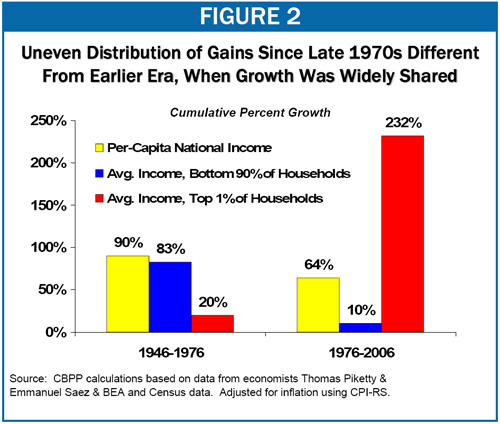
I point you to this study (from October of last year, but as new to me as a never before seen rerun of 30 Rock) from the Center on Budget and Policy Priorities, which shows how the proportion of national income accruing to the top 1% of households is as high as it has been since the Great Depression. I encourage you to read the entire study, or just look at the graphic below, which sort of says it all.

Income Inequality

Income Inequality

Climate Change Threatens US Troops

The NY Times recently reported that the Pentagon has started incorporating global warming into its strategic planning, because the impacts of climate change – drought, rising sea levels, mass migration, new pandemics – will likely pose threats to the United States. Although the Defense Department has long considered energy costs in its planning (sadly, fighter jets don’t come in hybrid versions), the recognition of climate change as threatening US security is relatively new.

When US security is threatened, the military has to plan, and sometimes act. Thus, the Pentagon has some interest in seeing whether global warming can be mitigated. According to retired Marine Corps General Anthony Zinni, “We will pay for this one way or another. We will pay to reduce greenhouse gas emissions today, and we’ll have to take an economic hit of some kind. Or we will pay the price later in military terms. And that will involve human lives.”

But it’s not just the liberal Times reporting this. Last year National Defense Magazine, which is the publication of the defense industry lobbying association (not exactly cuddly liberals: their motto is “Promoting national security since 1919”), reported the exact same thing last year. Army General Gordon Sullivan called climate change a “threat multiplier,” and Navy Admiral Joe Lopez, foreshadowed General Zinni, saying “National security and the threat of climate change [are] real, and we can pay for it now, or pay even more dearly for it later.”

I agree that fixing climate change will cost us. In fact, as I noted here, that is exactly what cap & trade, or a carbon tax, will do: make energy more expensive and thus incent us to be more efficient. What the Pentagon is saying is that if we don’t pay some dollars now, we’ll end up paying in soldier’s lives later. So maybe some of those Republican politicians who claim to “support our troops” but are against any efforts to stop global warming (I’m talking to you, John Boehner, Mitch McConnell and James Inhofe, you hypocrites) ought to revisit their positions.

Even better, maybe the corporate executives who are against any carbon legislation that will hurt their profits, but tend to be Republican and thus pro-troop, will also rethink their position. I’m talking about the National Association of Manufacturers, who use bogus data to claim that cap and trade won’t help the environment, or the energy executives who make up 7 of the top 10 best-paid CEOs in 2008. But those guys don’t really care about the troops, since their sons never join the military. No, those corporate executives care more about profits, so that they can pay their sons’ tuition at Princeton and Harvard Business School. When Admiral Lopez says that we have to pay now in money or pay later in soldiers’ lives, I guess we all know which one the corporate executives are going to choose.

“Death Panels” Are Another GOP Lie

Check out this NY Times article which shows in detail how the ridiculous rumor about “death panels” in the current health care reform effort came from the same sources whose lies helped kill Clinton’s health care reform. Why do Republicans so hate health care reform? Do they really think it’s OK for poor people to get worse health care than wealthy ones?

Slate on $100 Million Bonuses

Slate business writer Daniel Gross has another take on Andrew Hall’s bonus, about which I wrote last week. Gross notes that hedge funds primarily exist to make traders rich, and do little for non-employee shareholders. So he questions why Citigroup shareholders would want to retain Hall and his Phibro operation.

Congress Flies in Private Jets

Please read this Wall Street Journal article about how Congress has appropriated $550 million to buy some new private jets. And not even simple jets,  but the highest end of private: Boeing 737 business jets and Gulfstream Vs. This was an appropriation beyond what the Defense Department asked for. And this is the same Congress that lambasted (rightly) banks and car companies for flying private. This is the hypocrisy that makes citizens hate Congress. Let’s hope that during the August recess our representatives get a full dose of voter anger during town halls and constituent meetings.

Open Letter to Bank CEOs

Not from me, but from Breakingviews.com, which as a specialized business newsletter has more credibility than I do. Their site is subscription only, but the NY Times reprinted the letter here. The basic gist: hey CEOs, instead of paying obscene bonuses, you should use your current profits to build strong balance sheets so the taxpayers don’t need to bail you out again.

Krugman on $100 Million Bonuses

Just a quick link to Paul Krugman’s column on Andrew Hall’s $100 million bonus, about which I wrote the other day. Krugman focuses more on the downside of financial speculation than on the economic factors I discussed, but he is a Nobel prize winner, so linking to him is generally a good thing.

$100 Million Bonuses Should Not Exist

My headline refers to the $100 million bonus that Andrew Hall, the head of Citigroup’s Phibro commodities trading group, is reputedly due this year. This bonus is in addition to the $100 million he was paid last year. Mr. Hall has a profit sharing formula to determine his pay, and his group is very profitable; hence the huge paydays.

When I say that such a large bonus should not exist, I am not referring to the controversy of whether a bank that has received so much taxpayer aid should honor Hall’s contract and pay such a large bonus (although they probably shouldn’t) or whether it is in any way appropriate for a society that pays teachers and firemen $50,000 per year to pay a guy $100 million to speculate in oil futures (duh: it isn’t appropriate, and in fact is obscene).

No, I say that such a bonus shouldn’t exist because economic theory says it shouldn’t. Under classic microeconomics [as I learned in Professor Bresnahan’s Firms and Markets class), if a firm is making outsized profits, other firms will see those profits and enter the market. The competition will reduce returns until profitability is in line with the industry.

If Phibro is repeatedly paying Hall $100 million per year, it’s safe to say that their profits are awesome, and thus outsized. There certainly isn’t a lack of traders and capital on Wall Street, all chasing returns. Hedge funds alone have $1.4 trillion in capital. So why isn’t the competition battering Phibro? I don’t know the answer, but here are a few possibilities:

  1. There is some sort of barrier to entry. It’s not capital, because plenty of people have that, but maybe there is a regulatory hurdle. Perhaps the few entrants in oil trading have figured out a way to maintain an oligopoly and thereby restrain competition.
  2. Maybe everyone in the oil trading business is insanely profitable, but only Hall has the sort of contract that pays him such a huge sum. It could be so easy that if I started swapping a few oil futures, I too could make millions.
  3. Or, it could just be that Hall and the folks at Phibro are really that much better than anyone else in the industry.

Again, I don’t why, but I do know that the only way a person should be able to consistently make that much money is if they are an absolute superstar or if they have figured out a way to restrain trade, which is usually illegal. Given the ways of Wall Street, if I had to pick one of those answers, I’d guess the slimy one.

Greedy Doctors Are The Same As Wall Street Bankers

Given the current legislative efforts to reform health care, it’s not surprising that there are plenty of articles being written on the subject. But I was surprised that in just one day last weekend I managed to read three articles that blamed doctors for a decent chunk of our out of control health care costs. More interesting, not one of these articles was talking about defensive medicine or a focus on high tech care; no, they were all basically saying that too many doctors are greedy for money.

First there was this article in the NY Times, which discussed how the AMA has since 1929 (yes, 80 years ago) fought against systems (such as cooperatives) that would potentially limit doctor incomes by creating a salary structure rather than a fee for service structure. Although some cooperatives were formed, it was over the objections of the AMA. Not coincidentally, the two medical groups that are continually held up as paragons of cost-effective and world-class care, the Mayo Clinic and the Cleveland Clinic, are both cooperatives. At a recent conference on cost-effective care, most doctors and hospital executives agreed that the fee for service system is “archaic and fundamentally at odds” with good practice.

Next was this article by Dr. Atul Gawande in The New Yorker, in which he investigates why health care in McAllen, Texas is so much higher than the national average. In fact, he notes, McAllen’s health expenses are twice as high as El Paso, Texas, which has the exact same demographics. Gawande explores a number of reasons – service quality, technology, legal environment – but ultimately concludes that it comes down to massive overuse of medical care. Doctors in McAllen do far more tests and scans and procedures than average.

But Gawande goes even further. He blames this overuse not on a surfeit of caution, or desire to better treat patients, but on doctor greed. Doctors make more money when they do more procedures, and if they have ownership stake or revenue sharing agreements with imaging centers or labs or hospitals (and many of them do), then they have financial incentive to send patients to those facilities. Interviewing doctors in McAllen, Gawande uncovers a culture of greed, where doctors are in it for the money. Or, as a McAllen cardiac surgeon says, “Medicine has become a pig trough here.”

I sent Gawande’s article to a friend of mine, who is a doctor in a family practice, but who also has a Master’s in Public Health and did a fellowship in preventative medicine. My friend agreed with Gawande’s conclusions, noting that “nobody wants to give up that $500k+ salary, and the AMA is a huge lobby.”

Finally, The New Republic had a piece that sort of summed it all up, noting:

“Given how much of the game of reining in costs hinges on doctors–whether they see themselves as profit-maximizing small businessmen (or, for that matter, large businessmen), or as fundamentally involved in healing patients and receiving fair compensation for that service–I think we have to think about the kinds of people who go into the profession.”

And this is where I get to have my say. Because if someone is going into medicine because they want to make a million dollars, I say they should go to Wall Street instead. As this chart shows, it isn’t exactly like doctors are hurting for money. Practicing medicine isn’t a license to print money, and when a doctor orders an extra $1,000 procedure, while he gets to keep that $1,000, we all have to pay for it through higher insurance premiums. At which point he is no better than the greedy mortgage-backed security trader whose huge bonus ended up being subsidized by taxpayers.

This just in: right before posting, I read this article in the Wall Street Journal about how the AMA and the American College of Surgeons both came out against the idea of a commission setting Medicare payments to doctors. These groups continually lobby against reductions in Medicare payments.

Added bonus links:

  • Slate article describing how a Supreme Court anti-trust decision gave rise to doctor-owned hospitals and other greedy doctor abominations.
  • Denver Post article about a woman who died when a doctor-owned specialty hospital that didn’t have the resources necessary to handle her post-surgery complications.
  • Book review by Harvard Medical School professor Arnold Relman, who attacks the “medical-industrial complex” and the whole concept of profit-driven medicine: “in no other country is medical care marketed and advertised so aggressively, as if it were just another commodity in trade.”
  • New York Times article describing how the greediest hospital in Gawande’s article is one of the largest contributors to Democrats this year as it lobbies “to soften measures that could choke its rapid growth.” This lobbying has been successful, as language limiting physician ownership of hospitals has been stripped out of bills. According to Democrat Pete Stark, the physicians “just thought they could buy their way out of it, and it’s a sad commentary on the Congress.”

Rolling Stone Hates Goldman Sachs

If you have the time, I recommend reading this Rolling Stone article. It places Goldman Sachs at the center of every financial bubble since the Great Depression, and details how the firm has profited greatly from the travails of the average investor. I don’t necessarily agree with the author’s focus on Goldman. I think all the big investment banks have been doing this; Goldman just does it biggest and best. But I do think that the banks have been  manipulating prices and selling securities that they knew were crap. And, as mentioned by John Talbott and Simon Johnson in my new favorite article, if there were just one criminal investigation that started to subpoena internal emails, we would see all kinds of nefarious behavior exposed. In fact, just yesterday the Commodity Futures Trading Commission came out with a study that blamed last year’s crazy oil prices on financial speculators, rather than on operating supply and demand.