Category Archives: Politics

Alaska Loves Federal Money

Yesterday I posted about how Alaska politicians talk a big game about wanting the federal government to leave them alone, but in reality they suck down more federal money than any other state. Having just spent a week in Alaska, I brought some photographic evidence of our biggest state’s big appetite for taxpayer money.

Here is the beginning of a beautifully built and maintained trail at the Mendenhall Glacier outside Juneau. You can see that construction of the trail, which must have employed several people to cut brush and grade the path, was paid for by the federal stimulus package. As for the big Bob Marley joint depicted on the sign….it’s unclear if federal dollars paid for that.
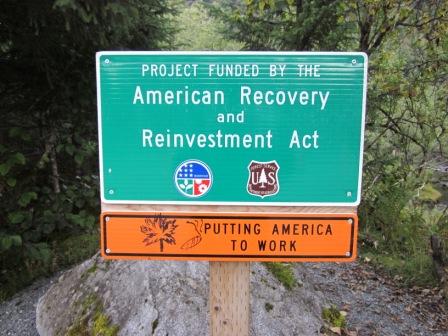
Trail paid for by US taxpayers

In Gustavus, a small town which is the gateway to Glacier Bay, a brand new $20 million dock is being built with federal stimulus dollars. I spoke with the owner of my hotel and with the pilot of my whale watching boat, and both said that the dock was completely unnecessary. But it was employing a whole bunch of skilled laborers, so many that they had to come in from Juneau, since Gustavus didn’t have that many construction workers.

The new dock at Gustavus

Here is a photo of all the pickups and SUVs owned by the people working on the dock. Again, these are local workers being paid with US taxpayer dollars.

Construction worker trucks

I have no problem with stimulus dollars paying people to build paths and docks; that is how a government stimulus package works. The government injects money into the system to boost employment and spending.  My problem is with a state that talks about how it doesn’t believe in the stimulus or in federal help at all while it continues to take as much federal money as it can.

Voters are Ill-informed; Politicians are Hypocrites

The NY Times recently ran an article about Alaska, which attracted my attention since I was planning a vacation to that giant state (in fact, I am drafting this entry on my flight to Anchorage). But this article wasn’t about fishing, or the awesome glaciers, or how to avoid being eaten by bears. No, this article was about the irony of Alaska being the home of such anti-government fervor (Sarah Palin’s small government views are pretty representative of her home state) while at the same time being the largest recipient of federal stimulus money.

For example, Alaska state representative Carl Gatto called to roll back the federal government’s “entire socialistic experiment in federal hegemony.” Yet he also celebrated that “for every $1 we give them in taxes for highways, they give us back $5.76.”  Jay Ramras, another state rep, embodied the dichotomy in a single quote: “If you want to feed us federal money like it’s a narcotic and make the state into a junkie of the U.S. Treasury, O.K.,” he allows. “But we would like to be an Emersonian Alaska and just get control of our resources.”

Of course, Alaska is not alone in this irony. There is a strong correlation between conservative states talking a big game about “government out of our business” while sucking aggressively at the federal teat. This map shows how red states take more than they give, and this chart shows traditionally republican states leading the way in receiving more federal dollars than they pay in taxes. And here is a brand new map from the NY Times based on census data.

So how do we explain this paradox? I suppose it could simply be the essential greed of humanity, people feeling that they are justified in taking as much as they can while giving as little as possible. Or it could be a canny political move, trying to drain the coffers of the government in order to force it to shrink, sort of a “starve the beast” movement at the grass roots level. But I don’t think either of those explanations fly. I think, instead, that the average voter doesn’t even make the connection between small government and services provided, between taxes paid and resources received. When voters say “don’t tax me” while taking a bridge paid by other citizen’s taxes, they don’t see the irony because they don’t even realize that taxes are what pay for bridges. See this piece by James Kwak on how the whole tax & service thing works, and this piece by David Sirota on how American voters seem to lack the ability to remember what policies worked or didn’t work in the past.

The politicians, on the other hand, who vote for these policies, like Carl Gatto and Jay Ramras from the NY Times article, or Ted Stevens, a major obtainer of federal dollars for the state, should actually understand how taxes and services are related. I mean, they are professional legislators, and this is a basic part of government budgeting. They are not ignorant, like the voters; they’re just hypocritical, saying and doing whatever they must to get reelected. They recognize the irony in calling for lower taxes while trumpeting the bacon they bring home from Washington…they just don’t care. They use that irony to cynically take advantage of the electorate’s lack of understanding, and it gets them elected year after year.

I just returned from a week in Alaska, where I saw this phenomenon in action multiple times. There will be follow-on posts on this topic.

Michael Kinsley Takes on Laffer

Regular Thoughtbasket readers know how I mock the Laffer Curve, a flawed theory that tax-cutting fiends use in order to claim that reducing marginal tax rates will actually increase government revenue as it unleashes a flood of investment and entrepreneurship. See my mockery here and here, for example.

So of course I was heartened to see Michael Kinsley at The Atlantic take up the cause.  Enjoy his mockery here.

Slate Magazine vs. Sarah Palin

I had pretty much forgotten about Sarah Palin, or started to ignore the news items about her, and I had assumed that maybe she was holed up learning about policy or facts. But then Slate runs an article trying to analyze how she might come up with some of the wacky stuff  she says.  I read a quote like the one below, and it’s hard to see the issue as one of policy differences:

“Oil and coal? Of course, it’s a fungible commodity and they don’t flag, you know, the molecules, where it’s going and where it’s not. … So, I believe that what Congress is going to do, also, is not to allow the export bans to such a degree that it’s Americans that get stuck to holding the bag without the energy source that is produced here, pumped here.”

I’m sorry, but regardless of where you are on the political spectrum, that makes no sense. Take Newt Gingrich: he is deeply conservative and I deeply disagree with him, but that guy could talk for a week straight and he would never say anything as idiotic as the Palin quote above. I want to be generous and assume that Palin isn’t stupid; that she just uses folksy idioms and is slightly misinformed. But I read what she says, I hear about the “refudiates”  and that generosity is hard to find. Can someone help me solve this conundrum?

The Taliban as a Desert Gang

Here is a great article in Foreign Policy that compares Afghanistan’s Taliban movement to the Bloods and Crips and other urban gangs here in the US. The author notes similar structures and similar motivations, and then discusses successful methods that urban police departments have used to reduce gang violence, and how they could be applicable in the deserts of Afghanistan.

Interesting fact: as part of counterinsurgency training, US Marines from Camp Pendleton are embedding with Los Angeles cops to see anti-gang policing in action.

Extra shout out: for the headline Straight Outta Kandahar.

More on Taxes & Government Services

In a timely follow up to my piece this week on the inherent relationship between taxes and government services provided, Anne Applebaum wrote a great article in Slate about the general hypocrisy of Americans who demand smaller government while castigating their government for not preventing or solving problems like the underwear bomber or the financial meltdown or the BP oil disaster. Ms. Applebaum doesn’t put it this way, but I will: if you want your government to do things, you can’t continually agitate for, and only fund, a small government. Doing things requires resources.

No Taxes = No Government Services

There was a great article in the Wall Street Journal on Saturday about cash-strapped counties letting their rural roads decay from pavement to gravel, since gravel is much cheaper to maintain. It seems telling and appropriate that we are going back to 1940’s road conditions, since we’ve spent the six decades since then overspending, undersaving and generally acting like idiots.

Several of the counties mentioned in the article have put the gravel decision up for a vote, with ballot measures that give citizens the opportunity to choose higher taxes and pavement or lower taxes and gravel. I dig that: let the people decide. But of course, this being America, some people want it both ways.

“Judy Graves of Ypsilanti, N.D., voted against the measure to raise taxes for roads. But she says she and others nonetheless wrote to Gov. John Hoeven and asked him to stop Old 10 from being ground up because it still carries traffic to a Cargill Inc. malting plant.”

So Judy doesn’t want to pay taxes to cover the cost of the road, but she wants the road paved anyway. OK people, let me explain some basic math to you. If you don’t pay taxes, you don’t get services. It’s that simple. If you don’t pay the cashier at Safeway, you don’t get to take your groceries. If you don’t pay at Home Depot, you’re not able to walk out with paint and brushes. Why should government be any different? If you don’t pay for it, you’re not going to get it.

Serious libertarians know this. Their approach is that government shouldn’t provide most services. Cool. I don’t agree, but I get it. Unfortunately, the common approach in our society is more Judy Graves and less libertarian, calling for lower taxes but more services. Less money in, more money out. This is unsustainable, and it’s why Judy and her Ypsilanti neighbors are going to be driving on gravel instead of asphalt.

Palestinians Try Nonviolence; Will They Stick With It?

Two articles recently, one in the Wall Street Journal and one in the NY Times (by Thoughtbasket plagiarist Nicholas Kristof), both discussed nascent efforts by Palestinian activists to use non-violence as a tactic against Israel, departing from the usual Hamas trope of violence against Israeli civilians and military targets.

As the WSJ article notes, violence clearly hasn’t worked for the Palestinians. “‘When we use violence, we help Israel win international support,’ said Aziz Dweik, a leading Hamas lawmaker in the West Bank.” Well, duh. The amazing thing is that Hamas is still using the same violent tactics that have clearly proven ineffective. It’s as if they’ve never bothered to examine their own history. Or, frankly, any other history. Because generally speaking, violent separatist movements don’t work very well. Why doesn’t Hamas go talk to the folks from the Tamil Tigers, or the Shining Path, or FARC, or the IRA? Those guys tried violence for decades, and it mostly got them killed or jailed. None of those movements achieved their aims.

Or, the Palestinians could look at political movements that did work, in India or Poland or South Africa or the American south. These movements were all built on non-violence. Moreover, they were all led by paragons of non-violence: Gandhi, Lech Walesa, Nelson Mandela and Martin Luther King, respectively. Who do the Palestinians have? Yasser Arafat. You can see their problem. Had the Palestinians spent the past 15 years sitting peacefully in front of Israeli bulldozers instead of throwing rocks and shooting rockets, they would probably have their own state now. Instead, Hamas is the worst enemy the Palestinians have.

And yes, I know all these situations are more nuanced than I make them out to be. The ANC did use violence, and the IRA now has seats in Parliament. And the greatest independence movement of all, the American secession from England, was indeed violent. Of course, nothing is black and white. But the general trend is clear. For the past century, non-violent movements have been more successful than violent ones. If they Palestinians really want a state, rather than just wanting power, or wanting to kill Jews, they should follow Gandhi’s lead, not Arafat’s.

Not Either/Or, But Both

If you spend any time reading about current affairs, whether you read newspapers, magazines or blogs, you tend to see that issues are discussed in dualistic terms. Most authors say the matter at hand is the result of either X or Y: two oppositional explanations.

For example, in this Atlantic article about obesity in America, the discussion tends to fall in one of two camps: either X) the obese are weak-willed, or Y) the obese are victims of the US system of cheap corn subsidies and for-profit food companies with their manipulative marketing and clever chemists.

Or in this NY Times article about why the military is awarding fewer Medals of Honor, the reasons given are: either X) the nature of current war doesn’t create as much of the close-in combat that tends to lead to Medals of Honor, or Y) the military system that awards medals has become so risk averse and bureaucratic that someone in the chain rejects even worthy Medal of Honor recommendations.

I understand why authors do this; it’s easier to bundle complex systems into single narratives, and creating oppositional tension makes an article more interesting. But rarely in real life are there two mutually exclusive and oppositional reasons for something. It’s not either/or; it’s both.

Life is complicated, and in virtually all situations there are multitudinous reasons for any phenomenon. Take obesity: of course some people simply won’t restrain their appetites. But it’s equally obvious that the nexus of policies and food companies greatly increases the likelihood of people eating fattening food. X and Y. And there are plenty of other likely causes too.

This shouldn’t be a great revelation to anyone – “oh, you mean there usually isn’t one simple cause for everything?” – yet journalists and pundits continue to employ the binary analysis. Does this matter? I think it does, because popular dialogue ends up framing the debate. If all people ever hear about is either/or, then they will look for a single solution, which will inevitably be insufficient. If the public instead hears about both, then they will look for more complex solutions that can address the multiple causes, and which will be far more likely to succeed.

For example, take the ballooning federal deficit, please. Pundits and politicians would like you to believe that the cause is either too much government spending or tax rates that are too low. If the public buys into that dichotomy, then the public will assume that simply cutting spending or raising taxes will solve the problem. But it won’t. The problem involves both federal spending and insufficient taxes, and it will only be solved by addressing both causes.

Discussion matters because it ends up circumscribing actual policy. So let’s make sure our discussions are accurate, even if complicated, because life is complicated.

CEO Pay: Out of Control

I was reading an article the other day about executive pay in America. This article said that in 1980 the ratio of what the CEO made to what the average worker made was 44:1. By 2007, that ratio had risen to 344:1. In other words, CEO pay went up 7.8 times as much as average worker pay.

That got me to thinking: has the average American company gotten 7.8 times as complex since 1980? That seems unlikely. So I searched for data that would answer my question, and I couldn’t find any. Therefore my assumption that companies have not gotten 8 times more complicated will have to stand.

But even if that assumption is wrong – even if companies HAVE gotten 7.8 times more complicated – that doesn’t mean that the ratio of CEO pay should have gone up that much. The ratio compares CEO pay to average worker salary. And if companies are getting more complex, then lots of worker salaries should be going up. Maybe not folks on the factory floor, but the guys who run the factory. Basically, everyone at director level and above should have their salaries going up to reflect any increasing complexity. Thus CEO pay is going up even faster than any increase in corporate complexity.

So what is the explanation? You’ll have to read the article, which discusses the invidious system of compensation consultants and interlocking boards. But the bottom line comes down to greed. CEOs get as much as they can, without concern for the impact of their compensation on the company or the workers below them in the hierarchy.

As many pundits pointed out after the financial meltdown [see examples here, here and here], American companies used to have a public service obligation; they were expected to provide some value to society, not be purely profit-making vehicles. The authors of the article (who are both, I should note, professors at Harvard Business School, the American epicenter of corporate greed) call for a return to that earlier attitude, with societal obligations providing a normative check on unrestrained greed. Their money quote (sweet irony!) is here:

“Every corporation is embedded in a social matrix, and is accountable for multiple factors within that social setting: obligations to the society that provides it tax advantages or public goods, such as public schooling, publicly financed research, or basic infrastructure such as roads and airports. In a democratic society like the United States, the general public expects responsible and ethical practices and the exercise of self-restraint among business leaders in exchange for vesting an extraordinary amount of power that affects society’s well-being in private, corporate hands.”