Category Archives: Politics

Don’t Screw Up Healthcare to Make Political Points

The health care reform effort in Congress is hitting some snags, and reports are discussing how the republicans see this as a make or break moment for the Obama administration. The republicans want to stop reform to make Obama look bad and weaken his chances to implement other parts of his agenda. Jim DeMint (R-SC) called it a “Waterloo moment” for the president.

This is why people hate politicians. Because instead of focusing on policy and helping their country and their constituents, they play douche bag political games like this is some sort of high school mock senate instead of the real thing.

If politicians don’t like the health care reform bills being presented, that’s fine. They are challenging bills, and concerns about their cost or about growing government bureaucracy or any number of other issues are legitimate. Hell, if you think that the free market should rule and people should be on their own for health care, that’s a legitimate, although heartless, view.

Virtually everyone – including republicans – agrees that health care reform is needed. The disastrous state of the American health care system is well known. So to fight health care reform bill – not fight to improve it, but fight against it passing at all – just to score political points, well that sucks. As happens so often here at Thoughtbasket, I must ask our representatives to stop dicking around and do the right thing.

Judges Are People, Not Robots

During last week’s confirmation hearings for Sonia Sotomayor, there were repeated calls from all concerned to show fidelity to the law, to call balls and strikes, to keep personal opinions out of judicial decision making. These statements were emblematic of the modern rules of confirmation hearings, in which any admittance of the role of personal interpretation will automatically raise the hackles of the other side, whether it’s John Roberts admitting “yes, I generally side with the powerful” or Sotomayor saying “as an underdog, I understand where underdogs come from.” Instead, everyone maintains the fiction that it’s all about facts and laws.

Of course, being a judge is very much about ruling on how the facts of a case fit the law as written. But sometimes the facts don’t exactly fit the law, and so the judge has to make some….wait for it….judgments. If it was all automatic, just applying the facts and law, then we could have machines do it, or bureaucrats. Even the Wall Street Journal recently noted that “judges are not algorithms.” If this judging gig was just calling balls and strikes, then the Supreme Court and courts of appeal and every other multi-judge panel would never have split decisions; everyone would simply agree on the facts and the law.

But we do have split decisions, because the facts are sometimes complicated and messy, and how a judge thinks can influence how they sort through the mess. Rather than pretending this doesn’t happen, wouldn’t we be better off addressing it and actually understanding how a nominee might rule? Maybe not. That might inflame senators’ passions so much that nobody could ever be approved. But it seems crazy to have a system where everyone is lying, we all know they’re lying, and the lies are essential to making the system work.

By the way, I’m not just talking out of my butt here. The friendly staff at the U.S. District Court listened to my diatribe and gently corrected me where appropriate.

Is Healthcare Rationing Inevitable?

Yesterday’s NY Times magazine preview had a thought-provoking article by Peter Singer on health care rationing. Singer clearly comes at this from an extreme position (this is a guy whose fame is due to weighing hypothetical lives against each other), but he raises some excellent points. I’m not sure where I come down on rationing, and how it might work, but it’s clear that spending $50,000 on new drugs that only extend life by a few months is not a sustainable system. As congress gets ready to debate the health care bills coming out of committee, we should all start thinking about how America pays for health care, and reading Singer’s article is a good place to start. You only really need to read the first half. In the second half he goes into his usual shtick about disabled people vs. fully abled and goes off point.

Carbon: The Ultimate Externality

The House of Representatives just passed (barely!) the climate change bill, although analysts say that it will face a tough road in the Senate. This is the bill that includes a cap and trade system for carbon, or “cap and tax,” as the Republicans call it. Certainly the Republicans, and all the conservative bloggers, have attacked the bill, saying that it will increase the cost of energy and of many manufactured goods, and those increased costs will be passed on to consumers. And I agree; costs will go up, which is exactly the point. The cost of things that create carbon should go up. To explain this, I thought it might make sense to take a step back and discuss externalities.

In economics, “an externality…of an economic transaction is an impact on a party that is not directly involved in the transaction.” There can be positive and negative externalities, but the classic example is a negative one: pollution. If a plant manufacturing widgets spews its waste chemicals into a river, poisoning that river for 15 miles downstream, that is an externality. People downstream – fishermen, swimmers, kayak tour guides – suffer an impact from the widget manufacturing, but they have no economic say in that impact.

You might just say “whatevs,” as many have said over the years about pollution, but even the most ardent free market fan should recognize that externalities warp the market. As the supply-demand graph (a diagram dear to the heart of any good capitalist, and to me, since I was an econ major) below shows, an externality causes the market to produce too much of a good, at too low of a price, relative to the optimal solution if the externality is taken into account. This is not efficient, and economists hate inefficiency.
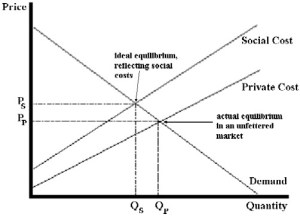
Negative_externality
Of course, as regular readers of Thoughtbasket know, I am not an ardent free market fan, so I would layer in an ethical cost as well. Why should the owners of the widget plan make money at the cost of the health of people living downriver? Who gives them the right to take the public good – the river – and ruin it?

Fortunately, both the economic and the ethical problem can be solved by actually monetizing the externality and including it in the business calculation. Polluting a common good should not be free. Assign an actual cost to polluting, and charge the factory owner that cost, and you will quickly see the plant move to producing the preferred social equilibrium quantity. Of course it is tremendously difficult to come up with the appropriate cost, but it’s difficult to go to the moon too, and we still managed that (unless you are a conspiracy theorist). Just because something is hard doesn’t mean we shouldn’t do it.

Unfortunately for factories, as science discovers more pollutants that are bad for us, there are more and more externalities that they have to take into account. Carbon and global warming are a perfect example. Carbon emissions didn’t reach the externality level – unlike, say, dioxin spewing into a lake – until science discovered that global warming was going to kill us all.

Hence, cap and trade legislation. Which is, in many ways, as the Republicans have pointed out, like a carbon tax. Either way, the point is to take what was a social cost – the spewing of carbon – and then monetize it and apply it to producers. What will happen as the costs of carbon go up? We will use less of it. Factories will figure out how to make their widgets using less carbon. People will turn their air conditioners down. Whatevs. Make carbon expensive and people will use less of it, moving production down to the appropriate social equilibrium. That’s what the economists would want, and it’s certainly what our grandkids will want.

Food and Politics

I was listening to Micahel Pollan on the radio last night (yes, on NPR; I was drinking chardonnay and eating sushi too) do his usual spiel on food, although this time it involved him promoting his new film “Food, Inc.” And although I know his viewpoint already — the American diet is unhealthy and politicians don’t care because they accept money from food corporations — this time I got  angry.

Maybe it was because this time Pollan told a story I hadn’t heard before: about how in 1977 Senator George McGovern led a committee that called for Americans to eat less red meat, until the meat industry threw a hissy fit and forced the committee to water its position down to “eat less saturated fat.” I just hate the fact that a single industry gets to throw money at politicians and thereby screw the American public.

Or possibly it’s because Pollan was speaking in the middle of the debate over health care reform. Politicians are feuding over the cost of health care and insurance, but they continue to throw subsidy money at the corn farmers and beef ranchers whose products are what make our diet so unhealthy. Hell, even the Wall Street Journal ran a column yesterday in which a doctor said that preventing obesity would save enough money to cover everything and everyone else.

So politicians, I ask you, again, please try to do what is right for the American people, and stop doing what some lobbyist pays you $2,000 to do.

Gitmo Prisoner in US: Run, Run for Your Life!

Just a few hours after I posted yesterday regarding the ridiculous fear surrounding the transfer of Gitmo prisoners to the United States, a story comes out that Ahmed Khalfan Ghailani, a suspect in the 1998 embassy bombings, was moved from Gitmo to the federal detention facility in New York City so that he can stand trial in federal court. Yes, you heard that right: the federal lockup in Manhattan, not the Supermax prison in Colorado. The same facility that currently houses Bernie Madoff. Are New Yorkers leaving town to avoid this horrible danger? Will the authorities order the evacuation of Manhattan? No, of course not. Ghailani (oddly close to Giuliani, don’t you think?) is under massive guard, and nobody thinks he will escape. The only person worked up about this is notorious douchebag John Boehner, who called the move ”the first step in the Democrats’ plan to import terrorists into America.”

Supreme Court Agrees With Thoughtbasket

OK, the justices didn’t exactly mention me in their decision, but they did unanimously (according to Scotusblog) rule against the Indiana pension funds who were whining that they hadn’t gotten enough money for their secured debt. The highest court in the country has thus decided that the Obama administration did not violate the rule of law in pushing through the Chrysler bankruptcy. Read here my post saying just that. Of course, some argue that this issue is too political for the Court to be focused just on the law, but if that were the driving issue here, wouldn’t this conservative court be likely to rule against Obama, not for him?

Please Focus on Policy, Not on Fear

Opponents of President Obama’s plan to close the prison at Guantanamo Bay have recently seized on the tactic of asking “do you want these terrorists in your neighborhood?” and thus playing on people’s fears. This is purely a rhetorical feint, and it’s offensive. The president isn’t planning on installing the Gitmo inmates in your local condo complex, and his opponents know that. The inmates will go into military brigs or maximum security prisons: the same places that currently house murderers, rapists and drug dealers. Are Obama’s opponents saying that these prisons aren’t secure? If so, shouldn’t they focus on fixing the prisons, so that rapists aren’t wandering your neighborhoods?

The fact is that the opponents of closing Gitmo know perfectly well that moving the inmates to a US supermax facility is perfectly safe. They just disagree with closing the island prison on policy grounds. And that’s fine. There are reasons – cost, isolation from US courts, desire to maintain military control – for wanting to keep Gitmo open. But let’s discuss those actual reasons, instead of using fear mongering and mistruths to get people scared and worked up.

Speaking of mistruths, on the same day that Admiral Mike Mullen, the chairman of the Joint Chiefs, said that he has long wanted to close Gitmo because it “has been a recruiting symbol for those extremists and jihadists who would fight us,” Republican Senator John Kyl, who is a major league douchebag, claimed that “it’s palpably false to suggest that the existence of Gitmo created terrorists.” Who is a more reputable source – the career soldier or the sleazy politician?

Glenn Greenwald has an excellent piece in Salon describing how this is an ongoing pattern: Republicans use specious arguments to make voters afraid, and Democrats feel a need to act tough instead of pointing out the ridiculousness of the Republican arguments. The NY Times recently ran a piece showing how the Republicans were planning even before Obama’s inauguration to use this strategy. To me, this demonstrates that the strategy is purely political, with no basis in fact or policy.

Wall Street Has Gone Too Far

In the wake of the financial meltdown there has been continued tension between Main Street and Wall Street; between the working class (and the politicians who represent them) and the financiers (and the lobbyists who represent them). Despite the commentary from populists such as me who have been railing against Wall Streeters continuing to pay themselves huge bonuses, some of this tension has been between legitimate positions of free markets versus genuine concern about greed and income inequality.

But now the financiers have gone too far. First was an article last week saying that some big banks are looking at participating in the government’s PPIP (Public Private Investment Program) in order to buy their own toxic assets. Wait…so they are going to borrow cheap money from US taxpayers, and then use it to buy their own assets, with US Treasury backstopping on their losses? That is appalling without even considering the obvious conflict of interest regarding what price the assets are sold for. You have got to be kidding me.

Then today’s NY Times reports about the extensive lobbying effort that the big NY banks have launched to limit regulation of derivatives. You remember derivatives – the financial “weapons of mass destruction” that were a huge cause of the meltdown? The big banks make a ton of money on derivatives, and they don’t want that gravy train derailed. And since when they lose money, the taxpayers bail them out, they are clearly in support of the status quo. So they formed a lobbying organization and hired a big-name lawyer to lead the charge, paying him over $400,000 for four months of work. Now they are lobbying Congress to water down any sort of regulation of derivatives.

For banks that received taxpayer bailouts to now be spending money lobbying to avoid regulation on the very products that caused them to require bailouts? No way. It is time for Congress, and for the Obama administration to say “Fuck you, Wall Street.” The big banks make billions in profit on unregulated derivatives? Too damn bad. So maybe some traders will only make $2 million per year instead of $10 million. Tough shit. The Treasury Department-Wall Street axis of greed has to stop, and it has to stop now. President Obama, it’s time you step up to the plate on this.

Added bonus links: 1) Paul Krugman on how Reagan-era decisions on deregulation set the stage for financial catastrophe; and 2) a hilarious piece on Harvard Business School students taking a pledge to serve “the greater good” instead of their “narrow ambitions.” The money paragraph is the last one, with a quote about principles from a woman who is taking a job at Goldman Sachs, one of the leaders of the lobbying effort excoriated above. Oh, HBSers, it’s such a shame that you don’t understand irony.

Chrysler Bailout and Contract Law

Conservative commentators have been criticizing how President Obama handled the Chrysler bankruptcy, saying that because the Administration pushed the secured creditors to take less than the UAW, which was unsecured, the basic tenets of contract law were violated. If the Administration had actually forced the secured creditors into this position, by passing some new law or threatening to arrest them, I would completely agree with these commentators. Rule of law is an essential underpinning of the American system.

But Obama did not “force” the creditors to do anything; he simply applied leverage. This is what parties do in contentious business negotiations. Whether it’s a bankruptcy or unwinding a marketing partnership, when it gets ugly the businesspeople start deploying whatever leverage they have. In Obama’s case, he had two levers: 1) the bully pulpit of the presidency; and 2) the fact that without the UAW on board, Chrysler was worthless and the creditors would get nothing.

With his bully pulpit lever, Obama did indeed “browbeat” the creditors. But hey, this is hardball here, and there were billions of dollars at stake. Plus these are vulture funds…they are used to being insulted. With his second lever, Obama simply was playing the game of chicken that is usually played in a bankruptcy, and he won. The creditors were saying “give us what we want or we’ll take over the company” and Obama replied “take what we’re offering or we’ll give you the company.” The creditors blinked first; they knew that if they took over the company it would essentially disintegrate overnight, and they would be left with a bunch of factories nobody would buy.

I’m as big a supporter of the rule of law as anyone – I have long said that exporting law is more important than exporting democracy – but this is not a case of the government ignoring the law. Instead it’s a case of government playing by the same rules as business, but playing better, which is something the right wing ideologues just can’t handle. And lest you think I’m alone in this, here are a law professor and a private equity professional saying similar things.

Which isn’t to say that I am a blanket supporter of the auto bailouts, because I’m not. I would have been perfectly happy to see Chrysler shut down. But any criticism should be on the merits, not based on a spurious claim being advanced for political reasons.