Category Archives: Politics

Living The Health Care Debate

There are plenty of policy papers out there on both sides of the health care reform issue, as well as plenty of nutjobs talking about death panels. But here is an anecdote from the front lines: I recently had a test done at California Pacific Medical Center, which is purportedly a non-profit hospital affiliated with Sutter Health, a collection of non-profit hospitals. CPMC is the only hospital in the northern half of San Francisco, and essentially has a monopoly on health care for a big chunk of the city. What do they do with their monopoly power? My breath test, which was run not by a doctor but by a young technician, and which took 90 minutes, was billed at $3,000. That’s right: $2,000 per hour was what they charged for their technician’s time and use of the machine. To compare, a top partner at a major corporate law firm I have used billed me at $650 per hour. This is why the current system is unsustainable. Insured individuals never see these bills, because their insurance pays it, so hospitals keep charging obscene rates. But for those of us who have to pay our own medical bills, we have no choice but to protest and fight back. Reforming the system is part of our fight.

U.S. Is Not A Meritocracy

George Will recently published a column in Newsweek about taxation. It was his usual supply side pabulum, about how nobody will work or invest if marginal tax rates go up. Ironically enough, a guy whose only thought ever is cut taxes says the following: “But people with only one idea really have no idea.” Whatever. I am happy to take on George Will; he’s a moron whose view of the world is that everybody goes to Exeter and Yale and thus they can all fend for themselves. For Will, higher taxes means waiting a year to remodel the kitchen in your weekend house on Nantucket.

But in his column, Will quoted Richard Posner, a judge on the US Court of Appeals and professor at University of Chicago Law School. Taking on Judge Posner is something I do with trepidation. He is among the smartest of America’s public intellectuals, with knowledge that is both deep and broad, and he is insanely prolific. He seems to publish a book about as often as I can write a blog entry. However, I have no choice but to take issue with what he was saying in Will’s column. Here is the quote in its entirety:

“As society becomes more competitive and more meritocratic, income inequality is likely to rise simply as a consequence of the underlying inequality—which is very great—between people that is due to differences in IQ, energy, health, social skills, character, ambition, physical attractiveness, talent, and luck.”

Judge Posner is not entirely wrong. Smart, hard-working people can get ahead in America, and that can take the form of higher salaries or greater wealth. But this is true more often in theory than in practice. There are many Americans who are very smart, very hard-working, chock full of merit, who for a variety of reasons don’t manage to get ahead. Those reasons include geography, family, or education. But the reason I most want to focus on is generational. When you include the impact of inherited opportunities, it is difficult to call America a pure meritocracy.

Commitment to education, legacy admissions to elite colleges, career networks, wealth – these are all things that parents can pass to their children, and they all tilt the playing field against merit. Economist James Heckman, another University of Chicago professor (and a Nobel Prize winner) has produced significant work showing how early childhood treatment (eg. having parents who use a large vocabulary) correlates to adult success skills. But as important as nurturing an infant may be, I don’t think it compares to having a father who is a partner at Skadden Arps and thus helps gets you in the analyst program at Goldman Sachs.

Consider two teenagers, both equally smart and hard-working. One lives in Brookline, Massachusetts, where he goes to an excellent high school and his parents, who met when they were undergrads at Harvard, support him in his studies. The other lives in Oak Hill, West Virginia, where his school is terrible, and his high school dropout parents are too busy earning a living to help him with his coursework. Of these two teens, which do you think is more likely to go to a good college, join a hedge fund and become wealthy? Sure, the West Virginian could, in theory, make it to Wall Street, but we all know that his odds are low.

So for Judge Posner to argue that meritocracy inevitably leads to an acceptable inequality is to completely miss the point. Success in America’s meritocracy is correlated as much to parental merits, or grandparental merits, as it is to any individual’s merits. This is precisely why Bill Gates’ father (whose partner position in a corporate law firm helped send young Bill to computer classes and then to Harvard) is such a full-throated proponent of the estate tax. He knows that America’s meritocracy is skewed by inheritance. Judge Posner is more than smart enough to know the same thing.

Bankers Moving for Higher Pay? Go Ahead!

A recent item in the Wall Street Journal talked about how British banks are pushing back against any sort of regulation on pay practices, saying that such regulation “will harm competitiveness, as jobs and tax revenues move to friendlier climates.” Wall Street banks are saying the exact same thing to Washington. My question is: where exactly are they going to move? Is the talent going to run to Bear Stearns or Lehman? Clearly not. After all the recent layoffs, there are fleets of unemployed bankers ready to replace anyone on a trading desk. But maybe the talent will move offshore, to Paris or Zurich or Tokyo – any place that doesn’t limit compensation. Really? They are going to take their kids out of Greenwich Country Day School, quit the country club, and move around the world? Some will, sure, but the majority won’t. The uproar from kids and spouses alone will force most of them to stay put. For those without families, I would think that the concept of living in a social democratic country makes moving a non-starter.

Income Inequality at Record Post-1929 Levels

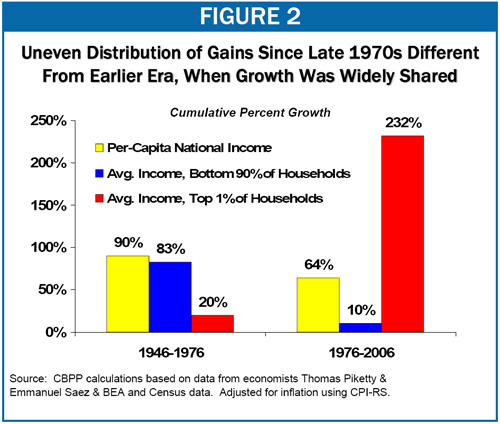
I point you to this study (from October of last year, but as new to me as a never before seen rerun of 30 Rock) from the Center on Budget and Policy Priorities, which shows how the proportion of national income accruing to the top 1% of households is as high as it has been since the Great Depression. I encourage you to read the entire study, or just look at the graphic below, which sort of says it all.

Income Inequality

Income Inequality

Climate Change Threatens US Troops

The NY Times recently reported that the Pentagon has started incorporating global warming into its strategic planning, because the impacts of climate change – drought, rising sea levels, mass migration, new pandemics – will likely pose threats to the United States. Although the Defense Department has long considered energy costs in its planning (sadly, fighter jets don’t come in hybrid versions), the recognition of climate change as threatening US security is relatively new.

When US security is threatened, the military has to plan, and sometimes act. Thus, the Pentagon has some interest in seeing whether global warming can be mitigated. According to retired Marine Corps General Anthony Zinni, “We will pay for this one way or another. We will pay to reduce greenhouse gas emissions today, and we’ll have to take an economic hit of some kind. Or we will pay the price later in military terms. And that will involve human lives.”

But it’s not just the liberal Times reporting this. Last year National Defense Magazine, which is the publication of the defense industry lobbying association (not exactly cuddly liberals: their motto is “Promoting national security since 1919”), reported the exact same thing last year. Army General Gordon Sullivan called climate change a “threat multiplier,” and Navy Admiral Joe Lopez, foreshadowed General Zinni, saying “National security and the threat of climate change [are] real, and we can pay for it now, or pay even more dearly for it later.”

I agree that fixing climate change will cost us. In fact, as I noted here, that is exactly what cap & trade, or a carbon tax, will do: make energy more expensive and thus incent us to be more efficient. What the Pentagon is saying is that if we don’t pay some dollars now, we’ll end up paying in soldier’s lives later. So maybe some of those Republican politicians who claim to “support our troops” but are against any efforts to stop global warming (I’m talking to you, John Boehner, Mitch McConnell and James Inhofe, you hypocrites) ought to revisit their positions.

Even better, maybe the corporate executives who are against any carbon legislation that will hurt their profits, but tend to be Republican and thus pro-troop, will also rethink their position. I’m talking about the National Association of Manufacturers, who use bogus data to claim that cap and trade won’t help the environment, or the energy executives who make up 7 of the top 10 best-paid CEOs in 2008. But those guys don’t really care about the troops, since their sons never join the military. No, those corporate executives care more about profits, so that they can pay their sons’ tuition at Princeton and Harvard Business School. When Admiral Lopez says that we have to pay now in money or pay later in soldiers’ lives, I guess we all know which one the corporate executives are going to choose.

“Death Panels” Are Another GOP Lie

Check out this NY Times article which shows in detail how the ridiculous rumor about “death panels” in the current health care reform effort came from the same sources whose lies helped kill Clinton’s health care reform. Why do Republicans so hate health care reform? Do they really think it’s OK for poor people to get worse health care than wealthy ones?

Congress Flies in Private Jets

Please read this Wall Street Journal article about how Congress has appropriated $550 million to buy some new private jets. And not even simple jets,  but the highest end of private: Boeing 737 business jets and Gulfstream Vs. This was an appropriation beyond what the Defense Department asked for. And this is the same Congress that lambasted (rightly) banks and car companies for flying private. This is the hypocrisy that makes citizens hate Congress. Let’s hope that during the August recess our representatives get a full dose of voter anger during town halls and constituent meetings.

Greedy Doctors Are The Same As Wall Street Bankers

Given the current legislative efforts to reform health care, it’s not surprising that there are plenty of articles being written on the subject. But I was surprised that in just one day last weekend I managed to read three articles that blamed doctors for a decent chunk of our out of control health care costs. More interesting, not one of these articles was talking about defensive medicine or a focus on high tech care; no, they were all basically saying that too many doctors are greedy for money.

First there was this article in the NY Times, which discussed how the AMA has since 1929 (yes, 80 years ago) fought against systems (such as cooperatives) that would potentially limit doctor incomes by creating a salary structure rather than a fee for service structure. Although some cooperatives were formed, it was over the objections of the AMA. Not coincidentally, the two medical groups that are continually held up as paragons of cost-effective and world-class care, the Mayo Clinic and the Cleveland Clinic, are both cooperatives. At a recent conference on cost-effective care, most doctors and hospital executives agreed that the fee for service system is “archaic and fundamentally at odds” with good practice.

Next was this article by Dr. Atul Gawande in The New Yorker, in which he investigates why health care in McAllen, Texas is so much higher than the national average. In fact, he notes, McAllen’s health expenses are twice as high as El Paso, Texas, which has the exact same demographics. Gawande explores a number of reasons – service quality, technology, legal environment – but ultimately concludes that it comes down to massive overuse of medical care. Doctors in McAllen do far more tests and scans and procedures than average.

But Gawande goes even further. He blames this overuse not on a surfeit of caution, or desire to better treat patients, but on doctor greed. Doctors make more money when they do more procedures, and if they have ownership stake or revenue sharing agreements with imaging centers or labs or hospitals (and many of them do), then they have financial incentive to send patients to those facilities. Interviewing doctors in McAllen, Gawande uncovers a culture of greed, where doctors are in it for the money. Or, as a McAllen cardiac surgeon says, “Medicine has become a pig trough here.”

I sent Gawande’s article to a friend of mine, who is a doctor in a family practice, but who also has a Master’s in Public Health and did a fellowship in preventative medicine. My friend agreed with Gawande’s conclusions, noting that “nobody wants to give up that $500k+ salary, and the AMA is a huge lobby.”

Finally, The New Republic had a piece that sort of summed it all up, noting:

“Given how much of the game of reining in costs hinges on doctors–whether they see themselves as profit-maximizing small businessmen (or, for that matter, large businessmen), or as fundamentally involved in healing patients and receiving fair compensation for that service–I think we have to think about the kinds of people who go into the profession.”

And this is where I get to have my say. Because if someone is going into medicine because they want to make a million dollars, I say they should go to Wall Street instead. As this chart shows, it isn’t exactly like doctors are hurting for money. Practicing medicine isn’t a license to print money, and when a doctor orders an extra $1,000 procedure, while he gets to keep that $1,000, we all have to pay for it through higher insurance premiums. At which point he is no better than the greedy mortgage-backed security trader whose huge bonus ended up being subsidized by taxpayers.

This just in: right before posting, I read this article in the Wall Street Journal about how the AMA and the American College of Surgeons both came out against the idea of a commission setting Medicare payments to doctors. These groups continually lobby against reductions in Medicare payments.

Added bonus links:

  • Slate article describing how a Supreme Court anti-trust decision gave rise to doctor-owned hospitals and other greedy doctor abominations.
  • Denver Post article about a woman who died when a doctor-owned specialty hospital that didn’t have the resources necessary to handle her post-surgery complications.
  • Book review by Harvard Medical School professor Arnold Relman, who attacks the “medical-industrial complex” and the whole concept of profit-driven medicine: “in no other country is medical care marketed and advertised so aggressively, as if it were just another commodity in trade.”
  • New York Times article describing how the greediest hospital in Gawande’s article is one of the largest contributors to Democrats this year as it lobbies “to soften measures that could choke its rapid growth.” This lobbying has been successful, as language limiting physician ownership of hospitals has been stripped out of bills. According to Democrat Pete Stark, the physicians “just thought they could buy their way out of it, and it’s a sad commentary on the Congress.”

Rolling Stone Hates Goldman Sachs

If you have the time, I recommend reading this Rolling Stone article. It places Goldman Sachs at the center of every financial bubble since the Great Depression, and details how the firm has profited greatly from the travails of the average investor. I don’t necessarily agree with the author’s focus on Goldman. I think all the big investment banks have been doing this; Goldman just does it biggest and best. But I do think that the banks have been  manipulating prices and selling securities that they knew were crap. And, as mentioned by John Talbott and Simon Johnson in my new favorite article, if there were just one criminal investigation that started to subpoena internal emails, we would see all kinds of nefarious behavior exposed. In fact, just yesterday the Commodity Futures Trading Commission came out with a study that blamed last year’s crazy oil prices on financial speculators, rather than on operating supply and demand.

How Are Bribes Different Than Lobbying?

Reading stories about this year’s massive New Jersey corruption scandal, I almost have to laugh at the ridiculousness of it. The perp walk into the rented bus, the mayor only three weeks into his term, the cereal box (Apple Jacks!) stuffed with cash – the images are straight out of TV. But it brings up an important question: how do we draw the line between bribes and lobbying? When you hand a mayor $5,000 in cash in hopes of getting a building permit approved, you both go to jail. But when Goldman Sachs hands $3M in campaign contributions to congressmen in hopes of getting regulations eased, it’s totally legal. Does that seem right?

Simon Johnson and John Talbott recently published three articles (which I cannot recommend highly enough) in Salon describing the role of corporate lobbying and deregulation in the financial crisis. In their view, this sort of lobbying IS criminal. And when you look at the facts, it’s hard to disagree with them.

Here are some of those facts. In August 2008, as the financial crisis heated up, Goldman hired a famous lobbyist to come in house and focus on regulation. In January 2009, Goldman was one of several firms receiving bailout money that continued to lobby in Washington DC. And how much did they lobby? The chart below (from opensecrets.org) details their official lobbying over the last decade. ABC News reported that since 1989 Goldman and its executives have given $43 million in campaign contributions.

Goldman Sachs annual lobbying expenditures

Goldman Sachs annual lobbying expenditures

Or let’s look at earmarks. A defense spending bill that passed in the House this week contained more than 1,100 earmarks totaling $2.7 billion in spending. The 18 members of the subcommittee that wrote the bill included 148 earmarks totaling $461 million for entities whose employees have given $822,765 in campaign contributions to those congressmen since 2007. John Murtha, the notoriously corrupt earmark slut from Pennsylvania, chaired the subcommittee and wrote $77 million in earmarks. Defense contractor Argon ST and its employees donated $46,600 to Murtha since 2007, and it got an earmark providing $8 million to improve its torpedo-decoy technology. Special thanks to the Wall Street Journal for all of the info above.

So again, let’s make the comparison: a building inspector in New Jersey takes $30,000 to make sure a real estate developer’s projects move forward, and he goes to jail. A congressman takes $46,000 make sure a company gets an $8 million contract and it’s perfectly legal. And we wonder why the federal government is so screwed up.