Category Archives: Business

Data on Taxes

With President Obama recently saying that he plans to let the Bush era tax cuts expire, it seems like a good time to clear up some myths about US taxes. Fortunately, Pulitzer Prize winning tax journalist David Kay Johnston did exactly that in a long article printed in a variety of weekly newspapers. You can read it here, or read Felix Salmon’s summary here. Two brief tidbits:

  • The bottom 90% of wage earners saw their income grow by 1% from 1980 to 2008. Not 1% per year. One percent total. Folks in the top percent of wage earners saw their income double during the same time.
  • The federal income tax is less that half of federal taxes and only 20% of taxes paid at all levels. Social security, medicare, unemployment, sales taxes….they make up the other 80%.

Joe Stiglitz on Income Inequality

He’s a Nobel Prize winner, so he must be smart.

Read his article here.

Links to Great Articles

Yves Smith on the macro effects of oversized Wall Street pay.

I normally don’t love Paul Krugman, despite his Nobel Prize, since he is too strident and preachy and predictable, but this take on what really separates Right from Left in America is pretty interesting.

John Mearsheimer on American foreign policy and realpolitik.

John Cassidy on whether Wall Street adds value to society. Hint: it doesn’t. This is from the New Yorker, so it won’t be available online forever.

Law professor David Beatty compares American constitutional jurisprudence to how they do it in other countries. I’m no expert, but I found it fascinating.

On Airlines, Hospitals, Blizzards and Flu Outbreaks

Here is a really interesting article comparing the airline industry to the public health system, with full service hospitals being the legacy carriers, serving everyone and subsidizing low fare services with high fare ones. Specialty hospitals are the upstart airlines, able to focus on only providing profitable services. And as they all cut capacity to remain profitable, what happens when crisis hits? We just saw what happens to airlines when a blizzard strikes; so what happens to hospitals when a pandemic hits?

Free Trade Works, But Can Cause Real Pain

I understand and appreciate free trade. I was an economics major at a college with a pretty conservative econ department (our professors regularly write op-eds in the Wall Street Journal), so I was well inculcated in the ways of Ricardo. Comparative advantage works: each country exports what it’s good at and everyone comes out ahead.

The developing world’s comparative advantage is generally cheap labor. That’s why China exports clothing and furniture. America’s comparative advantage is innovation and creativity. That’s why we export Avatar. Unfortunately, we also export Charlie’s Angels 2, but that’s a different issue. This theory also explains why the US invents iPods and China makes them.

The theory postulates that in the long run, as the developing world does more and more labor, the developed world will move into higher value services and creativity and all will be good. Everybody’s standard of living continues to go up. In the short term, however, dislocations can occur. Think of the television factory in Pennsylvania that shuts down, laying off a thousand workers, because the corporate parent can make things cheaper in China. Under free trade theory, those workers will shift into jobs that leverage America’s comparative advantage: something creative or innovative, something involving technology.

But in the short run, how do they do that? They live in the middle of Pennsylvania, likely with just a high school education. They can’t design iPods or program social networking sites. They can’t all move to Hollywood and become gaffers. For classic blue collar factory workers, their comparative advantage IS their labor. That advantage is now gone, taken by the developing world. So for free trade to work for everyone (at the micro level that is; we know it works at the macro level), we need to figure out ways to smooth those short term dislocations. Education and training for dislocated workers is the most obvious path, but I’m sure there are others.

Interesting Thoughts on the Federal Deficit

From the smart folks at the Roosevelt Institute, including Nobel prize winner Joe Stiglitz.

Summary: 1) there are smart and there are less smart ways to reduce the deficit; and 2) it’s not clear that the deficit is as terrible as some are making it out to be.

Red States Living on Federal Money

Here is a new article with data showing a direct correlation between how GOP leaning a state is and how much federal money it sucks down. This follows up on my posts on this very topic.

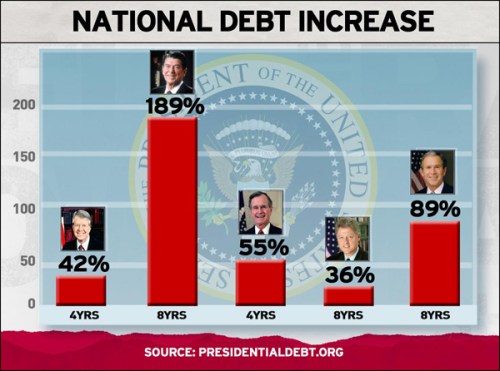
Increase in National Debt by President

Increase in national debt...by president

Humans Might Actually Like Taxes

The Wall Street Journal recently ran an article by Jonah Lehrer asking whether humans might not be as averse to paying taxes as our political discussion currently assumes. He describes a study by scientists at Caltech which showed that people dislike inequality. Study participants were put into scanners, and the pleasure areas of their brains lit up more when money was given to others than when money was given to them. This was especially true of those who had started the study “rich,” which was determined by random assignment. Following this study to its logical conclusion, perhaps people who are well off might not be as unhappy as politicians seem to think about paying higher taxes to help the less fortunate.

However, Lehrer points out that the random assignment of riches skews the study. Other studies have shown that this altruism effect is less powerful when the rich feel that their wealth is earned. When we bring this back to politics and tax rates it opens a whole can of worms. What is “earned” in a society where massive advantages (not just wealth) are passed down through the generations? I won’t open that can of worms here, but point you to this post from last year on some of the challenges of “earning” wealth for the lower classes.

Sarah Palin Gets Schooled on Economics

Alan Blinder wrote a column in Monday’s Wall Street Journal defending the Federal Reserve’s new quantitative easing (QE) policy. This policy has come under attack from many directions, including foreign ministers (worried about declines in the dollar) and Republicans (worried about inflation). In the latter camp was Sarah Palin, who criticized the policy, and then got her facts wrong about inflation, and then misquoted the Journal to defend herself.

Blinder is an economics professor at Princeton, and he takes a professor’s approach to the issue, explaining that the current bout of QE is pretty much the same as what the Fed normally does (printing money to buy short term Treasury bills), except that this time the Fed is buying long term securities. Blinder also notes that inflation is currently below the Fed’s target rate of 1.5-2%, so we have a ways to go before inflation becomes a problem, and the Fed can unwind this policy well before inflation gets out of hand.

Now some economists tend liberal, and some tend conservative, and Blinder is on the liberal site of the line, although not nearly as liberal as Paul Krugman. Yes, he also defends Keynes in the same column, and points out that the Republican phrase “job killing spending” is ridiculous. But Blinder is also a highly respected economist and co-author of one of the standard introductory texts, which I used in college. So if I had to choose who to believe on the likely effects of a Federal Reserve policy, I would choose Alan Blinder over Sarah Palin every time.