Category Archives: Business

Carbon: The Ultimate Externality

The House of Representatives just passed (barely!) the climate change bill, although analysts say that it will face a tough road in the Senate. This is the bill that includes a cap and trade system for carbon, or “cap and tax,” as the Republicans call it. Certainly the Republicans, and all the conservative bloggers, have attacked the bill, saying that it will increase the cost of energy and of many manufactured goods, and those increased costs will be passed on to consumers. And I agree; costs will go up, which is exactly the point. The cost of things that create carbon should go up. To explain this, I thought it might make sense to take a step back and discuss externalities.

In economics, “an externality…of an economic transaction is an impact on a party that is not directly involved in the transaction.” There can be positive and negative externalities, but the classic example is a negative one: pollution. If a plant manufacturing widgets spews its waste chemicals into a river, poisoning that river for 15 miles downstream, that is an externality. People downstream – fishermen, swimmers, kayak tour guides – suffer an impact from the widget manufacturing, but they have no economic say in that impact.

You might just say “whatevs,” as many have said over the years about pollution, but even the most ardent free market fan should recognize that externalities warp the market. As the supply-demand graph (a diagram dear to the heart of any good capitalist, and to me, since I was an econ major) below shows, an externality causes the market to produce too much of a good, at too low of a price, relative to the optimal solution if the externality is taken into account. This is not efficient, and economists hate inefficiency.
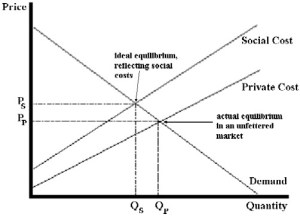
Negative_externality
Of course, as regular readers of Thoughtbasket know, I am not an ardent free market fan, so I would layer in an ethical cost as well. Why should the owners of the widget plan make money at the cost of the health of people living downriver? Who gives them the right to take the public good – the river – and ruin it?

Fortunately, both the economic and the ethical problem can be solved by actually monetizing the externality and including it in the business calculation. Polluting a common good should not be free. Assign an actual cost to polluting, and charge the factory owner that cost, and you will quickly see the plant move to producing the preferred social equilibrium quantity. Of course it is tremendously difficult to come up with the appropriate cost, but it’s difficult to go to the moon too, and we still managed that (unless you are a conspiracy theorist). Just because something is hard doesn’t mean we shouldn’t do it.

Unfortunately for factories, as science discovers more pollutants that are bad for us, there are more and more externalities that they have to take into account. Carbon and global warming are a perfect example. Carbon emissions didn’t reach the externality level – unlike, say, dioxin spewing into a lake – until science discovered that global warming was going to kill us all.

Hence, cap and trade legislation. Which is, in many ways, as the Republicans have pointed out, like a carbon tax. Either way, the point is to take what was a social cost – the spewing of carbon – and then monetize it and apply it to producers. What will happen as the costs of carbon go up? We will use less of it. Factories will figure out how to make their widgets using less carbon. People will turn their air conditioners down. Whatevs. Make carbon expensive and people will use less of it, moving production down to the appropriate social equilibrium. That’s what the economists would want, and it’s certainly what our grandkids will want.

Austin, TX Sticks it to Wall Street

The Wall Street Journal ran a great article on Thursday about how a small investment firm in Austin made a clever trade at the expense of some of the biggest Wall Street firms. Amherst Holdings wrote credit default swaps on a specific pool of mortgages, which had $29 million in loans outstanding out of an original pool of $335 million. Because these remaining loans were the dregs of the pool, everyone assumed they would default. So JP Morgan and Bank of America and their pals were willing to pay 80-90% of the face value for insurance that would give them 100% on default, apparently assuming that their own genius would allow them to book a risk-free 10-20% return.

Because people can buy these swaps without owning the underlying bonds, Amherst wrote about $130 million of the swaps, pocketing $104 million to $117 million. With the proceeds, Amherst went and paid off all $29 million of the mortgages. Therefore, there were no defaults, the swaps expired worthless, and Amherst got to keep all the proceeds. Genius! According to the WSJ, the big banks are “seething” at being outwitted by a Texas runt, and are complaining to various authorities. Wait, aren’t these the same banks who are lobbying against regulation of credit default swaps? And now they are complaining to the authorities? Stop crying like whiny little babies and take your losses. Welcome to the new world, masters of douchebaggery.

Supreme Court Agrees With Thoughtbasket

OK, the justices didn’t exactly mention me in their decision, but they did unanimously (according to Scotusblog) rule against the Indiana pension funds who were whining that they hadn’t gotten enough money for their secured debt. The highest court in the country has thus decided that the Obama administration did not violate the rule of law in pushing through the Chrysler bankruptcy. Read here my post saying just that. Of course, some argue that this issue is too political for the Court to be focused just on the law, but if that were the driving issue here, wouldn’t this conservative court be likely to rule against Obama, not for him?

Wall Street Has Gone Too Far

In the wake of the financial meltdown there has been continued tension between Main Street and Wall Street; between the working class (and the politicians who represent them) and the financiers (and the lobbyists who represent them). Despite the commentary from populists such as me who have been railing against Wall Streeters continuing to pay themselves huge bonuses, some of this tension has been between legitimate positions of free markets versus genuine concern about greed and income inequality.

But now the financiers have gone too far. First was an article last week saying that some big banks are looking at participating in the government’s PPIP (Public Private Investment Program) in order to buy their own toxic assets. Wait…so they are going to borrow cheap money from US taxpayers, and then use it to buy their own assets, with US Treasury backstopping on their losses? That is appalling without even considering the obvious conflict of interest regarding what price the assets are sold for. You have got to be kidding me.

Then today’s NY Times reports about the extensive lobbying effort that the big NY banks have launched to limit regulation of derivatives. You remember derivatives – the financial “weapons of mass destruction” that were a huge cause of the meltdown? The big banks make a ton of money on derivatives, and they don’t want that gravy train derailed. And since when they lose money, the taxpayers bail them out, they are clearly in support of the status quo. So they formed a lobbying organization and hired a big-name lawyer to lead the charge, paying him over $400,000 for four months of work. Now they are lobbying Congress to water down any sort of regulation of derivatives.

For banks that received taxpayer bailouts to now be spending money lobbying to avoid regulation on the very products that caused them to require bailouts? No way. It is time for Congress, and for the Obama administration to say “Fuck you, Wall Street.” The big banks make billions in profit on unregulated derivatives? Too damn bad. So maybe some traders will only make $2 million per year instead of $10 million. Tough shit. The Treasury Department-Wall Street axis of greed has to stop, and it has to stop now. President Obama, it’s time you step up to the plate on this.

Added bonus links: 1) Paul Krugman on how Reagan-era decisions on deregulation set the stage for financial catastrophe; and 2) a hilarious piece on Harvard Business School students taking a pledge to serve “the greater good” instead of their “narrow ambitions.” The money paragraph is the last one, with a quote about principles from a woman who is taking a job at Goldman Sachs, one of the leaders of the lobbying effort excoriated above. Oh, HBSers, it’s such a shame that you don’t understand irony.

Chrysler Bailout and Contract Law

Conservative commentators have been criticizing how President Obama handled the Chrysler bankruptcy, saying that because the Administration pushed the secured creditors to take less than the UAW, which was unsecured, the basic tenets of contract law were violated. If the Administration had actually forced the secured creditors into this position, by passing some new law or threatening to arrest them, I would completely agree with these commentators. Rule of law is an essential underpinning of the American system.

But Obama did not “force” the creditors to do anything; he simply applied leverage. This is what parties do in contentious business negotiations. Whether it’s a bankruptcy or unwinding a marketing partnership, when it gets ugly the businesspeople start deploying whatever leverage they have. In Obama’s case, he had two levers: 1) the bully pulpit of the presidency; and 2) the fact that without the UAW on board, Chrysler was worthless and the creditors would get nothing.

With his bully pulpit lever, Obama did indeed “browbeat” the creditors. But hey, this is hardball here, and there were billions of dollars at stake. Plus these are vulture funds…they are used to being insulted. With his second lever, Obama simply was playing the game of chicken that is usually played in a bankruptcy, and he won. The creditors were saying “give us what we want or we’ll take over the company” and Obama replied “take what we’re offering or we’ll give you the company.” The creditors blinked first; they knew that if they took over the company it would essentially disintegrate overnight, and they would be left with a bunch of factories nobody would buy.

I’m as big a supporter of the rule of law as anyone – I have long said that exporting law is more important than exporting democracy – but this is not a case of the government ignoring the law. Instead it’s a case of government playing by the same rules as business, but playing better, which is something the right wing ideologues just can’t handle. And lest you think I’m alone in this, here are a law professor and a private equity professional saying similar things.

Which isn’t to say that I am a blanket supporter of the auto bailouts, because I’m not. I would have been perfectly happy to see Chrysler shut down. But any criticism should be on the merits, not based on a spurious claim being advanced for political reasons.

Is Sub-prime the New Dot-com?

I recently came across an article that I wrote in 2001, right after the dot-com bubble had burst in the San Francisco area, and I was struck by how similar the themes were to articles that are being written now in the wake of the mortgage meltdown. In fact, replace “dot-com” with “sub-prime” and I could nearly publish the article as is. But I would never be so lazy with Thoughtbasket, so instead I’m going to point out some parallels between then and now. I would like to do this in table format, but my friends at WordPress haven’t added that technology yet, so I’m going to use paragraphs (very Gutenberg, I know (no, not Guttenberg)) instead.

The first, and most obvious, parallel is that of income and spending. During the dot-com boom folks in the Bay Area were making tons of money, and spending it freely. Salaries were high, and nobody bothered saving because their options were all going to be worth zillions. Every fancy restaurant in SF was packed, and there were waiting lists at the BMW and Mercedes dealerships. Audi too, but that’s an SF thing. This is remarkably similar to the mortgage and hedge fund frenzy of the past few years, including my paradigmatic example of the Cristal-swilling mortgage-writing meathead.

A second, and much less obvious, parallel is that both bubbles had specious intellectual theories trying to justify what were obviously market failures. The dot-com’s sham theory was the “new economy,” in which economic cycles were banished, cast into the dustbin of history by the ever-increasing productivity that computer technology would drive forevermore. As the recession of 2002 clearly demonstrated, the new economy was a fairy tale. The mortgage meltdown was fueled by the theory that financial firms could, using mathematical models, split up and quantify the risks in a basket of securities and then sell off the pieces to parties who had corresponding risk appetites, as calculated by their own mathematical models. As the recession of now is clearly demonstrating, the efficient market for risk is a fairy tale. Sound familiar?

The last parallel is the aftermath of the bubbles, the hangovers resulting from what were really drunken bacchanalia of faux-mastery of the universe, with the lucky few guzzling goblets of their own press and in their dizzy haze thinking themselves geniuses. Ex post partyo, of course, there is a period of regret and soul-searching (“I’m never going to drink again”), as people are humbled and their bank accounts flushed, and they try to make sense of their sudden fall from grace. In the case of the dot-com, this period lasted a few years. For a while, VCs lived by their stumbling home mantra (“I’ll never again invest in a company without a business model”), until they saw Twitter. Wall Street remains chastened, still debating whether it should stay in bed or go out for a greasy breakfast, but how long will that last? Wall Street spinmeisters are already pumping out stories about how they have to pay fat bonuses to retain good people. My prediction: by the fall of this year, we’ll see Wall Street reaching again for their beloved goblet.

Less Greed, More Patience: The Wisdom of Roald Dahl

This is the last post in my series inspired by President Obama’s inaugural call to “set aside childish things” and start pulling together for the good of the nation. And in this post, I hope to speak less of specific acts of greed and more of a general attitude that has pervaded our society over the past couple of decades. This attitude – one of “I want it all, NOW” – was perhaps not among the childish things of which the president was thinking, but its consumptive nature and its impatience certainly strikes me as childish. In fact, it reminds me of nothing so much as Veruca Salt from Willie Wonka and the Chocolate Factory (the first movie, of course, not the remake), whose constant claim of “Daddy, I want it now!” led to her falling down the garbage chute after being judged a “bad egg.”

I wrote last week about how this attitude played out in spending, with people buying houses and cars and TVs that they couldn’t afford. But it also had a dramatic impact on economic and policy decisions, or often decisions put off. Examples include:

  • Asking for lower taxes while demanding more government services
  • Expecting cutting edge medical treatments while complaining about ever-higher health care costs
  • Unwillingness to invest in infrastructure
  • Refusal to address the impending catastrophes of Social Security and Medicare
  • Managing companies for quarterly earnings instead of for the long term

I could go on and on. But don’t listen to me; the NY Times magazine put it much better a few weeks ago:

“The norms of the last two decades or so – consume before invest; worry about the short term, not the long term – have been more than just a reflection of the economy. They have also affected the economy. Chief executives have fought for paychecks that their predecessors would have considered obscenely large. Technocrats inside Washington’s regulatory agencies, after listening to their bosses talk endlessly about the dangers of overregulation, made quite sure that they weren’t regulating too much. Financial engineering became a more appealing career track than actual engineering or science.”

Frank Rich added his own take, typically overwrought, but still relevant, here. But whether the phenomenon is described by the Times or by me, the process is still the same. When we, the public, all think like Veruca Salt, then our business leaders will think the same way, and we will elect politicians who will implement Veruca Salt policies. So unless we want the whole country to go down the garbage chute, let’s be less Veruca Salt and more Charlie. Instead of wanting it all now, we can aim for getting most of it soon. Remember, Veruca was sent down to the furnace, but Charlie ended up owning the whole factory.

Greed: It’s Not Just For Wall Street

After my last post, full of invective against greed by Wall Street bankers and corporate chiefs, it’s only fair that I mention that we are all guilty of some greed. When President Obama said in his inaugural address that the current financial crisis is a result of “our collective failure to make hard choices and prepare the nation for a new age,” he wasn’t just talking about Wall Street. “Collective” means all of us, and we all share some blame. Or if not actually “all,” at least most of us.

Most of us were on a consumption binge of one sort or another. Some were buying things they didn’t need, others were buying things they couldn’t afford. The most obvious, and painful, example, is in the housing market. Folks bought more house than they could afford, and often more than they needed, seduced by low teaser rates, or by the chance to get a big win by selling it later. Others bought houses purely as investments, planning to flip them, only to be squeezed by rising mortgage payments and falling housing prices. Some refinanced with foolish mortgages, so they could “take money out of the house” and use the tax-subsidized proceeds to buy consumer products.

But it wasn’t just houses. We bought giant flat screen TVs, charging them to our credit cards. We drove around in monstrous Ford Excursions (financed by the geniuses on Wall Street), burning a gallon of gas every 15 miles. We drank bottled water instead of tap, we carried Coach purses, we stayed at 4 Seasons hotels when our income was purely Hamptons Inn.

While the Wall Street big shots may have taken huge bonuses with our tax dollars, they weren’t the only ones looking for the big score. We all wanted some goodies, whatever our income level. Those days are over. The goodies are nice, if they haven’t been repossessed, but we can’t afford them anymore. We couldn’t afford them then, which is the whole point. The days of living beyond our means are over. That doesn’t mean we’re going to be in yurts, heated only by burning cow manure. It just means that maybe we don’t need to have the biggest and newest, all the time.

Obama: Greed is “Shameful”

This is the second in a series of posts about the need for Americans to step up and be more responsible. We all knew this need was coming – it has been a theme running through many of my posts – but when President Obama called it out during his inaugural address, I decided to address it more directly. My first entry in this series was about NIMBY attitudes preventing environmental projects from moving forward. Today’s entry is about greed, particularly among corporate executives and Wall Street bankers.

When Obama said during his inauguration that “what is required of us now is a new era of responsibility — a recognition on the part of every American that we have duties to ourselves, our nation and the world,” my guess is that he meant businesspeople too. And yet just three days after the inauguration, the Wall Street Journal ran an article about companies using dicey calculations to boost the value of pension payments they are making to senior executives. I won’t get into the mathematical details, but the basic story is that instead of using IRS rates to discount the value of future pension payments, companies are using their own rates, to generate a higher payment.

For example, one of the executives profiled, John Hammergren of McKesson, is due to receive $84.6 million, rather than the $66.4 million he would be paid using the IRS rate. This man made $38 million in 2008, $25 million in 2007 and over $10 million per year for the last several years. And on top of all this money he gets paid, he is due a pension payment of $66 million. But that isn’t enough…he seems to need even more money, so he monkeys with the numbers to boost that pension by another $20 million.

Merrill Lynch is a steady source of greed. First you have John Thain (am I the only one who thinks he’s a dead ringer for Mitt Romney?)

romn

spending $1 million to redecorate his office. His excuse: the redecoration was done during better times. Dude, if you’re spending $1 million of shareholder money on office decorations, you are being greedy, no matter how well your company is doing. Then there is Thomas Montag, who Thain recruited to Merrill from Goldman Sachs with a guaranteed pay package of $39 million for 2008. Mr. Montag’s debt unit lost $16 billion in Q4 of 2008. Because of those losses, taxpayers have had to invest over $20 billion in Bank of America to support its acquisition of Merrill, and agree to share losses on $118 billion in assets. But has Montag (who, let’s not forget, after 20 years at Goldman is already rich) offered to take less of his bonus? No way. Why? Because he is greedy.

Of course, the ultimate symbol of greed was the recent news that Wall Street bankers paid themselves $18 billion in bonuses while taxpayers bailed out all their companies. It was this act of greed that President Obama called “shameful.” And he was right. For bankers to insist on getting their multi-million dollar performance bonuses, when their companies clearly had not performed, and were taking taxpayer money to survive, is the apex of greed. Companies claimed that they had to pay bonuses to retain employees. Where were those employees going to go? Bear Stearns? Lehman? I don’t think so.

Look, I understand people wanting to make money. I understand the desire to be rich. But rich people grubbing for the last dollar…I have to ask: have you no sense of decency? Responsibility and duty – to the nation, to our neighbors – means sometimes leaving a little money on the table. If we are to “begin again the work of remaking America,” as President Obama encourages us to do, reducing greed is a good place to start. How can we expect to solve problems like Social Security, health care, or global warming if everyone is grabbing as much money as they can? Whether the sacrifice is flying commercial instead of private, or buying a 30″ flat screen instead of 50″, if we are going to build America back up we must all change our attitude from “I want it all now” to “I’d like most of it, but I’m willing to share.” Let’s show a little restraint and try to come together to solve some really difficult challenges.

J.S. Mill and Financial Regulation

I was recently on vacation, which gave me a chance to reread John Stuart Mill’s On Liberty. This is a classic of the individual liberty movement, and I thought this might be an apt time to revisit it, what with the government nationalizing some financial institutions and making major investments in others, and almost certainly about to heavily reregulate the financial markets.

My expectation was that Mill would provide ammunition for those arguing against government involvement, but I was wrong. In fact, Mill clearly supports a government that is active in many affairs of its citizens, as long as there are definite and specific limits to that activity. As Mill says, “the fact of living in society renders it indispensable that each should be bound to observe a certain line of conduct toward the rest.” (p 70, all quotes from the Norton edition)

But let me take a step back. The money quote that summarizes all of On Liberty is this: “the only purpose for which power can be rightfully exercised over any member of a civilized community, against his will, is to prevent harm to others.” (p. 10) Mill’s basic position is that people should be allowed to do and say as they please, as long as they don’t harm anybody else. If left at this, Mill could easily be read to support a fully Libertarian position.

But Mill doesn’t leave it at that. Instead, he teases out a pretty broad definition of “harm,” and thereby a broad set of circumstances under which government can interfere in individual affairs. Continuing the quote from above, Mill notes “this conduct consists, first, in not injuring the interests of one another.” (p. 70) This sentence alone seems to support regulation of Wall Street, since virtually every trade has a counterparty whose interests are affected. Mill goes even further, claiming that the state can compel certain behavior from individuals: “to bear his fair share in the common defence, or in any other joint work necessary to the interest of the society of which he enjoys the protection.” (p. 12)

For Mill, the default position is to give people freedom, but he recognizes that a civil society involves so many interactions that the default may be infrequent, and thus there is significant warrant for government action. So while there are plenty of reasons to disagree with government policy on the financial bailout, John Stuart Mill is not one of them.