Tag Archives: Trends

Is Corporate Culture The Same As Country Culture?

I recently posted about corporate cultures, and how the only way a corporation can change its culture is from the top. Based on some of the feedback I received I’ve decided to expand my scope and explore a larger cultural change: how the United States might change some parts of its culture. For example, one aspect of America’s current culture that seems problematic is that we want all kinds of services (Medicare, Social Security, strong defense, good roads, etc.) but we want the lowest taxes possible. Those two desires are incompatible; a culture that emphasizes taking without giving will prove challenging in the long run.

In my prior post, I discussed that a change in corporate culture requires a CEO who is willing to push that change. In the case of a country, who might play that role? You would naturally think the president, but we know that won’t work. Plenty of recent presidents have talked about changing the culture, but none have succeeded. Hell, none of them could change the culture of a few hundred people in Congress, let alone a whole country. And that’s not really surprising; a country is not a hierarchical structure the way a company is, so people have no reason to necessarily follow what the leader says.

The president could try to lead by example, or by using the bully pulpit, but I can only imagine the furor  that would erupt  if a president (or governor, or senator, or mayor) announced that “OK people, your constant desire to get lots while paying little is complete crap; going forward we are all going to be more realistic.” No, that wouldn’t work at all.

What if all our leaders teamed up? Suppose a whole slew of politicians – national and local, democrat and republican, male and female – got together to announce an initiative aimed at realism. This could be risky, since taking a stand isn’t really what politicians do; they hate being out on limbs by themselves. But that is why they would team up with members of the other party. After all, as I noted in my prior post, cultural change requires leaders to actually lead. Then they could get business leaders on board; everyone from Warren Buffett to Charles Koch. Throw in some celebrities – nothing happens in America without celebrities – and then maybe we’d have something.

It’s possible that this is nothing but a pipe dream. Can we really expect politicians to team up in order to lecture voters? Probably it will never happen. But maybe we should expect more from our leaders.


Folder People vs. Non-Folder People

In reading reviews of the new Apple OS X (Lion), I was struck by how many reviewers mentioned the All My Files, Mission Control and Launchpad features, all of which display files and applications in a way so that users don’t have to organize their work in folders. I was reminded of when Gmail first came out, and everyone talked about how it didn’t have folders, because you could just search for whatever email you wanted to see.

This was alien to me. I have always organized my work in folders, both in my computer and in real life. When I worked in finance, each new deal got its own accordion file into which went a series of manila folders: due diligence, projections, legal issues, etc. So organizing my computer files and email into folders and sub-folders seemed completely natural to me. How else could you display your work on a computer?

Folders. Very neat, very organized. Even with a mustache.

And there I went, blithely assuming that everyone was comfortable with the folder metaphor. Sometimes I would look at someone’s computer where the desktop was a mass of unorganized icons, but I assumed that was an aberration; I must have just caught them in the middle of a crazy project.

It wasn’t until I read about computer scientist David Gelernter that I realized there might be other ways to look at your information. He developed something called Lifestreams in order “to minimize the time users spend managing their documents.” Lifestreams dumped the file and folder metaphor in favor of “a time-ordered stream of documents.” That seemed crazy to me – I would much rather look for documents “from Project Neptune” than “from sometime in 2003, which I think is when I worked on Neptune” – but it was clear that other people, even computer science people, didn’t think that way.

It appears that lots of people don’t think the way I do. Maybe most people. But whether the count is lots or most, clearly many would prefer to avoid the folder metaphor. To quote from one review of Lion, “The addition and prominence of “All My Files” is yet another vote of no-confidence in the user’s ability to understand and navigate the file system.”

So let’s add another dichotomy into which we can divide people: folder people vs. non-folder people. While improvements in search technology may eventually make this distinction obsolete, right now it seems like the non-folderites have the upper hand, with user interface designers catering to them. That’s fine, as long as folder capability still exists. But if that capability disappears, folder thinkers will have no choice but to rise up and let the Lifestreamers tremble. We have nothing to lose but our files!

More Tech Bubble Datapoints

Here are two more items showing that Silicon Valley is in the midst of another startup bubble:

  1. TaskRabbit, which has A) a dumb name; B) a terrible premise; C) the ridiculous idea that it won’t need to staff up in order to grow (because it has a terribly inexperienced CEO); and D) NO REAL BUSINESS MODEL.
  2. A WSJ article about how PR firms are now turning down clients and taking equity in lieu of cash compensation. Since the main value of PR firms is hiring cute young women who flirt with male reporters to ensure that their clients get press coverage, any time PR firms start feeling as powerful as VC funds (like they did in 1999), you know that you’re in a bubble.
  3. San Francisco apartment rents are skyrocketing, to the point that local real estate people are calling it a bubble.

More on Tipping Point Flaws

A new study out of RPI shows that when 10% of a population shares a belief, that belief will inevitably be taken up by a majority of society. And when less than 10% has a belief, it will never be taken up. This conclusion was reached by running many scenarios through various computer models of societies. Most interesting, and most daggerly through Malcolm Gladwell’s theoretical heart, is that no matter what sort of connection scheme the researchers put in their models — equal connections, some highly connected “influencers,” promiscuous connections — the results turned out the same. Yet again, Gladwell’s concept of important trend setters falls under the weight of experimental data.

No More Tipping Point

The Calculus of Romance

I’m not using calculus metaphorically in that headline. I really want to talk about calculus and romance, specifically differential calculus and romantic relationships. But this needn’t be a math lesson; you can follow the links to Wikipedia for the full details on how calculus works, or take lessons from the Khan Academy.

Generally speaking, a derivative is a measure of change, and you can take derivatives of derivatives. So a first derivative describes a function, measuring the rate of change of that function. In the graph below, the first derivative is the tangent that measures the slope of the function. A second derivative describes the rate of change of the first derivative, a third derivative describes the second, and so on. You get the point.

Illustration of derivatives

How on earth does that relate to romance? Well, consider a romantic relationship to be a function, moving along the X-axis of time. When you are discussing your relationship (which you hopefully do sometimes), that is like the first derivative – describing the trajectory of your relationship. Sometimes you may talk about how you talk about your relationship, improving your communications skills. That is the second derivative. But if you are having real problems communicating, you may talk about how you talk about talking about your relationship. That is the third order derivative, and it’s bad.

Nobody likes higher order derivatives, and nobody likes talking about talking about talking. So make sure you get those second derivatives right!

Cupcakes Anyone? Yes, Please!

As long as we are talking about bubbles (which I did here and here and here), I should note that some people also think we are in a cupcake bubble (like this person and this person and even this person). I can’t disagree; here in SF there are three cupcakeries in just a 10 block area, each selling pretty much identical over-priced cupcakes with too much frosting.

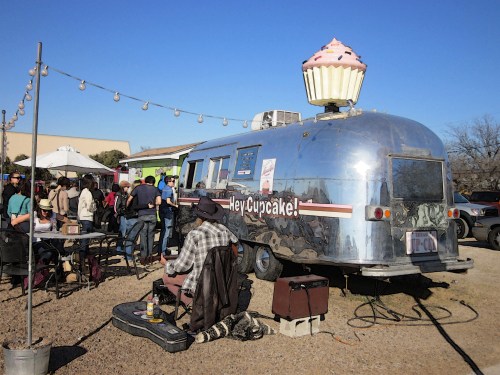
And yet, there is something special about a cupcake. Look at this photo (taken by me, in case you thought I was just a pretty writer):

The cupcake trailer, in Austin TX

Seriously, how fun does that cupcake look? Really fun. And that, I think, is the key to the cupcake’s success. They are so little and whimsical and colorful that you can’t help but smile when you see them. Most important, they have that dollop of frosting on top. Of course it’s too much, and too sweet, but it looks like a swirly party hat, a pastel pillow of creamy goodness that you could jump right into. No wonder you can’t resist a cupcake on your plate.

When you see a full cake, it looks delicious, but also kind of serious, maybe even intimidating. You have to slice it, and share it, and then probably store what you didn’t finish, and then you have the pressure to keep eating the leftovers so that you can finish them before they start to get hard and crusty in the refrigerator. A cupcake, on the other hand, has none of those difficulties. No slicing, no leftovers, no pressure. Just pop it in your mouth (one, two or three bites…it’s up to you) and be transported back to your childhood.

So yes, there is definitely a bubble in cupcake bakeries, but the cupcakes themselves will continue to crowd out cakes, as long as we prefer fun to dour in our desserts made out of flour.


More on the Tech Bubble

One day, two NY Times articles bolstering the bubble hypothesis.

One explicitly describes the bubbly behavior of investing $41 million in photo-sharing startup Color before it even launched its product.

The other describes how some Wall Street broker-dealers with no experience in technology are throwing money at shares in hot private companies. Fast-money Wall Streeters are one step above the shoe shine boy when it comes to bubble indicators.

Yes, It Is A Tech Bubble

We’ve seen lots of talk recently about whether there is another technology bubble going on, with LinkedIn’s super successful IPO, and shares of Facebook, Twitter, et. al. trading on secondary markets at multibillion dollar valuations. I lived through the first dot.com bubble in 1999-2001, and based that experience I am saying right here, categorically and emphatically, that we are definitely in another bubble. I will add some caveats at the end, but listed below are my top reasons for calling this a bubble. Every single thing I list below also happened in 2000, and made rational observers then realize that we were in a bubble. The more things change, the more they stay the same.

A) Insanely high valuations with no reasonable relation to the metrics (revenue, income) of the company (LinkedIn, Groupon)

B) Retail investor hunger for tech stocks. Back in 1999, we were all talking about Joe Kennedy’s famous line: “when you get stock tips from your shoeshine boy, it’s time to sell.” When the public is hungry to invest in a category, it’s a bubble

C) Farcical metrics. In the dot.com era we were supposed to look at eyeballs, not revenues. Now Groupon tells us that we should ignore marketing costs and look at “adjusted consolidated segment operating income

D) The emergence and venture funding of many copycat businesses. How many flash sale or social coupon businesses do people need? And what about Color, which raised $41 million to launch yet another iPhone photo sharing service, and reputedly only shared 5 photos during the iPhone developers conference and had its president leave within months of launch?

E) Especially the emergence and venture funding of narrow vertical copycats. For example, Juice in the City is Groupon for moms, Pawsley is Facebook for dogs, Everloop is Facebook for tweens (who will, by definition, leave as soon as they are old enough to join Facebook), etc. Anyone who lived through the dot.com remembers “vertical portals.” That didn’t work out so well.

F) Society and entertainment figures or kids fresh out of Stanford and Harvard business school as entrepreneurs.  (Juice in the City, Rent the Runway, Ashton Kutcher.)

G) Venture funds you’ve never heard of leading rounds in vertical copycats (Juice in the City funded by HU Investments and Tandem Enterprises)

H) Companies you’ve never heard of buying prime time TV commercials (Peel)

I) Ridiculous and nearly identical company names (Buzzr, Socialzr, Apptizr  etc.)

J) Weekly launching of new “incubators,” in which people, some with limited experience, will mentor new companies in return for some equity (Growlab, Capital Factory). Or one incubator, 500 Startups, that funded two nearly identical companies: StoryTree and Vvall.

K) Putting a tech sheen on non-tech companies so that they can raise money at tech company valuations (The Melt)

L) Features posing as companies. A clever little web widget, even a useful one that gets a lot of users, might not be enough to support a viable company. And starting companies that you know can only succeed by being acquired is a classic bubble move. For example, StumbleUpon, Blippy. Actually, Blippy alone is enough to prove my bubble hypothesis. Only in a bubble could that company have even existed.

Now for the caveats, or counterpoints:

As many have noted, some of these companies, particularly the big ones (LinkedIn, Groupon) are generating real revenues. Back in 2000, revenues were a rare thing. However, I should note that neither LinkedIn nor Groupon are particularly profitable. Neither is Pandora. Twitter still doesn’t really have a revenue model. The random widgets and apps that are raising money? Not so revenuefull.

There are more customers now. With the spread of broadband and smartphones, an online business has a much larger base of potential customers than in 1999. That means that the same capital investment can, theoretically, be spread over a much larger revenue base.

This bubble is focused on consumer-facing internet businesses. Not all tech companies are being lifted by the bubble. Microsoft, Google, Amazon and the ilk at still trading at normal to relatively normal valuations.

Questions and Comments About Words

Why is the word “emasculate?” Wouldn’t it be better if it was “demasculate?” And then you could reverse it, with “remasculate.”

And speaking of improving words, “nefariousness” is just a lame version of “nefarious,” which is a great word. My proposal: “nefarity” as the new noun version.

Final comment: “adequacy” is merely adequate. “Adequacity” is a much fuller and rounder way of describing the state of being adequate. And wouldn’t we all be better off if we were more accepting of things that are simply adequate?

The Newspaper of the Future (ie. Now)

The painful decline of the daily city newspaper is well chronicled by now, so much so that there is even an entire website dedicated to watching newspapers die. The causes are myriad (see the footnote below), but they can generally be tied to A) the internet; and B) changing patterns in the consumption of information.

Papers have tried a variety of approaches to counter these trends, with most of these approaches based on changing websites (paid, free, semi-paid!) and cutting costs. Few of these approaches, however, have even touched on content strategy. As regular Thoughtbasket readers know, I firmly believe that content is king.  My thoughts on what city newspapers should do are highly influenced by my reaction to my local news market, San Francisco. SF’s historical daily, The Chronicle is, and always has been, a terrible paper. The Chronicle’s website, SFGate, is even worse than the paper.

My advice is pretty simple: relentless focus on local journalism. Cover city hall, cover local issues, cover local teams. Big parade for Columbus Day? Cover it. District attorney owns a strip club on the side? Cover it. Downtown real estate prices dropping? Cover it. Cut costs by getting rid of all non-local coverage. A city paper doesn’t need any national or world coverage. License a few AP stories to give your readers the big picture basics, but certainly don’t have a Washington bureau. Maybe, if your city is big enough (ie. Chicago, LA and not much else), you have one reporter in DC to cover what your Congressmen do. In the same vein, maybe you have a reporter in your state capital, but purely to cover local issues. Leave broad coverage of the state capital to that city’s paper. If your readers want state, national or world news, they know how to find it: on the internet!

Do people care about local coverage? Absolutely. Think about the old axiom that all politics is local. Because people care a lot more about the pot holes near their homes than they do about Washington DC discussions of foreign aid. In my city, San Francisco, there are not one but TWO new papers that have launched purely to provide deep local coverage. Both are non-profits, it’s true, but they clearly sense a consumer need or they wouldn’t have bothered to raise the money required to launch. And that is in addition to the two local alternative weeklies, one of which has repeatedly (like the two stories summarized here) broken major stories about local politics that the Chronicle has missed. Plus you have AOL’s Patch, which provides hyper-local coverage. Moreover, the old afternoon paper, The Examiner, is still around, although kept alive through some payment deal with the Chronicle. The presence of all these local news sources tells you that people want to read local coverage. The question is why the big legacy local papers, who should own this space, don’t cover it.

Some people say that you can’t make money on local news because good local coverage will eventually cause discomfort to the powerful and wealthy in the community, who will then pull advertising. Certainly a strong local paper will, at some point, have to cause some pain to the city’s power brokers. Since most cities are run by a few wealthy families, a couple of businesses, and real estate interests, everybody knows what the sensitivities are. But it’s exactly those sensitivities – corrupt politicians, incompetent civil servants, venal and debauched businessmen – that readers crave. Readers want to know the truth about the powerful, and as long as a paper speaks that truth, it will have readers. And if a paper has readers, there will always be advertisers ready to pay to reach those readers.

Footnote with more specific causes of newspaper decline:

  • Craigslist
  • The end of the local department store
  • Decreased public acceptance of journalistic “authority”
  • Family dynasties seeking cash instead of a legacy (hello Bancrofts)
  • A generation that prefers screens to paper
  • Lower margins for car dealers