Tag Archives: economics

Carbon: The Ultimate Externality

The House of Representatives just passed (barely!) the climate change bill, although analysts say that it will face a tough road in the Senate. This is the bill that includes a cap and trade system for carbon, or “cap and tax,” as the Republicans call it. Certainly the Republicans, and all the conservative bloggers, have attacked the bill, saying that it will increase the cost of energy and of many manufactured goods, and those increased costs will be passed on to consumers. And I agree; costs will go up, which is exactly the point. The cost of things that create carbon should go up. To explain this, I thought it might make sense to take a step back and discuss externalities.

In economics, “an externality…of an economic transaction is an impact on a party that is not directly involved in the transaction.” There can be positive and negative externalities, but the classic example is a negative one: pollution. If a plant manufacturing widgets spews its waste chemicals into a river, poisoning that river for 15 miles downstream, that is an externality. People downstream – fishermen, swimmers, kayak tour guides – suffer an impact from the widget manufacturing, but they have no economic say in that impact.

You might just say “whatevs,” as many have said over the years about pollution, but even the most ardent free market fan should recognize that externalities warp the market. As the supply-demand graph (a diagram dear to the heart of any good capitalist, and to me, since I was an econ major) below shows, an externality causes the market to produce too much of a good, at too low of a price, relative to the optimal solution if the externality is taken into account. This is not efficient, and economists hate inefficiency.
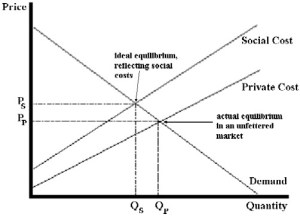
Negative_externality
Of course, as regular readers of Thoughtbasket know, I am not an ardent free market fan, so I would layer in an ethical cost as well. Why should the owners of the widget plan make money at the cost of the health of people living downriver? Who gives them the right to take the public good – the river – and ruin it?

Fortunately, both the economic and the ethical problem can be solved by actually monetizing the externality and including it in the business calculation. Polluting a common good should not be free. Assign an actual cost to polluting, and charge the factory owner that cost, and you will quickly see the plant move to producing the preferred social equilibrium quantity. Of course it is tremendously difficult to come up with the appropriate cost, but it’s difficult to go to the moon too, and we still managed that (unless you are a conspiracy theorist). Just because something is hard doesn’t mean we shouldn’t do it.

Unfortunately for factories, as science discovers more pollutants that are bad for us, there are more and more externalities that they have to take into account. Carbon and global warming are a perfect example. Carbon emissions didn’t reach the externality level – unlike, say, dioxin spewing into a lake – until science discovered that global warming was going to kill us all.

Hence, cap and trade legislation. Which is, in many ways, as the Republicans have pointed out, like a carbon tax. Either way, the point is to take what was a social cost – the spewing of carbon – and then monetize it and apply it to producers. What will happen as the costs of carbon go up? We will use less of it. Factories will figure out how to make their widgets using less carbon. People will turn their air conditioners down. Whatevs. Make carbon expensive and people will use less of it, moving production down to the appropriate social equilibrium. That’s what the economists would want, and it’s certainly what our grandkids will want.

Treasury Plan Turns Taxpayers into Dumb Money

Yesterday’s Wall Street Journal ran an article about how the Treasury’s bank buyout fund is luring “thousands of banks.” When the program was first announced, banks were afraid to apply, thinking it would make them look weak, but now they are afraid not to apply, since not having government money could make banks look like they were too weak to qualify.

But the article also noted that banks are thronging the Treasury because the Treasury capital – taxpayer capital – is so cheap. Here is the money quote:

Now institutions across the U.S. worry that if they don’t try for the money, the market will judge them as too unhealthy to qualify, or lacking the savvy to deploy cheap government capital on acquisitions and investments.

Many years ago I worked for a venture fund that was captive to a small investment bank. All the other VCs looked at us as dumb money. “Nobody else will invest in it, call those guys…they’ll do anything to get a banking fee.” Dumb money is who you call to bail out your losers. Dumb money accepts whatever price you offer, and doesn’t ask for better terms.

The Treasury department, acting on behalf of the taxpayers, is dumb money. WE’RE dumb money. That sucks.

More on the Laffer Curve

I recently discovered another tidbit that points out the lunacy of the Laffer Curve. Harvard economist Greg Mankiw – former Chairman of George W. Bush’s Council of Economic Advisorsquotes David Stockman, who was telling a story about Ronald Reagan:

[Reagan] had once been on the Laffer curve himself. “I came into the Big Money making pictures during World War II,” he would always say. At that time the wartime income surtax hit 90 percent. “You could only make four pictures and then you were in the top bracket,” he would continue. “So we all quit working after four pictures and went off to the country.” High tax rates caused less work. Low tax rates caused more. His experience proved it.

But that example is irrelevant to the actual economy. Movie actors can stop making movies when they feel like it. But people with real jobs, even big shots on Wall Street or in venture capital, or entrepreneurs, like John McCain’s “Joe the plumber” from last night’s debate, can’t just stop working in the fall when they’ve earned enough money. In the real world, you keep working all year, even if you don’t need the money you’ll make in those last two months, because you’ll lose your job if you stop working, or because your employees need the money even if you don’t. The fact that the Reagan economic plan, and thus Republican orthodoxy, was built on the unusual case of movie star economics is profoundly disturbing.

Republican Tax Policy

Republican tax policy is so big a target it’s almost hard to know where to begin. But I’ll start with the most basic fact: Republic policy is to cut taxes. In general, Republicans will always push for lower taxes. Income taxes? Lower. Capital gains? Lower. Corporate taxes? Lower. Got yourself a financial crisis? Lower taxes will solve your problem!

The Republican quest for lower taxes is driven by three major impulses, one philosophical, one economic, and one greedy. I’ll discuss each impulse in turn.

The philosophical impulse is, broadly speaking, that the government shouldn’t take what you earn. As the current GOP platform puts it, not only should you “keep more of what you earn,” but “government should tax only to raise money for its essential functions.” But this too has multiple components. Saying “essential functions” relates to the Republican emphasis on small government. I already dealt with that ridiculous canard here, so I shall discuss it no further.

But keeping more of what you earn, to Republicans that’s just part of liberty and freedom, Mom and apple pie. As the Club for Growth puts it, they believe that “opportunity come(s) through economic freedom.” I get that; part of the American foundational myth is freedom from the heavy hand of government – no taxation without representation and all that. But notice that the famous phrase does NOT say “no taxation,” it just demands fair representation. In fact, Section 2 of the Constitution, the fifth paragraph in the entire document, condones taxation. The Founders didn’t equate freedom with reduced taxation.

The pairing of freedom and low taxes is merely a Republican shibboleth, one that we are all supposed to believe because they have repeated it so often. Yet why must society accept their definition of freedom? After all, cannot freedom also mean living in a safe, just and ordered society? That society requires government, and government requires taxes. Or, as Oliver Wendell Holmes said, “taxes are the price of civilization.”

The second Republican impulse to lower taxes is economic. The theory is that lowering taxes stimulates growth.  Again, from the GOP platform: “Republicans lowered taxes in 2001 and 2003 in order to encourage economic growth.” Yes, under standard Keynesian economics, a tax cut will put more money into the economy and thereby stimulate consumption. But the Republican view is based more on the theory that tax cuts fuel productive investment. That theory is based primarily on the Laffer Curve. Dr. Laffer himself: “The higher tax rates are, the greater will be the economic (supply-side) impact of a given percentage reduction in tax rates.”

Famous for being sketched on a cocktail napkin in a Washington DC restaurant, the Laffer Curve states that at 100% taxation the government will make no money, since all activity will cease. Sure, and when the sun explodes, all activity will also cease. Duh. But that doesn’t mean that lowering taxes inevitably leads to more activity, which is how Republican supply-siders generally interpret Laffer. Simple common sense rejects that implication of Laffer; does anyone really believe that investor X or entrepreneur Y will refuse to build a company because their gains will be taxed at 60% instead of 30%? That’s ridiculous. And all empirical studies agree. No study supports Laffer effects at any tax rate below 90%.

Here are just a few links to various studies and summaries:

But Harvard economist Jeff Frankel put it best: “The Laffer Proposition, while theoretically possible under certain conditions, does not apply to US income tax rates:  a cut in those rates reduces revenue, precisely as common sense would indicate.”

Bottom line: this Republican concept that lowering tax rates will unleash torrents of investment and innovation is rubbish. It defies common sense, and every academic study proves it to be wrong.

The third and last Republican impulse driving taxes lower is pure greed. Quite simply, they want to keep more of the money they make. And again, I understand that; nobody really likes giving money away, especially to a government that may spend your money on things you don’t support.  But the Republicans driving this policy aren’t exactly Joe Sixpack, working class stiffs hoping to keep more of their hourly wages. Instead, they are folks like Stephen Moore and Grover Norquist, white middle-class intellectuals who have never had to worry about money or needed the support that tax dollars provide to the less fortunate. Or, even more pointedly, they are Wall Street titans like Henry Kravis and Steve Schwarzman, of KKR and Blackstone Group, who are worth billions and really don’t need the extra money. An article in yesterday’s Wall Street Journal noted that these and other Wall Street bigwigs were finally supporting McCain because “ ‘Reality set in,’ one fund-raiser said. ‘Donors realized they could face an Obama administration next month.’ They are petrified they will face steep increases in personal and corporate tax rates, this person said.” Schwarzman took home over $700 million when Blackstone went public. Does he really need a lower tax rate on his future income?

A New American Sense of Responsibility?

Over the past few months I have seen more and more data indicating that Americans are cutting back their consumption in the face of the deteriorating economic situation. Retailers, restaurants, car companies, airlines – it seems as if everybody is feeling the pain. Just last week the Wall Street Journal called the trend “U.S. Retools Economy, Curbing Its Thirst for Oil.”

I am wondering if maybe this trend will last beyond the current economy and represent a new, or renewed, sense of responsibility in America. The past few decades have been an orgy of consumerism in America (and much of the developed world, but I’ll focus on America simply because I know it best), as people lived beyond their means, purchasing things they didn’t need and couldn’t afford. Possibly the best quote I have heard on this trend came from Art Wong, a worker at the port of Long Beach, who was on NPR’s Marketplace:

You know, we’re being stretched, and I turn to my kids every so often and I ask them, how many more pairs of jeans do they need? How many more handbags can they buy? And how much room do they have in their closets? And they keep going, and they keep buying, and the port keeps seeing more and more cargo coming through here.

This consumption frenzy brought with it a number of problems. There were environmental considerations, both from the production of consumer goods and from the gasoline sucked down by the SUVs that were a major outlet of purchasemania. There were price dislocations from people purchasing items (homes, Tiffany bracelets, fancy meals) that they couldn’t afford. There were macroeconomic impacts as we financed our purchases with overseas capital. Finally, I think there were moral and psychological consequences (not surprising to regular readers of this blog) from an entire population giving up on any sort of self-restraint or thought for the future.

With gas prices above $4 per gallon and economic growth stagnating, our reduced consumption is not surprising. But maybe, just maybe, this decline in purchasing represents a broader change, a sense that untrammeled consumerism is simply unsustainable. Perhaps people were jolted awake by the impact on the environment, or the national security ramifications of our addiction to oil, or the deflation of the housing bubble. Are Americans now looking beyond their own material wants?

Maybe, and maybe not. Perhaps there is no broader sense of responsibility, but rather the inexorable force of economics. Maybe people still don’t care about the environment or national security, and all they really want is a bigger Jet Ski, but they simply no longer have the money to satisfy their wants. That is certainly what the economists think. “We’re going back to the good old days of living within our means,” said David Rosenberg, chief North American economist for Merrill Lynch. Adds another:

We’re seeing the birth pangs of a new economic structure,” said Neal Soss, chief economist for Credit Suisse First Boston. “The next year or two or three will be about the transition to a new equilibrium. Consumption by households will grow more slowly than their incomes, which is the exact opposite of the last 25 years when consumption grew faster than incomes.”

Although I would prefer to think that we are getting more responsible, and that issues larger than our checkbook are driving these new spending patterns, I suspect that A) the economists are right; and B) it may not really matter. Even if economics are behind the change, those economic conditions show no signs of changing in the near future, or possibly the medium future. There is even a theory that this shift is permanent, and that America’s days of being an economic powerhouse are over. “The world has become multipolar,” according to UC Berkeley economist Barry Eichengreen. “Our dominance will decline.” Jared Diamond, of Guns, Germs & Steel fame, even says that the developed world only has 30-50 years of first world living before we outstrip our own resources.

Either way, this change in spending, this “retooling of the economy,” looks like it will be with us for a while. This has tremendous implications for companies that sell to consumers. Think about:

  • Utilities dealing with decreased demand for energy
  • Car companies finally forced to produce smaller cars
  • Construction with a focus on energy efficiency and green materials
  • Appliances that are cheaper, smaller and use fewer resources
  • Consumers actually turning down credit card offers because they aren’t buying things
  • Retailers changing their product assortment
  • Discounters (Wal-Mart) gaining market share at the expense of stores that catered to the overreachers (Neiman-Marcus)

Convenience Consumption, Part 2

Just a few days after finishing my entry on convenience consumption I read in The Atlantic a great article by Virginia Postrel on what she termed “inconspicuous consumption.” She explores the works of several economists who show that spending on visible consumption goes up as neighborhood income goes down. In other words, people in poor neighborhoods are more likely to buy flashy cars and watches than people in wealthy neighborhoods.

Postrel notes that when Veblen was writing in 1899, America was a much poorer country than it is now, so the wealthy wanted to show off. But now, the wealthy have already established themselves, so it’s the better off among the poor who engage in the most conspicuous consumption. She quotes Euromonitor:

“Bling rules in emerging economies still eager to travel the status-through-product consumption road….[but] bling isn’t enough for growing numbers of consumers in developed economies.”

This plays right into my thesis of convenience consumption. The upper class no longer needs to display its wealth, so it displays its importance, as measured by convenience. Gaudy bling has been left to the hoi polloi while the upper class focuses on Fiji water and packaged meals from Whole Foods.