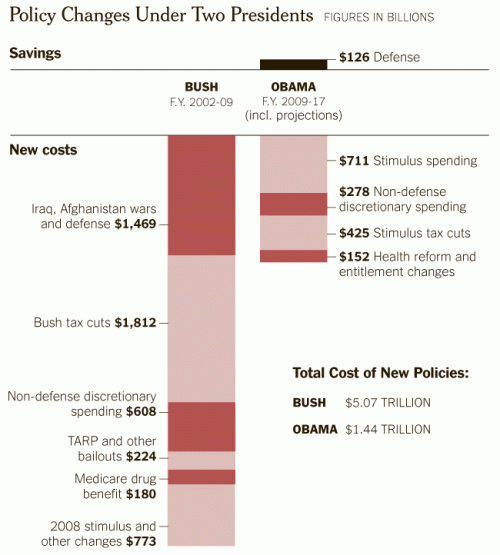
Courtesy NY Times

Courtesy NY Times
Here are two more items showing that Silicon Valley is in the midst of another startup bubble:
Posted in Business, Technology, Trends
Tagged bubble, Business, silicon valley, tech bubble, Technology, Trends, venture capital
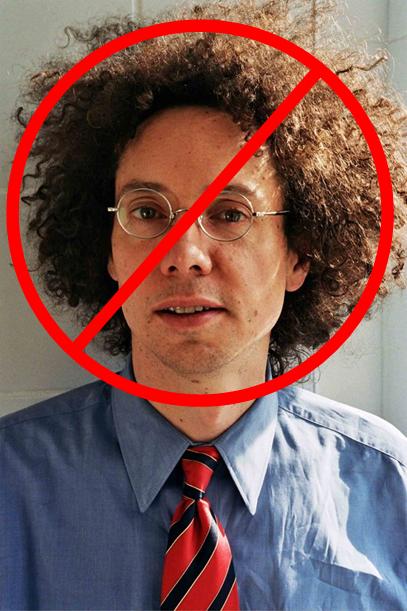
A new study out of RPI shows that when 10% of a population shares a belief, that belief will inevitably be taken up by a majority of society. And when less than 10% has a belief, it will never be taken up. This conclusion was reached by running many scenarios through various computer models of societies. Most interesting, and most daggerly through Malcolm Gladwell’s theoretical heart, is that no matter what sort of connection scheme the researchers put in their models — equal connections, some highly connected “influencers,” promiscuous connections — the results turned out the same. Yet again, Gladwell’s concept of important trend setters falls under the weight of experimental data.
No More Tipping Point
Posted in Business, Pop culture, Technology, Trends
Tagged beliefs, Business, influencers, malcolm gladwell, marketing, Pop culture, Technology, Trends
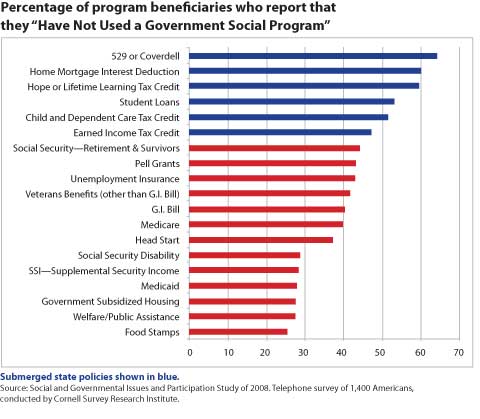
OK, maybe not all of us. But a lot of us. Really a lot. Cornell political scientist Suzanne Mettler has an article in the Washington Monthly about what she calls the “submerged state,” or the massive amounts of money at play in various tax deductions (eg. the mortgage interest deduction) that benefit particular populations.
As the chart below shows, there are all kinds of tax deductions that many people take, but those same people continue to insist that they don’t get any help from the government. Mettler’s point, backed up by her survey data: despite their cost, these programs are invisible to the public, making the public more susceptible to claims that government is too big.
James Fallows posts a comment from a businessman on what really creates jobs:
“IT’S DEMAND, STUPID!…A few more customers and I’ll hire another worker. Look, guys, that’s what we do out here! Don’t worry about cutting my taxes, don’t concern yourself with over-regulating me, don’t fuss about the “death tax” depriving my progeny of the joy of running my business. That is all trivia! This is all about Demand Side Economics.”
Exactly. Businesses don’t base their hiring decisions on taxes or uncertainty. They invest (in people or machines) to meet demand.
Also in the economic vein, here is Joe Stiglitz on the failure of pure free market economics.
As long as we are talking about bubbles (which I did here and here and here), I should note that some people also think we are in a cupcake bubble (like this person and this person and even this person). I can’t disagree; here in SF there are three cupcakeries in just a 10 block area, each selling pretty much identical over-priced cupcakes with too much frosting.
And yet, there is something special about a cupcake. Look at this photo (taken by me, in case you thought I was just a pretty writer):
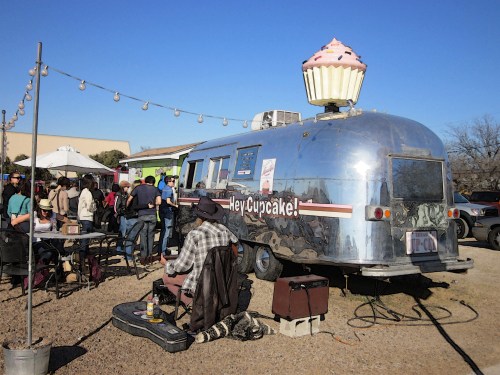
The cupcake trailer, in Austin TX
Seriously, how fun does that cupcake look? Really fun. And that, I think, is the key to the cupcake’s success. They are so little and whimsical and colorful that you can’t help but smile when you see them. Most important, they have that dollop of frosting on top. Of course it’s too much, and too sweet, but it looks like a swirly party hat, a pastel pillow of creamy goodness that you could jump right into. No wonder you can’t resist a cupcake on your plate.
When you see a full cake, it looks delicious, but also kind of serious, maybe even intimidating. You have to slice it, and share it, and then probably store what you didn’t finish, and then you have the pressure to keep eating the leftovers so that you can finish them before they start to get hard and crusty in the refrigerator. A cupcake, on the other hand, has none of those difficulties. No slicing, no leftovers, no pressure. Just pop it in your mouth (one, two or three bites…it’s up to you) and be transported back to your childhood.
So yes, there is definitely a bubble in cupcake bakeries, but the cupcakes themselves will continue to crowd out cakes, as long as we prefer fun to dour in our desserts made out of flour.
Posted in Business, Pop culture, Trends
Tagged austin, baked goods, Business, consumption, cupcakes, food, food trucks, Pop culture, texas, Trends
Come on people, you’re making it too easy for me. A social network for people with curly hair?
One day, two NY Times articles bolstering the bubble hypothesis.
One explicitly describes the bubbly behavior of investing $41 million in photo-sharing startup Color before it even launched its product.
The other describes how some Wall Street broker-dealers with no experience in technology are throwing money at shares in hot private companies. Fast-money Wall Streeters are one step above the shoe shine boy when it comes to bubble indicators.
Posted in Business, Technology
Tagged bubble, Business, economics, tech bubble, Technology, Trends
According to a recent WSJ article, each year ranchers from throughout the middle of the country take their cattle to Kansas to feed on the lush prairie grass that grows during the summer. As is often the case in plains and prairies, the grass is only lush if they burn out the brush, which the ranchers do each spring. This sends smoke with the wind, which sometimes takes the smoke to Wichita or Kansas City. As a consequence, those cities sometimes violate EPA clean air standards.
The EPA is trying to work with the ranchers on a way to avoid having their smoke drift over populated areas, primarily by only burning when the winds are travelling in the other direction. But the EPA is threatening stronger measures if the voluntary methods don’t work.
The ranchers are pushing back. They don’t want to change their ways. Why? Because it will cost them money. They are valuing their income above the health of strangers. Lots of strangers. Kansas City has more than 2,000,000 inhabitants.
Rancher Mike Collinge says “People in Wichita and Kansas City, they’ll complain a little. So will my wife. But I don’t think it’s causing huge air-quality problems.” He doesn’t think it’s causing problems. Of course, he doesn’t live in Wichita or Kansas City. He has no idea what it’s really like there. What he thinks is completely contrary to what the scientists say. That is what Stephen Colbert calls “truthiness.” In other words, and appropriate to this post, BS.
According to the article, the burning and subsequent lush grass gets ranchers about $40 more per head of cattle. Depending on how much cattle you have, of course that could add up. But let’s put it into context. The current market price for beef cattle is about $110 per 100 pounds. It’s unclear why they quote cattle prices in hundredweight and meat prices per pound, but that’s how it’s done. An average cow weighs about 1,200 pounds, which means it’s worth $1,320. That $40 savings is 3% of $1,320.
So these ranchers are willing to risk the health of millions of people, just to increase their income by 3%. That’s nice. Apparently the cowman and the farmer can’t be friends.
 Thoughtbasket