More Tech Bubble Data

Come on people, you’re making it too easy for me. A social network for people with curly hair?

More on the Tech Bubble

One day, two NY Times articles bolstering the bubble hypothesis.

One explicitly describes the bubbly behavior of investing $41 million in photo-sharing startup Color before it even launched its product.

The other describes how some Wall Street broker-dealers with no experience in technology are throwing money at shares in hot private companies. Fast-money Wall Streeters are one step above the shoe shine boy when it comes to bubble indicators.

Ranchers to City Folk: Screw You

According to a recent WSJ article, each year ranchers from throughout the middle of the country take their cattle to Kansas to feed on the lush prairie grass that grows during the summer. As is often the case in plains and prairies, the grass is only lush if they burn out the brush, which the ranchers do each spring. This sends smoke with the wind, which sometimes takes the smoke to Wichita or Kansas City. As a consequence, those cities sometimes violate EPA clean air standards.

The EPA is trying to work with the ranchers on a way to avoid having their smoke drift over populated areas, primarily by only burning when the winds are travelling in the other direction. But the EPA is threatening stronger measures if the voluntary methods don’t work.

The ranchers are pushing back. They don’t want to change their ways. Why? Because it will cost them money. They are valuing their income above the health of strangers. Lots of strangers. Kansas City has more than 2,000,000 inhabitants.

Rancher Mike Collinge says “People in Wichita and Kansas City, they’ll complain a little. So will my wife. But I don’t think it’s causing huge air-quality problems.” He doesn’t think it’s causing problems. Of course, he doesn’t live in Wichita or Kansas City. He has no idea what it’s really like there. What he thinks is completely contrary to what the scientists say. That is what Stephen Colbert calls “truthiness.” In other words, and appropriate to this post, BS.

According to the article, the burning and subsequent lush grass gets ranchers about $40 more per head of cattle. Depending on how much cattle you have, of course that could add up. But let’s put it into context. The current market price for beef cattle is about $110 per 100 pounds. It’s unclear why they quote cattle prices in hundredweight and meat prices per pound, but that’s how it’s done. An average cow weighs about 1,200 pounds, which means it’s worth $1,320. That $40 savings is 3% of $1,320.

So these ranchers are willing to risk the health of millions of people, just to increase their income by 3%. That’s nice. Apparently the cowman and the farmer can’t be friends.

Yes, It Is A Tech Bubble

We’ve seen lots of talk recently about whether there is another technology bubble going on, with LinkedIn’s super successful IPO, and shares of Facebook, Twitter, et. al. trading on secondary markets at multibillion dollar valuations. I lived through the first dot.com bubble in 1999-2001, and based that experience I am saying right here, categorically and emphatically, that we are definitely in another bubble. I will add some caveats at the end, but listed below are my top reasons for calling this a bubble. Every single thing I list below also happened in 2000, and made rational observers then realize that we were in a bubble. The more things change, the more they stay the same.

A) Insanely high valuations with no reasonable relation to the metrics (revenue, income) of the company (LinkedIn, Groupon)

B) Retail investor hunger for tech stocks. Back in 1999, we were all talking about Joe Kennedy’s famous line: “when you get stock tips from your shoeshine boy, it’s time to sell.” When the public is hungry to invest in a category, it’s a bubble

C) Farcical metrics. In the dot.com era we were supposed to look at eyeballs, not revenues. Now Groupon tells us that we should ignore marketing costs and look at “adjusted consolidated segment operating income

D) The emergence and venture funding of many copycat businesses. How many flash sale or social coupon businesses do people need? And what about Color, which raised $41 million to launch yet another iPhone photo sharing service, and reputedly only shared 5 photos during the iPhone developers conference and had its president leave within months of launch?

E) Especially the emergence and venture funding of narrow vertical copycats. For example, Juice in the City is Groupon for moms, Pawsley is Facebook for dogs, Everloop is Facebook for tweens (who will, by definition, leave as soon as they are old enough to join Facebook), etc. Anyone who lived through the dot.com remembers “vertical portals.” That didn’t work out so well.

F) Society and entertainment figures or kids fresh out of Stanford and Harvard business school as entrepreneurs.  (Juice in the City, Rent the Runway, Ashton Kutcher.)

G) Venture funds you’ve never heard of leading rounds in vertical copycats (Juice in the City funded by HU Investments and Tandem Enterprises)

H) Companies you’ve never heard of buying prime time TV commercials (Peel)

I) Ridiculous and nearly identical company names (Buzzr, Socialzr, Apptizr  etc.)

J) Weekly launching of new “incubators,” in which people, some with limited experience, will mentor new companies in return for some equity (Growlab, Capital Factory). Or one incubator, 500 Startups, that funded two nearly identical companies: StoryTree and Vvall.

K) Putting a tech sheen on non-tech companies so that they can raise money at tech company valuations (The Melt)

L) Features posing as companies. A clever little web widget, even a useful one that gets a lot of users, might not be enough to support a viable company. And starting companies that you know can only succeed by being acquired is a classic bubble move. For example, StumbleUpon, Blippy. Actually, Blippy alone is enough to prove my bubble hypothesis. Only in a bubble could that company have even existed.

Now for the caveats, or counterpoints:

As many have noted, some of these companies, particularly the big ones (LinkedIn, Groupon) are generating real revenues. Back in 2000, revenues were a rare thing. However, I should note that neither LinkedIn nor Groupon are particularly profitable. Neither is Pandora. Twitter still doesn’t really have a revenue model. The random widgets and apps that are raising money? Not so revenuefull.

There are more customers now. With the spread of broadband and smartphones, an online business has a much larger base of potential customers than in 1999. That means that the same capital investment can, theoretically, be spread over a much larger revenue base.

This bubble is focused on consumer-facing internet businesses. Not all tech companies are being lifted by the bubble. Microsoft, Google, Amazon and the ilk at still trading at normal to relatively normal valuations.

Great Singer/Songwriter

http://www.myspace.com/sharonvanetten

Questions and Comments About Words

Why is the word “emasculate?” Wouldn’t it be better if it was “demasculate?” And then you could reverse it, with “remasculate.”

And speaking of improving words, “nefariousness” is just a lame version of “nefarious,” which is a great word. My proposal: “nefarity” as the new noun version.

Final comment: “adequacy” is merely adequate. “Adequacity” is a much fuller and rounder way of describing the state of being adequate. And wouldn’t we all be better off if we were more accepting of things that are simply adequate?

Are Successful Religions Just Lucky?

Religion scholars have long said that what separates a religion from a sect is success. In other words, religions all start as small sects; if they stay that way, we never hear about them, but if they grow, then over time they become a religion. But these scholars haven’t really discussed what makes one sect succeed and one not, or if they have, it’s in the context of ex post facto justification of the success. History is written by the victors and all that.

Adherents of most faiths say that their religions have grown because they are right. The religion is the word of god, and so naturally it gains more and more followers. Non-believers, and even some adherents who see a religion as metaphor rather than the literal word of god, would say that their church has grown and lasted because it provides wisdom and values and spiritual succor.

But what if they are all wrong, and the successful religions were simply in the right place and the right time. What if religions succeed purely based on random luck?

This hypothesis of religious randomness is based on the work of Duncan Watts, a sociologist who I’ve mentioned before, in the context of showing that Malcolm Gladwell’s tipping point theory of “influencers” is fatally flawed.

Watts studies cultural phenomena and social networks, especially how trends and memes spread across a culture. He is perhaps best known for his work on “hit” music, in which the popularity of a song in an experimental population is self-propelling. People like a song because they see that other people like it. So once a song gains some initial popularity, in Watts’ experiments that song was almost certainly going to become a hit, because its early popularity propagated itself across the culture.

More importantly, what Watts discovered was that the initial burst of popularity, which destined the song for hit status, was not due to the musical quality of the song or the votes of initial “influential” listeners or any other objective measure. It was random. Watts ran his experiment over and over and over, and which songs became hits was a random walk. Here is the money quote from an NY Times article:

The reason is that when people tend to like what other people like, differences in popularity are subject to what is called “cumulative advantage,” or the “rich get richer” effect. This means that if one object happens to be slightly more popular than another at just the right point, it will tend to become more popular still. As a result, even tiny, random fluctuations can blow up, generating potentially enormous long-run differences among even indistinguishable competitors.

So let me break it down for you: purely at random, a song gets an initial burst of popularity. Not because it has a great melody, or words that speak universal truths, but because for whatever reason a bunch of people chose that song one day. Based on that initial popularity, other people start to like the song (“it’s popular, so it must be good”), and soon enough, the song is a hit. To wit: Lady Gaga or Justin Bieber.

The application to religion is pretty straightforward. Any religion – Christianity, Islam, Mormonism, whatever – has to get an initial burst of popularity. A few people start following the leader. Other people notice the following and start to tag along (“old Mr. Dalrymple is following, and he hates everything. It must be good”) and next thing you know, the small sect with a single leader becomes an established religion.

But why do people start following that one leader? Our traditional reaction is that it’s because he had something great to say. But if we follow Watts’ work, maybe it’s just random. Maybe Jesus gave an early sermon next to a lemonade stand on a hot day. Maybe Joseph Smith’s talk about his golden tablets attracted the prettiest woman in town, who then attracted a bunch of men.

Certainly there were plenty of other preachers right around Joseph Smith. His part of New York was called the “burned over district” because it was so frequently swept by religious fervor. So why did Smith’s story stick, and lead to a worldwide faith, when other preachers fell by the wayside? Maybe it’s because Smith’s story of the angel Moroni was the direct word of God. But the experimental data suggest that it was probably just random.

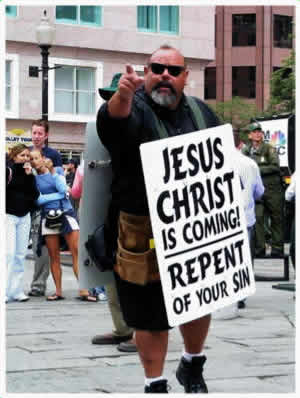
Are there examples of religions that didn’t have the lucky jump to popularity? I’m sure there are, but we don’t know about them. If a preacher only gets to 10 followers, then he is unlikely to make it into the history books. Religions that we know have disappeared – the Greco/Roman pantheon, for example, or Shakers – were reasonably successful in their day; they just suffered from conquering and celibacy problems. But go to Speakers’ Corner in Hyde Park, or listen to the speakers on sidewalks in America, and you might see a preacher who has great ideas but just hasn’t caught the lucky break that will turn him into the next Joseph Smith.

Street preacher

Readers have undoubtedly noticed that for established religions there are two concepts at play here: success and longevity. Not only are the established religions successful, but they have been around for many, many (sometimes MANY!) years. A religion could be successful in terms of popularity, but then not have what it takes to last. The success that I’m talking about in this post is the growth from tens of followers to thousands. This is the equivalent of going from an average song to a hit song and thus is, as Watts demonstrated, random. However, the extension from a popular sect to a long-lasting religion is more than just popularity; it’s like the difference between being Fountains of Wayne with Stacey’s Mom and being U2. Longevity demands continued provision of a quality experience, whether that is through great songwriting or spiritual relief.

The Newspaper of the Future (ie. Now)

The painful decline of the daily city newspaper is well chronicled by now, so much so that there is even an entire website dedicated to watching newspapers die. The causes are myriad (see the footnote below), but they can generally be tied to A) the internet; and B) changing patterns in the consumption of information.

Papers have tried a variety of approaches to counter these trends, with most of these approaches based on changing websites (paid, free, semi-paid!) and cutting costs. Few of these approaches, however, have even touched on content strategy. As regular Thoughtbasket readers know, I firmly believe that content is king.  My thoughts on what city newspapers should do are highly influenced by my reaction to my local news market, San Francisco. SF’s historical daily, The Chronicle is, and always has been, a terrible paper. The Chronicle’s website, SFGate, is even worse than the paper.

My advice is pretty simple: relentless focus on local journalism. Cover city hall, cover local issues, cover local teams. Big parade for Columbus Day? Cover it. District attorney owns a strip club on the side? Cover it. Downtown real estate prices dropping? Cover it. Cut costs by getting rid of all non-local coverage. A city paper doesn’t need any national or world coverage. License a few AP stories to give your readers the big picture basics, but certainly don’t have a Washington bureau. Maybe, if your city is big enough (ie. Chicago, LA and not much else), you have one reporter in DC to cover what your Congressmen do. In the same vein, maybe you have a reporter in your state capital, but purely to cover local issues. Leave broad coverage of the state capital to that city’s paper. If your readers want state, national or world news, they know how to find it: on the internet!

Do people care about local coverage? Absolutely. Think about the old axiom that all politics is local. Because people care a lot more about the pot holes near their homes than they do about Washington DC discussions of foreign aid. In my city, San Francisco, there are not one but TWO new papers that have launched purely to provide deep local coverage. Both are non-profits, it’s true, but they clearly sense a consumer need or they wouldn’t have bothered to raise the money required to launch. And that is in addition to the two local alternative weeklies, one of which has repeatedly (like the two stories summarized here) broken major stories about local politics that the Chronicle has missed. Plus you have AOL’s Patch, which provides hyper-local coverage. Moreover, the old afternoon paper, The Examiner, is still around, although kept alive through some payment deal with the Chronicle. The presence of all these local news sources tells you that people want to read local coverage. The question is why the big legacy local papers, who should own this space, don’t cover it.

Some people say that you can’t make money on local news because good local coverage will eventually cause discomfort to the powerful and wealthy in the community, who will then pull advertising. Certainly a strong local paper will, at some point, have to cause some pain to the city’s power brokers. Since most cities are run by a few wealthy families, a couple of businesses, and real estate interests, everybody knows what the sensitivities are. But it’s exactly those sensitivities – corrupt politicians, incompetent civil servants, venal and debauched businessmen – that readers crave. Readers want to know the truth about the powerful, and as long as a paper speaks that truth, it will have readers. And if a paper has readers, there will always be advertisers ready to pay to reach those readers.

Footnote with more specific causes of newspaper decline:

  • Craigslist
  • The end of the local department store
  • Decreased public acceptance of journalistic “authority”
  • Family dynasties seeking cash instead of a legacy (hello Bancrofts)
  • A generation that prefers screens to paper
  • Lower margins for car dealers

On Wall Street and Self-Regulation

Matt Taibbi has a new piece in Rolling Stone, using Senator Levin’s report on the financial meltdown to show that Goldman Sachs broke the law repeatedly. You have to take Taibbi with a grain of salt, especially when it comes to Goldman (here is the NY Times on the same report), but here is a stunning fact pattern on how prosecutions of financial crimes have gone steeply downhill in the past 20 years:

William Black was senior deputy chief counsel at the Office of Thrift Supervision in 1991 and 1992…. Black describes the regulatory MO back then. “Every year,” he says, “you had thousands of criminal referrals, maybe 500 enforcement actions, 150 civil suits and hundreds of convictions.”

But beginning in the mid-Nineties, when former Goldman co-chairman Bob Rubin served as Bill Clinton’s senior economic-policy adviser, the government began moving toward a regulatory system that relied almost exclusively on voluntary compliance by the banks. Old-school criminal referrals disappeared down the chute of history along with floppy disks and scripted television entertainment. In 1995, according to an independent study, banking regulators filed 1,837 referrals. During the height of the financial crisis, between 2007 and 2010, they averaged just 72 a year.

More on Microsoft-Skype (Microskype?)

The NY Times did a nice summary today of what analysts are saying about the Microsoft/Skype deal. And I don’t think it’s nice just because it confirms a lot of what I said yesterday. I think it’s nice because the author does a good job of quickly capturing and explaining a variety of viewpoints.

FYI, if you are over your 20 article limit on the Times, just clear your cookies. Bing, got more Times!