Category Archives: Trends

More on Tipping Point Flaws

A new study out of RPI shows that when 10% of a population shares a belief, that belief will inevitably be taken up by a majority of society. And when less than 10% has a belief, it will never be taken up. This conclusion was reached by running many scenarios through various computer models of societies. Most interesting, and most daggerly through Malcolm Gladwell’s theoretical heart, is that no matter what sort of connection scheme the researchers put in their models — equal connections, some highly connected “influencers,” promiscuous connections — the results turned out the same. Yet again, Gladwell’s concept of important trend setters falls under the weight of experimental data.

No More Tipping Point

The Calculus of Romance

I’m not using calculus metaphorically in that headline. I really want to talk about calculus and romance, specifically differential calculus and romantic relationships. But this needn’t be a math lesson; you can follow the links to Wikipedia for the full details on how calculus works, or take lessons from the Khan Academy.

Generally speaking, a derivative is a measure of change, and you can take derivatives of derivatives. So a first derivative describes a function, measuring the rate of change of that function. In the graph below, the first derivative is the tangent that measures the slope of the function. A second derivative describes the rate of change of the first derivative, a third derivative describes the second, and so on. You get the point.

Illustration of derivatives

How on earth does that relate to romance? Well, consider a romantic relationship to be a function, moving along the X-axis of time. When you are discussing your relationship (which you hopefully do sometimes), that is like the first derivative – describing the trajectory of your relationship. Sometimes you may talk about how you talk about your relationship, improving your communications skills. That is the second derivative. But if you are having real problems communicating, you may talk about how you talk about talking about your relationship. That is the third order derivative, and it’s bad.

Nobody likes higher order derivatives, and nobody likes talking about talking about talking. So make sure you get those second derivatives right!

Cupcakes Anyone? Yes, Please!

As long as we are talking about bubbles (which I did here and here and here), I should note that some people also think we are in a cupcake bubble (like this person and this person and even this person). I can’t disagree; here in SF there are three cupcakeries in just a 10 block area, each selling pretty much identical over-priced cupcakes with too much frosting.

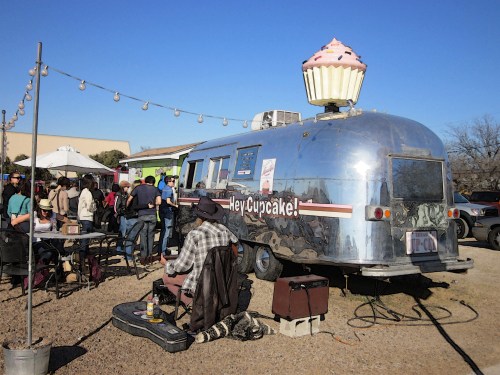
And yet, there is something special about a cupcake. Look at this photo (taken by me, in case you thought I was just a pretty writer):

The cupcake trailer, in Austin TX

Seriously, how fun does that cupcake look? Really fun. And that, I think, is the key to the cupcake’s success. They are so little and whimsical and colorful that you can’t help but smile when you see them. Most important, they have that dollop of frosting on top. Of course it’s too much, and too sweet, but it looks like a swirly party hat, a pastel pillow of creamy goodness that you could jump right into. No wonder you can’t resist a cupcake on your plate.

When you see a full cake, it looks delicious, but also kind of serious, maybe even intimidating. You have to slice it, and share it, and then probably store what you didn’t finish, and then you have the pressure to keep eating the leftovers so that you can finish them before they start to get hard and crusty in the refrigerator. A cupcake, on the other hand, has none of those difficulties. No slicing, no leftovers, no pressure. Just pop it in your mouth (one, two or three bites…it’s up to you) and be transported back to your childhood.

So yes, there is definitely a bubble in cupcake bakeries, but the cupcakes themselves will continue to crowd out cakes, as long as we prefer fun to dour in our desserts made out of flour.


Yes, It Is A Tech Bubble

We’ve seen lots of talk recently about whether there is another technology bubble going on, with LinkedIn’s super successful IPO, and shares of Facebook, Twitter, et. al. trading on secondary markets at multibillion dollar valuations. I lived through the first dot.com bubble in 1999-2001, and based that experience I am saying right here, categorically and emphatically, that we are definitely in another bubble. I will add some caveats at the end, but listed below are my top reasons for calling this a bubble. Every single thing I list below also happened in 2000, and made rational observers then realize that we were in a bubble. The more things change, the more they stay the same.

A) Insanely high valuations with no reasonable relation to the metrics (revenue, income) of the company (LinkedIn, Groupon)

B) Retail investor hunger for tech stocks. Back in 1999, we were all talking about Joe Kennedy’s famous line: “when you get stock tips from your shoeshine boy, it’s time to sell.” When the public is hungry to invest in a category, it’s a bubble

C) Farcical metrics. In the dot.com era we were supposed to look at eyeballs, not revenues. Now Groupon tells us that we should ignore marketing costs and look at “adjusted consolidated segment operating income

D) The emergence and venture funding of many copycat businesses. How many flash sale or social coupon businesses do people need? And what about Color, which raised $41 million to launch yet another iPhone photo sharing service, and reputedly only shared 5 photos during the iPhone developers conference and had its president leave within months of launch?

E) Especially the emergence and venture funding of narrow vertical copycats. For example, Juice in the City is Groupon for moms, Pawsley is Facebook for dogs, Everloop is Facebook for tweens (who will, by definition, leave as soon as they are old enough to join Facebook), etc. Anyone who lived through the dot.com remembers “vertical portals.” That didn’t work out so well.

F) Society and entertainment figures or kids fresh out of Stanford and Harvard business school as entrepreneurs.  (Juice in the City, Rent the Runway, Ashton Kutcher.)

G) Venture funds you’ve never heard of leading rounds in vertical copycats (Juice in the City funded by HU Investments and Tandem Enterprises)

H) Companies you’ve never heard of buying prime time TV commercials (Peel)

I) Ridiculous and nearly identical company names (Buzzr, Socialzr, Apptizr  etc.)

J) Weekly launching of new “incubators,” in which people, some with limited experience, will mentor new companies in return for some equity (Growlab, Capital Factory). Or one incubator, 500 Startups, that funded two nearly identical companies: StoryTree and Vvall.

K) Putting a tech sheen on non-tech companies so that they can raise money at tech company valuations (The Melt)

L) Features posing as companies. A clever little web widget, even a useful one that gets a lot of users, might not be enough to support a viable company. And starting companies that you know can only succeed by being acquired is a classic bubble move. For example, StumbleUpon, Blippy. Actually, Blippy alone is enough to prove my bubble hypothesis. Only in a bubble could that company have even existed.

Now for the caveats, or counterpoints:

As many have noted, some of these companies, particularly the big ones (LinkedIn, Groupon) are generating real revenues. Back in 2000, revenues were a rare thing. However, I should note that neither LinkedIn nor Groupon are particularly profitable. Neither is Pandora. Twitter still doesn’t really have a revenue model. The random widgets and apps that are raising money? Not so revenuefull.

There are more customers now. With the spread of broadband and smartphones, an online business has a much larger base of potential customers than in 1999. That means that the same capital investment can, theoretically, be spread over a much larger revenue base.

This bubble is focused on consumer-facing internet businesses. Not all tech companies are being lifted by the bubble. Microsoft, Google, Amazon and the ilk at still trading at normal to relatively normal valuations.

Are Successful Religions Just Lucky?

Religion scholars have long said that what separates a religion from a sect is success. In other words, religions all start as small sects; if they stay that way, we never hear about them, but if they grow, then over time they become a religion. But these scholars haven’t really discussed what makes one sect succeed and one not, or if they have, it’s in the context of ex post facto justification of the success. History is written by the victors and all that.

Adherents of most faiths say that their religions have grown because they are right. The religion is the word of god, and so naturally it gains more and more followers. Non-believers, and even some adherents who see a religion as metaphor rather than the literal word of god, would say that their church has grown and lasted because it provides wisdom and values and spiritual succor.

But what if they are all wrong, and the successful religions were simply in the right place and the right time. What if religions succeed purely based on random luck?

This hypothesis of religious randomness is based on the work of Duncan Watts, a sociologist who I’ve mentioned before, in the context of showing that Malcolm Gladwell’s tipping point theory of “influencers” is fatally flawed.

Watts studies cultural phenomena and social networks, especially how trends and memes spread across a culture. He is perhaps best known for his work on “hit” music, in which the popularity of a song in an experimental population is self-propelling. People like a song because they see that other people like it. So once a song gains some initial popularity, in Watts’ experiments that song was almost certainly going to become a hit, because its early popularity propagated itself across the culture.

More importantly, what Watts discovered was that the initial burst of popularity, which destined the song for hit status, was not due to the musical quality of the song or the votes of initial “influential” listeners or any other objective measure. It was random. Watts ran his experiment over and over and over, and which songs became hits was a random walk. Here is the money quote from an NY Times article:

The reason is that when people tend to like what other people like, differences in popularity are subject to what is called “cumulative advantage,” or the “rich get richer” effect. This means that if one object happens to be slightly more popular than another at just the right point, it will tend to become more popular still. As a result, even tiny, random fluctuations can blow up, generating potentially enormous long-run differences among even indistinguishable competitors.

So let me break it down for you: purely at random, a song gets an initial burst of popularity. Not because it has a great melody, or words that speak universal truths, but because for whatever reason a bunch of people chose that song one day. Based on that initial popularity, other people start to like the song (“it’s popular, so it must be good”), and soon enough, the song is a hit. To wit: Lady Gaga or Justin Bieber.

The application to religion is pretty straightforward. Any religion – Christianity, Islam, Mormonism, whatever – has to get an initial burst of popularity. A few people start following the leader. Other people notice the following and start to tag along (“old Mr. Dalrymple is following, and he hates everything. It must be good”) and next thing you know, the small sect with a single leader becomes an established religion.

But why do people start following that one leader? Our traditional reaction is that it’s because he had something great to say. But if we follow Watts’ work, maybe it’s just random. Maybe Jesus gave an early sermon next to a lemonade stand on a hot day. Maybe Joseph Smith’s talk about his golden tablets attracted the prettiest woman in town, who then attracted a bunch of men.

Certainly there were plenty of other preachers right around Joseph Smith. His part of New York was called the “burned over district” because it was so frequently swept by religious fervor. So why did Smith’s story stick, and lead to a worldwide faith, when other preachers fell by the wayside? Maybe it’s because Smith’s story of the angel Moroni was the direct word of God. But the experimental data suggest that it was probably just random.

Are there examples of religions that didn’t have the lucky jump to popularity? I’m sure there are, but we don’t know about them. If a preacher only gets to 10 followers, then he is unlikely to make it into the history books. Religions that we know have disappeared – the Greco/Roman pantheon, for example, or Shakers – were reasonably successful in their day; they just suffered from conquering and celibacy problems. But go to Speakers’ Corner in Hyde Park, or listen to the speakers on sidewalks in America, and you might see a preacher who has great ideas but just hasn’t caught the lucky break that will turn him into the next Joseph Smith.

Street preacher

Readers have undoubtedly noticed that for established religions there are two concepts at play here: success and longevity. Not only are the established religions successful, but they have been around for many, many (sometimes MANY!) years. A religion could be successful in terms of popularity, but then not have what it takes to last. The success that I’m talking about in this post is the growth from tens of followers to thousands. This is the equivalent of going from an average song to a hit song and thus is, as Watts demonstrated, random. However, the extension from a popular sect to a long-lasting religion is more than just popularity; it’s like the difference between being Fountains of Wayne with Stacey’s Mom and being U2. Longevity demands continued provision of a quality experience, whether that is through great songwriting or spiritual relief.

The Newspaper of the Future (ie. Now)

The painful decline of the daily city newspaper is well chronicled by now, so much so that there is even an entire website dedicated to watching newspapers die. The causes are myriad (see the footnote below), but they can generally be tied to A) the internet; and B) changing patterns in the consumption of information.

Papers have tried a variety of approaches to counter these trends, with most of these approaches based on changing websites (paid, free, semi-paid!) and cutting costs. Few of these approaches, however, have even touched on content strategy. As regular Thoughtbasket readers know, I firmly believe that content is king.  My thoughts on what city newspapers should do are highly influenced by my reaction to my local news market, San Francisco. SF’s historical daily, The Chronicle is, and always has been, a terrible paper. The Chronicle’s website, SFGate, is even worse than the paper.

My advice is pretty simple: relentless focus on local journalism. Cover city hall, cover local issues, cover local teams. Big parade for Columbus Day? Cover it. District attorney owns a strip club on the side? Cover it. Downtown real estate prices dropping? Cover it. Cut costs by getting rid of all non-local coverage. A city paper doesn’t need any national or world coverage. License a few AP stories to give your readers the big picture basics, but certainly don’t have a Washington bureau. Maybe, if your city is big enough (ie. Chicago, LA and not much else), you have one reporter in DC to cover what your Congressmen do. In the same vein, maybe you have a reporter in your state capital, but purely to cover local issues. Leave broad coverage of the state capital to that city’s paper. If your readers want state, national or world news, they know how to find it: on the internet!

Do people care about local coverage? Absolutely. Think about the old axiom that all politics is local. Because people care a lot more about the pot holes near their homes than they do about Washington DC discussions of foreign aid. In my city, San Francisco, there are not one but TWO new papers that have launched purely to provide deep local coverage. Both are non-profits, it’s true, but they clearly sense a consumer need or they wouldn’t have bothered to raise the money required to launch. And that is in addition to the two local alternative weeklies, one of which has repeatedly (like the two stories summarized here) broken major stories about local politics that the Chronicle has missed. Plus you have AOL’s Patch, which provides hyper-local coverage. Moreover, the old afternoon paper, The Examiner, is still around, although kept alive through some payment deal with the Chronicle. The presence of all these local news sources tells you that people want to read local coverage. The question is why the big legacy local papers, who should own this space, don’t cover it.

Some people say that you can’t make money on local news because good local coverage will eventually cause discomfort to the powerful and wealthy in the community, who will then pull advertising. Certainly a strong local paper will, at some point, have to cause some pain to the city’s power brokers. Since most cities are run by a few wealthy families, a couple of businesses, and real estate interests, everybody knows what the sensitivities are. But it’s exactly those sensitivities – corrupt politicians, incompetent civil servants, venal and debauched businessmen – that readers crave. Readers want to know the truth about the powerful, and as long as a paper speaks that truth, it will have readers. And if a paper has readers, there will always be advertisers ready to pay to reach those readers.

Footnote with more specific causes of newspaper decline:

  • Craigslist
  • The end of the local department store
  • Decreased public acceptance of journalistic “authority”
  • Family dynasties seeking cash instead of a legacy (hello Bancrofts)
  • A generation that prefers screens to paper
  • Lower margins for car dealers

Microsoft + Skype = Winning

Here are some of my initial thoughts on why the Skype deal is a good one for Microsoft, presented in sections, like a good PowerPoint.

Cool features that won’t make much (or any) money, but might improve market share:

  • In game voice calls when using Xbox
  • Skype someone straight from Outlook
  • Or Hotmail, if anyone even uses Hotmail any more
  • Skypeout someone at any phone number that shows up in any Office application
  • Find a number in Bing and one click call it

Ways Microsoft might use Skype to make money from businesses:

  • Integrate features into Exchange server to enable enterprise VOIP
  • Better yet: integrate features into the suite of online apps for small business – they need the savings on phones more than enterprises and lack the skills to set up their own VOIP
  • Implement a “call me” feature for advertisers

Strategic plays:

  • Integrate Skype into their investee Facebook to help counter Google’s voice products
  • Continue to wall off Yahoo from anything business related, relegating the ‘hoo to being a consumer content company
  • If the SMB play works, leverage it against Zoho, Google docs and other productivity apps
  • Build relationships with phone carriers who are moving to IP networks and losing landlines as fast as Lady Gaga is losing fans

Where it won’t work, even though Ballmer thinks it will:

  • Microsoft mobile OS

Did Microsoft overpay at $8.5 billion? Definitely. But they’ve got about a zillion dollars in cash, earning about zero percent interest, much of it sitting untouchable overseas, where Skype is conveniently located. So what’s a billion or two between friends?

Of course, all of the above assumes that Microsoft executes, which is a big (BIG!) assumption. After all, if Microsoft were good at executing this stuff we would all be using Outlook Live instead of Gmail.

See here and here for NY Times coverage, here for TechCrunch and here for GigaOm.

Ditto

See yesterday’s post, and repeat. Names change, facts remain the same.

Links to Great Articles

Yves Smith on the macro effects of oversized Wall Street pay.

I normally don’t love Paul Krugman, despite his Nobel Prize, since he is too strident and preachy and predictable, but this take on what really separates Right from Left in America is pretty interesting.

John Mearsheimer on American foreign policy and realpolitik.

John Cassidy on whether Wall Street adds value to society. Hint: it doesn’t. This is from the New Yorker, so it won’t be available online forever.

Law professor David Beatty compares American constitutional jurisprudence to how they do it in other countries. I’m no expert, but I found it fascinating.

On Airlines, Hospitals, Blizzards and Flu Outbreaks

Here is a really interesting article comparing the airline industry to the public health system, with full service hospitals being the legacy carriers, serving everyone and subsidizing low fare services with high fare ones. Specialty hospitals are the upstart airlines, able to focus on only providing profitable services. And as they all cut capacity to remain profitable, what happens when crisis hits? We just saw what happens to airlines when a blizzard strikes; so what happens to hospitals when a pandemic hits?