Monthly Archives: August 2009

U.S. Is Not A Meritocracy

George Will recently published a column in Newsweek about taxation. It was his usual supply side pabulum, about how nobody will work or invest if marginal tax rates go up. Ironically enough, a guy whose only thought ever is cut taxes says the following: “But people with only one idea really have no idea.” Whatever. I am happy to take on George Will; he’s a moron whose view of the world is that everybody goes to Exeter and Yale and thus they can all fend for themselves. For Will, higher taxes means waiting a year to remodel the kitchen in your weekend house on Nantucket.

But in his column, Will quoted Richard Posner, a judge on the US Court of Appeals and professor at University of Chicago Law School. Taking on Judge Posner is something I do with trepidation. He is among the smartest of America’s public intellectuals, with knowledge that is both deep and broad, and he is insanely prolific. He seems to publish a book about as often as I can write a blog entry. However, I have no choice but to take issue with what he was saying in Will’s column. Here is the quote in its entirety:

“As society becomes more competitive and more meritocratic, income inequality is likely to rise simply as a consequence of the underlying inequality—which is very great—between people that is due to differences in IQ, energy, health, social skills, character, ambition, physical attractiveness, talent, and luck.”

Judge Posner is not entirely wrong. Smart, hard-working people can get ahead in America, and that can take the form of higher salaries or greater wealth. But this is true more often in theory than in practice. There are many Americans who are very smart, very hard-working, chock full of merit, who for a variety of reasons don’t manage to get ahead. Those reasons include geography, family, or education. But the reason I most want to focus on is generational. When you include the impact of inherited opportunities, it is difficult to call America a pure meritocracy.

Commitment to education, legacy admissions to elite colleges, career networks, wealth – these are all things that parents can pass to their children, and they all tilt the playing field against merit. Economist James Heckman, another University of Chicago professor (and a Nobel Prize winner) has produced significant work showing how early childhood treatment (eg. having parents who use a large vocabulary) correlates to adult success skills. But as important as nurturing an infant may be, I don’t think it compares to having a father who is a partner at Skadden Arps and thus helps gets you in the analyst program at Goldman Sachs.

Consider two teenagers, both equally smart and hard-working. One lives in Brookline, Massachusetts, where he goes to an excellent high school and his parents, who met when they were undergrads at Harvard, support him in his studies. The other lives in Oak Hill, West Virginia, where his school is terrible, and his high school dropout parents are too busy earning a living to help him with his coursework. Of these two teens, which do you think is more likely to go to a good college, join a hedge fund and become wealthy? Sure, the West Virginian could, in theory, make it to Wall Street, but we all know that his odds are low.

So for Judge Posner to argue that meritocracy inevitably leads to an acceptable inequality is to completely miss the point. Success in America’s meritocracy is correlated as much to parental merits, or grandparental merits, as it is to any individual’s merits. This is precisely why Bill Gates’ father (whose partner position in a corporate law firm helped send young Bill to computer classes and then to Harvard) is such a full-throated proponent of the estate tax. He knows that America’s meritocracy is skewed by inheritance. Judge Posner is more than smart enough to know the same thing.
Bankers Moving for Higher Pay? Go Ahead!

A recent item in the Wall Street Journal talked about how British banks are pushing back against any sort of regulation on pay practices, saying that such regulation “will harm competitiveness, as jobs and tax revenues move to friendlier climates.” Wall Street banks are saying the exact same thing to Washington. My question is: where exactly are they going to move? Is the talent going to run to Bear Stearns or Lehman? Clearly not. After all the recent layoffs, there are fleets of unemployed bankers ready to replace anyone on a trading desk. But maybe the talent will move offshore, to Paris or Zurich or Tokyo – any place that doesn’t limit compensation. Really? They are going to take their kids out of Greenwich Country Day School, quit the country club, and move around the world? Some will, sure, but the majority won’t. The uproar from kids and spouses alone will force most of them to stay put. For those without families, I would think that the concept of living in a social democratic country makes moving a non-starter.

Income Inequality at Record Post-1929 Levels

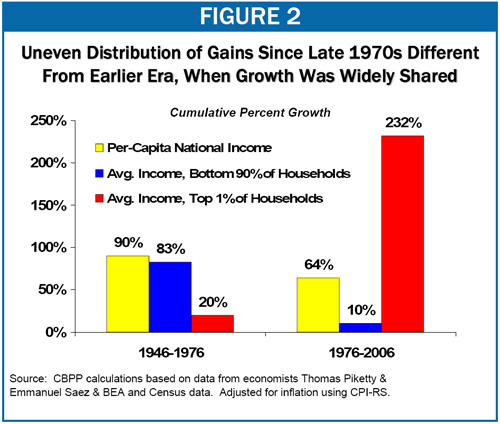
I point you to this study (from October of last year, but as new to me as a never before seen rerun of 30 Rock) from the Center on Budget and Policy Priorities, which shows how the proportion of national income accruing to the top 1% of households is as high as it has been since the Great Depression. I encourage you to read the entire study, or just look at the graphic below, which sort of says it all.

Income Inequality

Income Inequality

Climate Change Threatens US Troops

The NY Times recently reported that the Pentagon has started incorporating global warming into its strategic planning, because the impacts of climate change – drought, rising sea levels, mass migration, new pandemics – will likely pose threats to the United States. Although the Defense Department has long considered energy costs in its planning (sadly, fighter jets don’t come in hybrid versions), the recognition of climate change as threatening US security is relatively new.

When US security is threatened, the military has to plan, and sometimes act. Thus, the Pentagon has some interest in seeing whether global warming can be mitigated. According to retired Marine Corps General Anthony Zinni, “We will pay for this one way or another. We will pay to reduce greenhouse gas emissions today, and we’ll have to take an economic hit of some kind. Or we will pay the price later in military terms. And that will involve human lives.”

But it’s not just the liberal Times reporting this. Last year National Defense Magazine, which is the publication of the defense industry lobbying association (not exactly cuddly liberals: their motto is “Promoting national security since 1919”), reported the exact same thing last year. Army General Gordon Sullivan called climate change a “threat multiplier,” and Navy Admiral Joe Lopez, foreshadowed General Zinni, saying “National security and the threat of climate change [are] real, and we can pay for it now, or pay even more dearly for it later.”

I agree that fixing climate change will cost us. In fact, as I noted here, that is exactly what cap & trade, or a carbon tax, will do: make energy more expensive and thus incent us to be more efficient. What the Pentagon is saying is that if we don’t pay some dollars now, we’ll end up paying in soldier’s lives later. So maybe some of those Republican politicians who claim to “support our troops” but are against any efforts to stop global warming (I’m talking to you, John Boehner, Mitch McConnell and James Inhofe, you hypocrites) ought to revisit their positions.

Even better, maybe the corporate executives who are against any carbon legislation that will hurt their profits, but tend to be Republican and thus pro-troop, will also rethink their position. I’m talking about the National Association of Manufacturers, who use bogus data to claim that cap and trade won’t help the environment, or the energy executives who make up 7 of the top 10 best-paid CEOs in 2008. But those guys don’t really care about the troops, since their sons never join the military. No, those corporate executives care more about profits, so that they can pay their sons’ tuition at Princeton and Harvard Business School. When Admiral Lopez says that we have to pay now in money or pay later in soldiers’ lives, I guess we all know which one the corporate executives are going to choose.

“Death Panels” Are Another GOP Lie

Check out this NY Times article which shows in detail how the ridiculous rumor about “death panels” in the current health care reform effort came from the same sources whose lies helped kill Clinton’s health care reform. Why do Republicans so hate health care reform? Do they really think it’s OK for poor people to get worse health care than wealthy ones?

Slate on $100 Million Bonuses

Slate business writer Daniel Gross has another take on Andrew Hall’s bonus, about which I wrote last week. Gross notes that hedge funds primarily exist to make traders rich, and do little for non-employee shareholders. So he questions why Citigroup shareholders would want to retain Hall and his Phibro operation.

Congress Flies in Private Jets

Please read this Wall Street Journal article about how Congress has appropriated $550 million to buy some new private jets. And not even simple jets,  but the highest end of private: Boeing 737 business jets and Gulfstream Vs. This was an appropriation beyond what the Defense Department asked for. And this is the same Congress that lambasted (rightly) banks and car companies for flying private. This is the hypocrisy that makes citizens hate Congress. Let’s hope that during the August recess our representatives get a full dose of voter anger during town halls and constituent meetings.

Open Letter to Bank CEOs

Not from me, but from Breakingviews.com, which as a specialized business newsletter has more credibility than I do. Their site is subscription only, but the NY Times reprinted the letter here. The basic gist: hey CEOs, instead of paying obscene bonuses, you should use your current profits to build strong balance sheets so the taxpayers don’t need to bail you out again.

Krugman on $100 Million Bonuses

Just a quick link to Paul Krugman’s column on Andrew Hall’s $100 million bonus, about which I wrote the other day. Krugman focuses more on the downside of financial speculation than on the economic factors I discussed, but he is a Nobel prize winner, so linking to him is generally a good thing.

$100 Million Bonuses Should Not Exist

My headline refers to the $100 million bonus that Andrew Hall, the head of Citigroup’s Phibro commodities trading group, is reputedly due this year. This bonus is in addition to the $100 million he was paid last year. Mr. Hall has a profit sharing formula to determine his pay, and his group is very profitable; hence the huge paydays.

When I say that such a large bonus should not exist, I am not referring to the controversy of whether a bank that has received so much taxpayer aid should honor Hall’s contract and pay such a large bonus (although they probably shouldn’t) or whether it is in any way appropriate for a society that pays teachers and firemen $50,000 per year to pay a guy $100 million to speculate in oil futures (duh: it isn’t appropriate, and in fact is obscene).

No, I say that such a bonus shouldn’t exist because economic theory says it shouldn’t. Under classic microeconomics [as I learned in Professor Bresnahan’s Firms and Markets class), if a firm is making outsized profits, other firms will see those profits and enter the market. The competition will reduce returns until profitability is in line with the industry.

If Phibro is repeatedly paying Hall $100 million per year, it’s safe to say that their profits are awesome, and thus outsized. There certainly isn’t a lack of traders and capital on Wall Street, all chasing returns. Hedge funds alone have $1.4 trillion in capital. So why isn’t the competition battering Phibro? I don’t know the answer, but here are a few possibilities:

  1. There is some sort of barrier to entry. It’s not capital, because plenty of people have that, but maybe there is a regulatory hurdle. Perhaps the few entrants in oil trading have figured out a way to maintain an oligopoly and thereby restrain competition.
  2. Maybe everyone in the oil trading business is insanely profitable, but only Hall has the sort of contract that pays him such a huge sum. It could be so easy that if I started swapping a few oil futures, I too could make millions.
  3. Or, it could just be that Hall and the folks at Phibro are really that much better than anyone else in the industry.

Again, I don’t why, but I do know that the only way a person should be able to consistently make that much money is if they are an absolute superstar or if they have figured out a way to restrain trade, which is usually illegal. Given the ways of Wall Street, if I had to pick one of those answers, I’d guess the slimy one.